

Tuesday, July 28, 2026
Science
No Result
View All Result
  • Login
  • HOME
  • SCIENCE NEWS
  • CONTACT US
  • HOME
  • SCIENCE NEWS
  • CONTACT US
No Result
View All Result
Scienmag
No Result
View All Result
Home Science News Earth Science

Urbanization Alters Development Patterns, Boosting Anopheles stephensi Habitat Suitability

July 28, 2026
in Earth Science
Reading Time: 2 mins read
0
Urbanization Alters Development Patterns, Boosting Anopheles stephensi Habitat Suitability

Urbanization Alters Development Patterns, Boosting Anopheles stephensi Habitat Suitability

65
SHARES
587
VIEWS
Share on FacebookShare on Twitter
ADVERTISEMENT

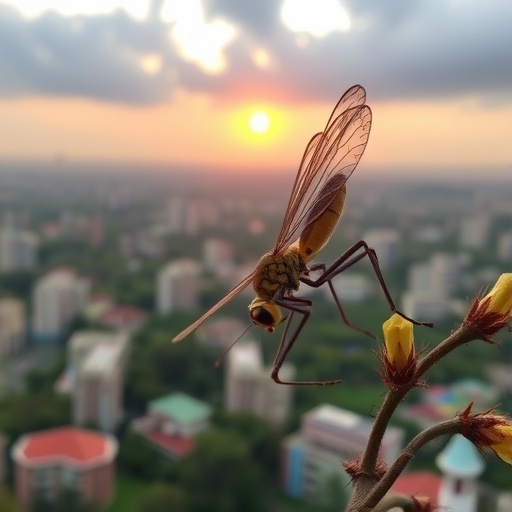
Urbanization is reshaping disease risk in subtle ways, and a new study points to a worrying match between city growth and the environmental preferences of Anopheles stephensi, a major malaria vector. Writing in Communications Earth & Environment, researchers report that development patterns can create habitat conditions that make the mosquito more likely to thrive, even before traditional “outbreak” signals appear.

The team analyzed how different aspects of urbanization—such as land-cover change, infrastructure expansion, and associated water-and-land management—translate into ecological conditions in space and time. Their central finding is that particular urban development characteristics systematically align with higher habitat suitability for An. stephensi, suggesting that city planning decisions may indirectly steer vector populations.

Using data-driven modeling, the study links environmental variables that proxy for breeding potential—like local moisture conditions, vegetation structure, and surface-water availability—to suitability for the species. Rather than treating urban areas as uniform, the authors examine fine-grained differences across neighborhoods and development stages.

A key technical emphasis is that habitat suitability does not rise randomly. The researchers show that certain urban transitions can increase the persistence of microhabitats suitable for larvae, for example by sustaining humid conditions or creating small water-retention zones around built environments. These effects can be amplified where urban growth alters drainage and the distribution of shallow, slow-moving water.

The results help explain why malaria transmission risk can increase in fast-growing cities even when overall climate trends appear stable. By identifying which development signatures correlate with enhanced mosquito habitat, the work offers a route to earlier risk forecasting.

Importantly, the study frames urbanization as a driver of ecological opportunity. When the built environment reduces natural barriers or changes how water is stored and evaporates, it can favor mosquitoes that exploit urban niches. An. stephensi is particularly capable of persisting in such settings, making the urban match clinically significant.

The authors argue that public health interventions need to keep pace with urban transformation. Targeting larval habitats in the specific microenvironments suggested by the model could be more effective than broad, area-wide measures, especially in rapidly changing urban landscapes.

Overall, the research delivers a viral-science message with direct implications: city growth is not just a backdrop for disease—it can be an amplifier of mosquito ecology, reshaping malaria risk from the ground up.

Subject of Research: Urbanization-driven habitat suitability for Anopheles stephensi and implications for malaria risk.

Article Title: Urbanization development characteristics coincide with elevated Anopheles stephensi habitat suitability.

Article References: Sun, Y., Liu, W., Han, Q. et al. Commun Earth Environ (2026). https://doi.org/10.1038/s43247-026-03833-0

Image Credits: AI Generated

DOI: 10.1038/s43247-026-03833-0

Keywords: Urbanization; habitat suitability; Anopheles stephensi; malaria vector; ecological modeling; land-cover change.

Tags: Anopheles stephensi habitat suitabilitycity planning and vector ecologyenvironmental factors influencing malaria vectorshabitat suitability prediction in urban areasinfrastructure expansion and water managementland cover change and mosquito breedingmodeling urbanization impact on disease vectorsurban development and malaria riskurban microhabitats for mosquito larvaeurban water retention zones and mosquito breedingUrbanizationurbanization-driven changes in disease transmission
Share26Tweet16
Previous Post

Kenya Study Explores Family and Community Care for Older Parkinson’s Patients

Next Post

UAE Study Tracks Survival and Pre-Discharge Outcomes in Extremely Preterm Neonates

Related Posts

Canada’s 2023 wildfire smoke cut solar generation by 2.8%, costing $2B
Earth Science

Canada’s 2023 wildfire smoke cut solar generation by 2.8%, costing $2B

July 28, 2026
Ground Radar Detects Natural Electron Bernstein Waves in Earth’s Ionosphere
Earth Science

Ground Radar Detects Natural Electron Bernstein Waves in Earth’s Ionosphere

July 28, 2026
Iron-Loaded Biochar Boosts Electron Shuttling for Ammonium Nitrate Reduction in Rice Soils
Earth Science

Iron-Loaded Biochar Boosts Electron Shuttling for Ammonium Nitrate Reduction in Rice Soils

July 28, 2026
Microbial Carbon Metabolism Tied to Organic Matter Chemistry in Soils
Earth Science

Microbial Carbon Metabolism Tied to Organic Matter Chemistry in Soils

July 27, 2026
Engineered microbial communities speed up removal of herbicide residues from soil
Earth Science

Engineered microbial communities speed up removal of herbicide residues from soil

July 27, 2026
Ancient Seawater Groundwater Still Shapes Coastal Paleo-Estuary Legacy
Earth Science

Ancient Seawater Groundwater Still Shapes Coastal Paleo-Estuary Legacy

July 27, 2026
Next Post
UAE Study Tracks Survival and Pre-Discharge Outcomes in Extremely Preterm Neonates

UAE Study Tracks Survival and Pre-Discharge Outcomes in Extremely Preterm Neonates

  • Mothers who receive childcare support from maternal grandparents show more

    Mothers who receive childcare support from maternal grandparents show more parental warmth, finds NTU Singapore study

    27656 shares
    Share 11059 Tweet 6912
  • University of Seville Breaks 120-Year-Old Mystery, Revises a Key Einstein Concept

    1061 shares
    Share 424 Tweet 265
  • Bee body mass, pathogens and local climate influence heat tolerance

    682 shares
    Share 273 Tweet 171
  • Researchers record first-ever images and data of a shark experiencing a boat strike

    546 shares
    Share 218 Tweet 137
  • Groundbreaking Clinical Trial Reveals Lubiprostone Enhances Kidney Function

    531 shares
    Share 212 Tweet 133
Science

Embark on a thrilling journey of discovery with Scienmag.com—your ultimate source for cutting-edge breakthroughs. Immerse yourself in a world where curiosity knows no limits and tomorrow’s possibilities become today’s reality!

RECENT NEWS

  • Columbia’s PROGRESS Study Lays Out Methods for Genetic Risk in Autism
  • Timing Transcatheter Closure of Hemodynamically Significant Patent Ductus in Preterm Infants
  • Canada’s 2023 wildfire smoke cut solar generation by 2.8%, costing $2B
  • Saitama University Reveals How Ductile Tunnel Supports Withstand Simulated Squeezing Ground Pressure

Categories

  • Agriculture
  • Anthropology
  • Archaeology
  • Athmospheric
  • Biology
  • Biotechnology
  • Blog
  • Bussines
  • Cancer
  • Chemistry
  • Climate
  • Earth Science
  • Editorial Policy
  • Marine
  • Mathematics
  • Medicine
  • Pediatry
  • Policy
  • Psychology & Psychiatry
  • Science Education
  • Social Science
  • Space
  • Technology and Engineering

Subscribe to Blog via Email

Enter your email address to subscribe to this blog and receive notifications of new posts by email.

Join 5,146 other subscribers

© 2025 Scienmag - Science Magazine

Welcome Back!

Login to your account below

Forgotten Password?

Retrieve your password

Please enter your username or email address to reset your password.

Log In
No Result
View All Result
  • HOME
  • SCIENCE NEWS
  • CONTACT US

© 2025 Scienmag - Science Magazine

Discover more from Science

Subscribe now to keep reading and get access to the full archive.

Continue reading
