


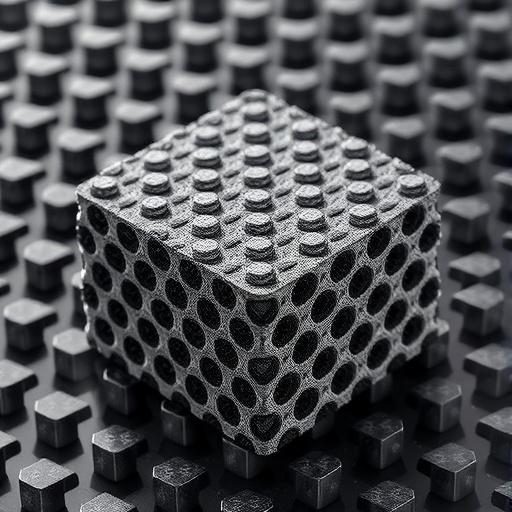
Aqueous zinc-ion hybrid capacitors (ZIHCs) promise a compelling balance of fast charge–discharge power and battery-like energy storage, while remaining comparatively safe, low-cost, and environmentally sustainable. Yet they have struggled with a long-standing tradeoff: zinc-anode kinetics and ion capacity often do not match the capacitive carbon cathode’s ability to store charge. Now, researchers report a strategy that directly addresses this mismatch by redesigning the carbon’s pore architecture and introducing a dual-ion storage pathway.
In a study published in ENG. Chem. Eng., the team developed hierarchical porous carbon nanosheets (CMK-x) from low-cost coal tar pitch. Using magnesium oxide as a structure-directing agent and potassium hydroxide as an activator, they tuned the heat-treatment temperature to optimize the pore-size distribution and surface chemistry. The best-performing sample, CMK-700, delivered a specific surface area of 2223.9 m²·g⁻¹, oxygen-containing functional groups at 10.15 at%, and a maximized ultramicroporous volume of 0.4836 cm³·g⁻¹.
The core advance is a “dual ion relay” mechanism that couples zinc-ion storage with proton-assisted access to ultramicropores. Larger hydrated zinc ions, [Zn(H₂O)₆]²⁺ (~0.86 nm), are preferentially accommodated in larger micropores and mesopores, where electric double-layer capacitance and adsorption on oxygen groups contribute to charge storage. However, their size and desolvation constraints prevent entry into ultramicropores (<1 nm).
In contrast, smaller hydrated protons (H₃O⁺, ~0.564 nm) can penetrate these confined ultramicropores. Molecular dynamics simulations and ex-situ characterization indicate that H₃O⁺ undergoes reversible chemical hydrogen adsorption/desorption inside ultramicropores—effectively “relaying” access so that regions previously inactive for zinc ions become electrochemically useful.
MD simulations of 0.7 nm and 1.0 nm slit-pores further support selective transport: [Zn(H₂O)₆]²⁺ is hindered by high desolvation energy barriers, while H₃O⁺ diffuses readily through the narrow channels. This selectivity validates the proposed proton-mediated route to additional pseudocapacitance.
Electrochemical tests show CMK-700 achieves a specific capacity of 368.1 mAh·g⁻¹ at 0.5 A·g⁻¹, outperforming CMK-600, CMK-800, and CMK-900. The galvanostatic charge–discharge profiles feature a plateau-like region between 0.3 and 0 V, linked to proton storage in ultramicropores.
At high rates, performance remained strong, retaining 133.7 mAh·g⁻¹ even at 20 A·g⁻¹. Cycling stability was also notable: 86.39% capacity retention after 21,000 cycles at 10 A·g⁻¹.
Finally, ex-situ SEM revealed discharge-related precipitates identified as Zn(OH)₂ and Zn₄ClO₄(OH)₇ below 0.3 V, which dissolve upon charging—consistent with reversible chemical precipitation/dissolution paired to proton adsorption–desorption.
Keywords
dual ion relay; aqueous zinc-ion hybrid capacitors; hierarchical porous carbon; ultramicropores; proton storage; molecular dynamics simulations; pseudocapacitance; electric double-layer capacitance; hydrated zinc ions; ex-situ characterization
Cite Scienmag News
Grant Pearson. (July 28, 2026). Hierarchical Porous Carbon Enables Dual-Ion Relay Storage in Zinc Hybrid Capacitors. Scienmag. https://scienmag.com/hierarchical-porous-carbon-enables-dual-ion-relay-storage-in-zinc-hybrid-capacitors/
Grant Pearson. "Hierarchical Porous Carbon Enables Dual-Ion Relay Storage in Zinc Hybrid Capacitors." Scienmag, 28 July 2026, https://scienmag.com/hierarchical-porous-carbon-enables-dual-ion-relay-storage-in-zinc-hybrid-capacitors/. Accessed 3 September 2026.
Grant Pearson. "Hierarchical Porous Carbon Enables Dual-Ion Relay Storage in Zinc Hybrid Capacitors." Scienmag. July 28, 2026. https://scienmag.com/hierarchical-porous-carbon-enables-dual-ion-relay-storage-in-zinc-hybrid-capacitors/


