

Monday, July 27, 2026
Science
No Result
View All Result
  • Login
  • HOME
  • SCIENCE NEWS
  • CONTACT US
  • HOME
  • SCIENCE NEWS
  • CONTACT US
No Result
View All Result
Scienmag
No Result
View All Result
Home Science News Chemistry

Real-Time Laser Ablation Monitoring Detects Wafer Penetration via Recoil Force

July 27, 2026
in Chemistry
Reading Time: 2 mins read
0
Real-Time Laser Ablation Monitoring Detects Wafer Penetration via Recoil Force

Real-Time Laser Ablation Monitoring Detects Wafer Penetration via Recoil Force

65
SHARES
587
VIEWS
Share on FacebookShare on Twitter
ADVERTISEMENT

Laser dicing is the backbone of making semiconductor chips, but it comes with an industrial reality: the process must be precise every time. Compared with blade cutting, laser dicing is attractive because it can separate delicate, low-strength materials while reducing mechanical stress. The trade-off is control. Too few laser pulses leave wafer regions only partially cut; too many can damage the substrate or even the tape used to hold it in place. Conventional monitoring approaches often struggle with speed, stability, or robustness on production floors.

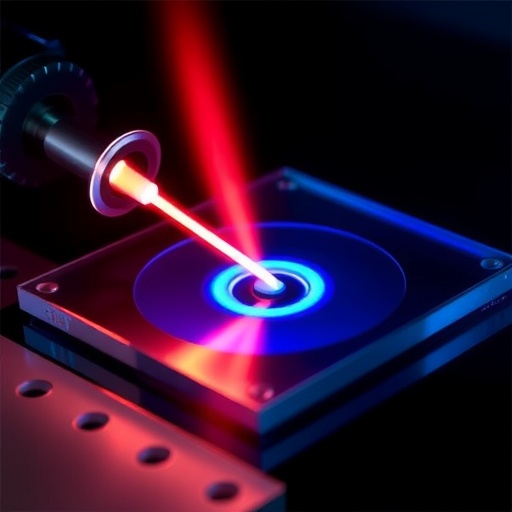
A research team led by Professor Hirofumi Hidai at Chiba University has introduced a fast, real-time diagnostic based on a signal that is easy to overlook: recoil force. Recoil force is the tiny reaction produced when a laser rapidly heats and vaporizes material at the wafer surface. By measuring this reaction with high sensitivity, the team aimed to infer how deeply the laser is actually processing the sample.

In laboratory tests, the researchers used nanosecond laser pulses lasting only 25 billionths of a second to drill silicon. During each pulse sequence, they recorded recoil force using a load cell, translating mechanical reaction into a measurable electrical signal. They found systematic trends: recoil force rose with increasing pulse energy, and decreased when the laser focus was defocused away from the wafer surface. These behavior patterns implied an underlying mathematical relationship between recoil force and processing conditions.

The core idea was then turned into a depth monitor. As repeated pulses drilled deeper into the wafer, the recoil force diminished along a predictable curve. At the point of full penetration, the curve shifted noticeably, marking the moment the laser had successfully cut through. This “signature” reduces reliance on post-process inspection and supports in-line feedback without disrupting manufacturing flow.

Prof. Hidai explains that directly measuring recoil enables detection of processing depth and penetration in real time—an advantage for maintaining yield during high-throughput dicing. Using their model, the team also estimated processing depth with a relative error of 24.3%, demonstrating practical utility despite inherent material and system variability.

Beyond validating a new sensing method, the researchers expect impact across precision laser manufacturing. Fewer under- or over-processed wafers could mean fewer defects, more stable chip supply, and lower costs for devices used in smartphones, automobiles, and medical equipment. They also envision integration with laser systems for automatic adjustment of cutting conditions, moving toward smarter, self-optimizing production tools.

The work was made available online on June 8, 2026, and is scheduled to be published in Volume 203 of Optics and Laser Technology on November 1, 2026.

More on Chiba University news can be found here: https://www.cn.chiba-u.jp/en/news/


Subject of Research: Experimental study
Article Title: Detection of processing depth and penetration based on recoil force induced by laser ablation
News Publication Date: 8-Jun-2026
Web References: http://dx.doi.org/10.1016/j.optlastec.2026.115604
References: 10.1016/j.optlastec.2026.115604
Image Credits: Credit: Professor Hirofumi Hidai from Chiba University, Japan. Image source link: Adapted from Fig. 9 in Sato et al. Optics and Laser Technology, licensed under CC BY 4.0.

Keywords

Laser dicing; recoil force sensing; laser ablation; processing depth monitoring; nanosecond pulses; semiconductor manufacturing; real-time diagnostics; load cell measurement; material penetration; yield optimization.

Tags: advanced process monitoring for chip fabricationhigh-sensitivity reaction force sensorslaser dicing precisionlaser-material interaction analysisminimizing substrate damage during laser cuttingnanosecond laser pulse drillingnon-contact process controlreal-time feedback in laser micromachiningReal-time laser ablation monitoringrecoil force measurement in semiconductor manufacturingsemiconductor wafer processing diagnosticswafer penetration detection
Share26Tweet16
Previous Post

AI Underwater Robots Monitor Diver Stress Using Exhaled Bubble Patterns

Next Post

Self-Sampling Boosts HPV Detection and Increases Cervical Cancer Screening Rates

Related Posts

Tension Builds as Nucleus Escapes Under Pressure
Chemistry

Tension Builds as Nucleus Escapes Under Pressure

July 27, 2026
Large-scale crystals may transform next-generation OLED display technology
Chemistry

Large-scale crystals may transform next-generation OLED display technology

July 27, 2026
Ytterbium Thrives as Researchers Celebrate Breakthrough in Science
Chemistry

Ytterbium Thrives as Researchers Celebrate Breakthrough in Science

July 27, 2026
Fabric Enables Multiple Stable Shapes Using Snap-Like Structural Design
Chemistry

Fabric Enables Multiple Stable Shapes Using Snap-Like Structural Design

July 27, 2026
Highly chemoselective access to alkyl-sulfur compounds via N2 extrusion of alkyl hydrazines
Chemistry

Highly chemoselective access to alkyl-sulfur compounds via N2 extrusion of alkyl hydrazines

July 27, 2026
CRISPR Guides Bacteria’s Backup Defenses Like a Commanding Officer
Chemistry

CRISPR Guides Bacteria’s Backup Defenses Like a Commanding Officer

July 27, 2026
Next Post
Self-Sampling Boosts HPV Detection and Increases Cervical Cancer Screening Rates

Self-Sampling Boosts HPV Detection and Increases Cervical Cancer Screening Rates

  • Mothers who receive childcare support from maternal grandparents show more

    Mothers who receive childcare support from maternal grandparents show more parental warmth, finds NTU Singapore study

    27656 shares
    Share 11059 Tweet 6912
  • University of Seville Breaks 120-Year-Old Mystery, Revises a Key Einstein Concept

    1061 shares
    Share 424 Tweet 265
  • Bee body mass, pathogens and local climate influence heat tolerance

    682 shares
    Share 273 Tweet 171
  • Researchers record first-ever images and data of a shark experiencing a boat strike

    546 shares
    Share 218 Tweet 137
  • Groundbreaking Clinical Trial Reveals Lubiprostone Enhances Kidney Function

    531 shares
    Share 212 Tweet 133
Science

Embark on a thrilling journey of discovery with Scienmag.com—your ultimate source for cutting-edge breakthroughs. Immerse yourself in a world where curiosity knows no limits and tomorrow’s possibilities become today’s reality!

RECENT NEWS

  • Dopamine-Linked Brain Network Reconfiguration Dynamics Altered in Parkinson’s Disease
  • Davemaoite Shows Limited Water Incorporation Under Lower-Mantle Conditions
  • APREAL Fall-Prevention Program Improves Safety for Hospitalized Elderly Patients
  • Programmable DNA tetrahedra enable selective, efficient capture of cells and proteins

Categories

  • Agriculture
  • Anthropology
  • Archaeology
  • Athmospheric
  • Biology
  • Biotechnology
  • Blog
  • Bussines
  • Cancer
  • Chemistry
  • Climate
  • Earth Science
  • Editorial Policy
  • Marine
  • Mathematics
  • Medicine
  • Pediatry
  • Policy
  • Psychology & Psychiatry
  • Science Education
  • Social Science
  • Space
  • Technology and Engineering

Subscribe to Blog via Email

Enter your email address to subscribe to this blog and receive notifications of new posts by email.

Join 5,146 other subscribers

© 2025 Scienmag - Science Magazine

Welcome Back!

Login to your account below

Forgotten Password?

Retrieve your password

Please enter your username or email address to reset your password.

Log In
No Result
View All Result
  • HOME
  • SCIENCE NEWS
  • CONTACT US

© 2025 Scienmag - Science Magazine

Discover more from Science

Subscribe now to keep reading and get access to the full archive.

Continue reading
