

Monday, July 27, 2026
Science
No Result
View All Result
  • Login
  • HOME
  • SCIENCE NEWS
  • CONTACT US
  • HOME
  • SCIENCE NEWS
  • CONTACT US
No Result
View All Result
Scienmag
No Result
View All Result
Home Science News Medicine

AI Underwater Robots Monitor Diver Stress Using Exhaled Bubble Patterns

July 27, 2026
in Medicine
Reading Time: 2 mins read
0
AI Underwater Robots Monitor Diver Stress Using Exhaled Bubble Patterns

AI Underwater Robots Monitor Diver Stress Using Exhaled Bubble Patterns

65
SHARES
587
VIEWS
Share on FacebookShare on Twitter
ADVERTISEMENT

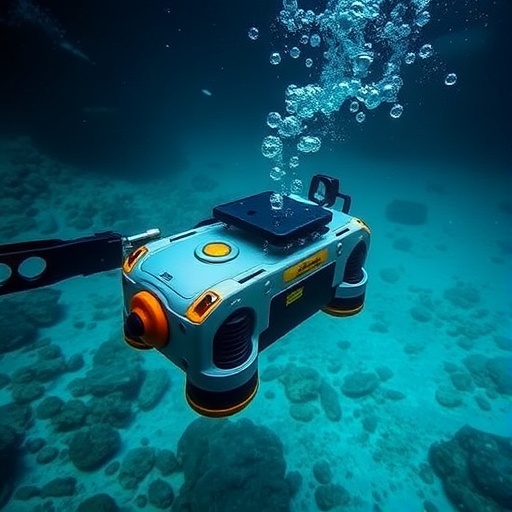
University of Minnesota Twin Cities researchers have unveiled a first-of-its-kind AI system for underwater companion robots that can assess a diver’s health in real time without physical sensors. The approach, reported in The International Journal of Robotics Research, estimates a diver’s Human Respiration Rate (HRR) by visually interpreting exhaled bubbles observed by a camera-equipped robot.

Scuba diving, especially in harsh environments, can quickly turn dangerous when physiological stress escalates. Excessive workload, exhaustion, or respiratory distress may develop faster than a diver can reliably self-report. Until now, underwater respiration monitoring has relied heavily on contact-based or wearable methods that struggle behind thick wetsuits and drysuits, while underwater wireless communication constrains data quality and bandwidth.

The new method treats breathing as a perception problem: bubbles provide a natural, non-contact signal that a robot can interpret. By detecting bubble patterns in video and mapping them to breaths per minute, the system converts routine underwater activity into an actionable respiratory metric.

A key technical challenge is training reliable perception under real-world conditions such as limited visibility, varying temperatures, and inconsistent bubble appearance. The team addressed this by building a dataset from multiple aquatic settings, including Lake Superior near Duluth, Square Lake near Stillwater, and an open-water test in the Caribbean Sea off Barbados.

To create ground truth, researchers developed a “fuzzy labeling” pipeline. They manually categorized thousands of frames while leveraging synchronized audio cues tied to regulator exhalations, teaching the model what a breath looks like even when visual cues are imperfect.

In field trials, the robot communicates dive-relevant status using a system dubbed HREyes. Breathing is categorized as below-normal (<14 breaths/min), normal (14–20 breaths/min), or above-normal (>20 breaths/min), enabling a safety partner to flag potential trouble early.

The researchers used an extensive set of audio and visual recordings to ensure the model generalized across environments with different clarity and acoustic conditions. This robustness is essential for any deployment where a robot must operate autonomously without recalibration.

Looking ahead, the team plans to fuse respiration-rate estimates with analysis of diver movement, aiming to generate a more comprehensive “wellness profile.” Such a profile could improve monitoring across groups of divers within a robot’s field of view.

Beyond safety, the work demonstrates a new category of underwater human-robot collaboration where the robot serves as a second set of eyes for physiological awareness. With non-contact sensing and AI-driven interpretation, the system offers a practical path toward more reliable assistance in deep-water exploration.

Subject of Research: Underwater robotic respiration monitoring for diver safety
Article Title: Robotic estimation of single scuba diver respiration rate for safety in underwater human-robot collaboration
News Publication Date: 27-Jul-2026
Web References: https://journals.sagepub.com/doi/10.1177/02783649251411466
References: 10.1177/0278364925141146
Image Credits: Photo provided by Junaed Sattar
Keywords: underwater robotics, artificial intelligence, human respiration rate, autonomous underwater vehicles, scuba safety, robotic vision, human-robot collaboration

Tags: AI-driven bubble pattern recognition in aquatic environmentsAI-powered underwater robot health assessmentaquatic environment dataset for underwater AI perceptionautonomous underwater respiratory monitoring systemcontactless diver vital sign measurementexhaled bubble pattern analysis for respirationnon-contact underwater respiration sensorsreal-time diver stress detection using visual cuestechnical challenges in underwater perception under variable conditionsunderwater AI diver health monitoringunderwater robotic systems for diver safetyunderwater vision-based physiological monitoring
Share26Tweet16
Previous Post

Anthropologists Probe Why Global Societies Once Buried the Dead at Home

Next Post

Real-Time Laser Ablation Monitoring Detects Wafer Penetration via Recoil Force

Related Posts

Drosophila Study Reveals Global Molecular Code Linking Birth Order to Neurons
Medicine

Drosophila Study Reveals Global Molecular Code Linking Birth Order to Neurons

July 27, 2026
Cross-Species Spatial Transcriptomics Reveals Conserved Drivers of Lupus Skin and Hair Loss
Medicine

Cross-Species Spatial Transcriptomics Reveals Conserved Drivers of Lupus Skin and Hair Loss

July 27, 2026
Validation of NEO-READY model for predicting discharge dates in preterm NICU patients
Medicine

Validation of NEO-READY model for predicting discharge dates in preterm NICU patients

July 27, 2026
AI Detection Model Uses Noncontact Multimodal Data for Early Parkinson’s Diagnosis
Medicine

AI Detection Model Uses Noncontact Multimodal Data for Early Parkinson’s Diagnosis

July 27, 2026
Cocrystal Enables Fixed-Dose Empagliflozin and Metformin Bilayer for Bioequivalence
Medicine

Cocrystal Enables Fixed-Dose Empagliflozin and Metformin Bilayer for Bioequivalence

July 27, 2026
Super Protein Powders Tested for Active Aging Using Artificial Stomach
Medicine

Super Protein Powders Tested for Active Aging Using Artificial Stomach

July 27, 2026
Next Post
Real-Time Laser Ablation Monitoring Detects Wafer Penetration via Recoil Force

Real-Time Laser Ablation Monitoring Detects Wafer Penetration via Recoil Force

  • Mothers who receive childcare support from maternal grandparents show more

    Mothers who receive childcare support from maternal grandparents show more parental warmth, finds NTU Singapore study

    27656 shares
    Share 11059 Tweet 6912
  • University of Seville Breaks 120-Year-Old Mystery, Revises a Key Einstein Concept

    1061 shares
    Share 424 Tweet 265
  • Bee body mass, pathogens and local climate influence heat tolerance

    682 shares
    Share 273 Tweet 171
  • Researchers record first-ever images and data of a shark experiencing a boat strike

    546 shares
    Share 218 Tweet 137
  • Groundbreaking Clinical Trial Reveals Lubiprostone Enhances Kidney Function

    531 shares
    Share 212 Tweet 133
Science

Embark on a thrilling journey of discovery with Scienmag.com—your ultimate source for cutting-edge breakthroughs. Immerse yourself in a world where curiosity knows no limits and tomorrow’s possibilities become today’s reality!

RECENT NEWS

  • Micropeptides from lncRNAs drive cancer progression and metastasis
  • HK1–LDHA feedback boosts Wnt5a histone lactylation, linking prenatal acetaminophen to male OA
  • Boosting antitumor immunity by triggering cancer cell pyroptosis
  • Pusan National University Scientists Create Smart Adaptive Vibration Isolator System

Categories

  • Agriculture
  • Anthropology
  • Archaeology
  • Athmospheric
  • Biology
  • Biotechnology
  • Blog
  • Bussines
  • Cancer
  • Chemistry
  • Climate
  • Earth Science
  • Editorial Policy
  • Marine
  • Mathematics
  • Medicine
  • Pediatry
  • Policy
  • Psychology & Psychiatry
  • Science Education
  • Social Science
  • Space
  • Technology and Engineering

Subscribe to Blog via Email

Enter your email address to subscribe to this blog and receive notifications of new posts by email.

Join 5,146 other subscribers

© 2025 Scienmag - Science Magazine

Welcome Back!

Login to your account below

Forgotten Password?

Retrieve your password

Please enter your username or email address to reset your password.

Log In
No Result
View All Result
  • HOME
  • SCIENCE NEWS
  • CONTACT US

© 2025 Scienmag - Science Magazine

Discover more from Science

Subscribe now to keep reading and get access to the full archive.

Continue reading
