

Sunday, July 26, 2026
Science
No Result
View All Result
  • Login
  • HOME
  • SCIENCE NEWS
  • CONTACT US
  • HOME
  • SCIENCE NEWS
  • CONTACT US
No Result
View All Result
Scienmag
No Result
View All Result
Home Science News Science Education

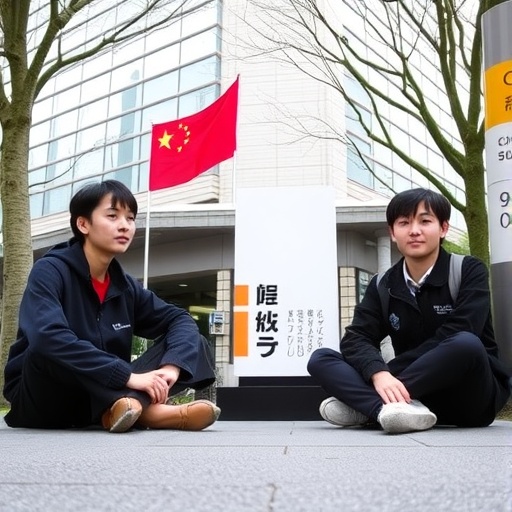
Chinese Graduate Students Reshape Japanese Universities as Active Partners

July 26, 2026
in Science Education
Reading Time: 2 mins read
0
Chinese Graduate Students Reshape Japanese Universities as Active Partners

Chinese Graduate Students Reshape Japanese Universities as Active Partners

65
SHARES
587
VIEWS
Share on FacebookShare on Twitter
ADVERTISEMENT

International students are commonly discussed as beneficiaries of education abroad—degree gains, language learning, employability, and intercultural skills. A new paper in ECNU Review of Education reframes the conversation by asking a different question: what do mobile students actually contribute to their host universities and societies?

The study, titled “How Do Chinese Graduate Students Contribute to Japanese Universities: An Agential Perspective,” examines Chinese graduate students in Japan and argues that they function as active agents rather than passive recipients. The authors—Lilan Chen (Waseda University), Shuoyang Meng (University of Tokyo), and Ming Li (University of Osaka)—position student mobility as a two-way knowledge flow.

Japan has pursued international student targets for decades, including large-scale goals of 100,000, 300,000, and more recently 400,000 inbound students. While prior scholarship emphasized why international students arrive and what they experience, less attention has been given to what they give back after enrollment.

To address this gap, the researchers use collaborative autoethnography, a qualitative approach that blends personal reflection, shared narrative, and collective interpretation. Rather than treating “contribution” as a single outcome, the method traces agency across academic and nonacademic spaces, and across formal and informal settings.

In formal academic arenas, participants expand research agendas by inserting China-relevant knowledge and transnational perspectives into Japanese scholarship. They also increase global academic visibility through English-language publications, conference presentations, and cross-border research collaborations.

International students further act as institutional conduits, linking Japanese and Chinese universities through lectures, translation, academic introductions, and collaborative opportunities. This work supports “knowledge diplomacy,” extending beyond bilateral ties toward wider global academic ecosystems.

The effects continue informally: students shape peers’ and supervisors’ research interests, encourage international publication strategies, and broker participation in multilingual research networks. Their lived experience positions them to connect scholars across linguistic and disciplinary divides.

Beyond academia, some participants contribute culturally and socially—teaching Chinese language, engaging in local cultural outreach, and participating in city-level exchange activities. In doing so, they mediate more nuanced understandings of China in everyday community contexts.

The paper also emphasizes bidirectional mobility effects. Experiences in Japan influence families, friends, and future applicants in China, reinforcing cycles of brain circulation and cross-cultural learning through ongoing transnational ties.

Finally, the authors argue that internationalization is not only a policy or institutional brand; it is produced through everyday academic, cultural, and interpersonal labor. Universities, they conclude, should recognize and support these roles through research networking, community engagement, intercultural education, and institutional internationalization initiatives.

Subject of Research: People
Article Title: How Do Chinese Graduate Students Contribute to Japanese Universities: An Agential Perspective
News Publication Date: 6-Jul-2026
Web References: https://doi.org/10.1177/20965311261454420
References: 10.1177/20965311261454420
Image Credits:
Keywords: international students, graduate education, knowledge diplomacy, collaborative autoethnography, academic networks, intercultural mediation

Tags: active agency of international studentsChinese graduate studentscollaborative autoethnographycross-cultural academic exchangeimpact of graduate students on host societyinternational student contributionsJapan-China academic collaborationsJapanese universitiesknowledge flow in higher educationrole of international students in university developmentstudent mobilitytransnational perspectives in research
Share26Tweet16
Previous Post

Scientists Unravel Climate Drivers Behind Bronze Age Civilization Collapses

Next Post

Venture-Backed Maternal Health Startups Confront Persistent Maternal Health Crisis

Related Posts

UL Research Institutes Appoints Elena Zinchenko as Chief Program Development Officer
Science Education

UL Research Institutes Appoints Elena Zinchenko as Chief Program Development Officer

July 17, 2026
E-Nose Diagnostics, Rare Disease Research, and AI Medical Education Tools Emerge
Science Education

E-Nose Diagnostics, Rare Disease Research, and AI Medical Education Tools Emerge

July 17, 2026
Tips for Teachers Adapting to 21st-Century Classrooms
Science Education

Tips for Teachers Adapting to 21st-Century Classrooms

July 17, 2026
Researchers Test Tiny Molecules to Slow Lung Cancer Progression
Science Education

Researchers Test Tiny Molecules to Slow Lung Cancer Progression

July 16, 2026
Study suggests dropping SAT/ACT requirements could boost access, but hinder admissions
Science Education

Study suggests dropping SAT/ACT requirements could boost access, but hinder admissions

July 16, 2026
Simulation boosts nursing students’ home-visit training immersion, skills still under study
Science Education

Simulation boosts nursing students’ home-visit training immersion, skills still under study

July 16, 2026
Next Post
Venture-Backed Maternal Health Startups Confront Persistent Maternal Health Crisis

Venture-Backed Maternal Health Startups Confront Persistent Maternal Health Crisis

  • Mothers who receive childcare support from maternal grandparents show more

    Mothers who receive childcare support from maternal grandparents show more parental warmth, finds NTU Singapore study

    27656 shares
    Share 11059 Tweet 6912
  • University of Seville Breaks 120-Year-Old Mystery, Revises a Key Einstein Concept

    1061 shares
    Share 424 Tweet 265
  • Bee body mass, pathogens and local climate influence heat tolerance

    682 shares
    Share 273 Tweet 171
  • Researchers record first-ever images and data of a shark experiencing a boat strike

    546 shares
    Share 218 Tweet 137
  • Groundbreaking Clinical Trial Reveals Lubiprostone Enhances Kidney Function

    531 shares
    Share 212 Tweet 133
Science

Embark on a thrilling journey of discovery with Scienmag.com—your ultimate source for cutting-edge breakthroughs. Immerse yourself in a world where curiosity knows no limits and tomorrow’s possibilities become today’s reality!

RECENT NEWS

  • Physics Pairing Enables Label-Free 3D Tracking of Lipid Droplet Motility
  • Centuries-long cooling after achieving net-zero greenhouse gas emissions
  • Brain regions differently control food intake following GIPR agonist or antagonist treatment
  • Children tailor curiosity to individuals when objects seem useful or special

Categories

  • Agriculture
  • Anthropology
  • Archaeology
  • Athmospheric
  • Biology
  • Biotechnology
  • Blog
  • Bussines
  • Cancer
  • Chemistry
  • Climate
  • Earth Science
  • Editorial Policy
  • Marine
  • Mathematics
  • Medicine
  • Pediatry
  • Policy
  • Psychology & Psychiatry
  • Science Education
  • Social Science
  • Space
  • Technology and Engineering

Subscribe to Blog via Email

Enter your email address to subscribe to this blog and receive notifications of new posts by email.

Join 5,146 other subscribers

© 2025 Scienmag - Science Magazine

Welcome Back!

Login to your account below

Forgotten Password?

Retrieve your password

Please enter your username or email address to reset your password.

Log In
No Result
View All Result
  • HOME
  • SCIENCE NEWS
  • CONTACT US

© 2025 Scienmag - Science Magazine

Discover more from Science

Subscribe now to keep reading and get access to the full archive.

Continue reading
