

Thursday, July 16, 2026
Science
No Result
View All Result
  • Login
  • HOME
  • SCIENCE NEWS
  • CONTACT US
  • HOME
  • SCIENCE NEWS
  • CONTACT US
No Result
View All Result
Scienmag
No Result
View All Result
Home Science News Athmospheric

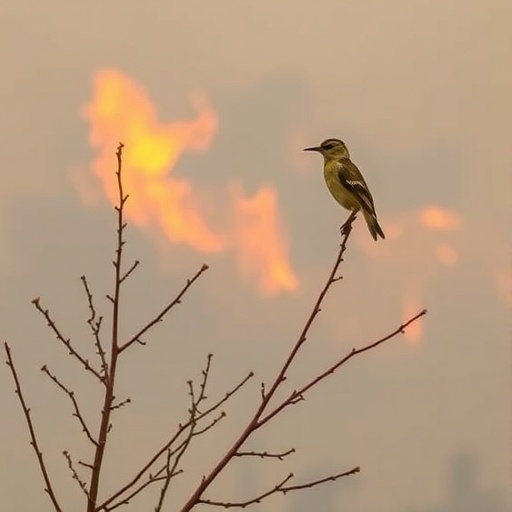
Canadian Wildfire Smoke Reduces Bird Sightings Across New York State

July 16, 2026
in Athmospheric
Reading Time: 2 mins read
0
Canadian Wildfire Smoke Reduces Bird Sightings Across New York State

Canadian Wildfire Smoke Reduces Bird Sightings Across New York State

65
SHARES
587
VIEWS
Share on FacebookShare on Twitter
ADVERTISEMENT

Canadian wildfire smoke has a reach far beyond the forests that burn. Even when the flames are hundreds of miles away, New York’s air can change rapidly—and with it, the signals that scientists rely on to track wildlife.

In a new University at Buffalo study published in Biodiversity and Conservation, researchers report that rising fine particulate matter (PM2.5), a marker strongly associated with wildfire smoke, is linked to fewer sightings of many breeding birds across New York State. The analysis drew on a period that included the 2023 season, when Canadian wildfires produced record-setting smoke transport.

The team first quantified PM2.5 during New York’s 2021–2023 breeding seasons. Concentrations peaked in 2023, when smoke degraded air quality through June and July, pushing PM2.5 above World Health Organization guidance multiple times—at peaks up to eightfold the recommended limit.

Next, they matched those air-quality measurements to nearly 99,000 birdwatching checklists from Cornell University’s eBird database, a citizen-science platform that compiles observations submitted by participants with varying experience levels. To reduce bias, the researchers applied rigorous data filtering and statistical controls.

Across the three seasons, they analyzed 84 breeding bird species. Overall, 65% of species showed altered detectability as PM2.5 rose, with nearly half becoming less likely to be observed during smokier intervals. Many affected species were migratory forest songbirds, including warblers, thrushes, and vireos.

One plausible mechanism is behavioral: smoky conditions may suppress singing, reduce movement, or shift activity deeper into dense canopy, making birds harder to detect even if they remain present. The authors emphasize that the ecological meaning of “absence” in observation data is not straightforward when air quality changes.

Interestingly, 15 species were more likely to be observed at higher PM2.5, while 29 showed no significant change. The study notes that these patterns may reflect where birdwatchers choose to look during poor air-quality days—often favoring more open habitats rather than changes in bird abundance alone.

The key takeaway is methodological as well as ecological. If smoke-driven detectability shifts are ignored, biodiversity models may misinterpret temporary observation changes as real population declines. With climate change intensifying wildfire frequency, incorporating air-quality context becomes essential for reliable monitoring.

By treating PM2.5 as an exposure variable that can reshape what field surveys “see,” this work offers a framework for improving species distribution estimates during smoke events—turning a pervasive environmental disturbance into a measurable factor in conservation science.

Subject of Research: Animals

Article Title: Wildfire smoke alters observations of 65% of breeding bird species in New York State

News Publication Date: 3-Jul-2026

Web References: https://link.springer.com/article/10.1007/s10531-026-03406-9

References: 10.1007/s10531-026-03406-9

Keywords: wildfire smoke; PM2.5; biodiversity indicators; ecological diversity; biodiversity conservation; species diversity; avian monitoring; detectability bias; climate change effects; ecological diversity indicators

Tags: 2023 wildfire season in New Yorkair pollution and wildlife monitoringair quality and bird detectabilitybiodiversity and conservation during wildfire seasonsCanadian wildfire smoke and air qualitycitizen science data on birdwatchingecological consequences of wildfire smokeeffects of fine particulate matter on bird behavioreffects of PM2.5 on breeding bird populationsenvironmental effects of Canadian wildfiresWildfire smoke impact on bird sightingswildfire smoke transport to New York State
Share26Tweet16
Previous Post

New Study Suggests Possible Atmosphere on Rocky Planet Near Nearby Star

Next Post

New Model Uncovers Hidden Disease Signals and Predicts Health Outcomes

Related Posts

First Atmosphere Detected on Rocky Exoplanet in Habitable Zone
Athmospheric

First Atmosphere Detected on Rocky Exoplanet in Habitable Zone

July 16, 2026
Nature Reviews Microbiology details how climate change is spreading waterborne diseases
Athmospheric

Nature Reviews Microbiology details how climate change is spreading waterborne diseases

July 16, 2026
Climate Change Disproportionately Threatens Food Security in Small Island Developing States
Athmospheric

Climate Change Disproportionately Threatens Food Security in Small Island Developing States

July 16, 2026
Study Says FIFA Should Cut Ticket Prices to Reduce Mega-Event Emissions
Athmospheric

Study Says FIFA Should Cut Ticket Prices to Reduce Mega-Event Emissions

July 16, 2026
Himalayan Forests Use Dual Approach to Capture and Store More Carbon
Athmospheric

Himalayan Forests Use Dual Approach to Capture and Store More Carbon

July 15, 2026
Greenland snow reveals industrial impact through rising atmospheric methane levels
Athmospheric

Greenland snow reveals industrial impact through rising atmospheric methane levels

July 15, 2026
Next Post
New Model Uncovers Hidden Disease Signals and Predicts Health Outcomes

New Model Uncovers Hidden Disease Signals and Predicts Health Outcomes

  • Mothers who receive childcare support from maternal grandparents show more

    Mothers who receive childcare support from maternal grandparents show more parental warmth, finds NTU Singapore study

    27656 shares
    Share 11059 Tweet 6912
  • University of Seville Breaks 120-Year-Old Mystery, Revises a Key Einstein Concept

    1061 shares
    Share 424 Tweet 265
  • Bee body mass, pathogens and local climate influence heat tolerance

    682 shares
    Share 273 Tweet 171
  • Researchers record first-ever images and data of a shark experiencing a boat strike

    546 shares
    Share 218 Tweet 137
  • Groundbreaking Clinical Trial Reveals Lubiprostone Enhances Kidney Function

    531 shares
    Share 212 Tweet 133
Science

Embark on a thrilling journey of discovery with Scienmag.com—your ultimate source for cutting-edge breakthroughs. Immerse yourself in a world where curiosity knows no limits and tomorrow’s possibilities become today’s reality!

RECENT NEWS

  • Experts Urge Europe to Recognize Wildlife as Individuals Able to Suffer
  • Safe vaccine triggers durable immune responses to prevent pancreatic cancer in high-risk people
  • Data-Driven Framework Cuts Distillation Optimization Time Significantly
  • Scientists engineer next-generation cancer treatments by disabling tumor DNA repair

Categories

  • Agriculture
  • Anthropology
  • Archaeology
  • Athmospheric
  • Biology
  • Biotechnology
  • Blog
  • Bussines
  • Cancer
  • Chemistry
  • Climate
  • Earth Science
  • Editorial Policy
  • Marine
  • Mathematics
  • Medicine
  • Pediatry
  • Policy
  • Psychology & Psychiatry
  • Science Education
  • Social Science
  • Space
  • Technology and Engineering

Subscribe to Blog via Email

Enter your email address to subscribe to this blog and receive notifications of new posts by email.

Join 5,146 other subscribers

© 2025 Scienmag - Science Magazine

Welcome Back!

Login to your account below

Forgotten Password?

Retrieve your password

Please enter your username or email address to reset your password.

Log In
No Result
View All Result
  • HOME
  • SCIENCE NEWS
  • CONTACT US

© 2025 Scienmag - Science Magazine

Discover more from Science

Subscribe now to keep reading and get access to the full archive.

Continue reading
