


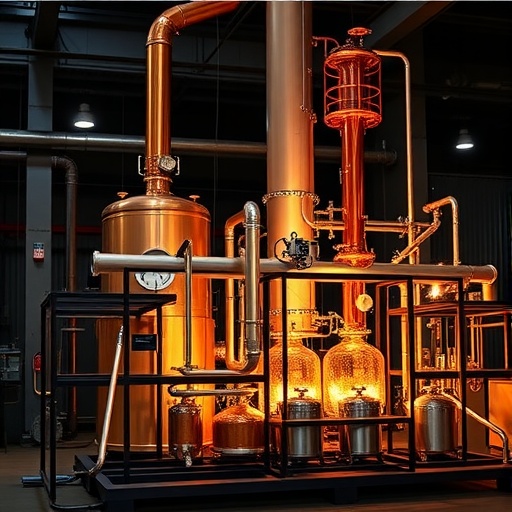
Distillation remains one of industry’s most energy-hungry separation steps, driving both operating costs and greenhouse-gas emissions. Yet improving distillation performance is far from straightforward: modern systems are governed by highly nonlinear models and often include both continuous and discrete decision variables. This combination turns optimization into a difficult mixed-integer nonlinear programming challenge. In practice, many widely used metaheuristics—such as genetic algorithms—can waste enormous computational effort by producing infeasible candidates, especially when process simulations fail to converge.
A team from Chongqing University and collaborators now report a multiobjective optimization framework designed to make these failures more useful rather than purely wasteful. Published in Engineering Chemistry Engineering, the approach builds on the familiar NSGA-II workflow, but adds targeted mechanisms that detect and repair specific classes of infeasible solutions. The goal is to concentrate expensive simulation calls on designs most likely to be competitive across multiple objectives.
The first enhancement uses a Gaussian process surrogate model to learn the structure of the decision space. Instead of treating infeasibility as a dead end, the surrogate is trained to distinguish Pareto-optimal regions from dominated ones using only the decision variables. The model is then applied to infeasible results to flag “promising infeasible solutions,” meaning candidates that lie near the boundary of high-performing trade-offs even though they fail feasibility checks.
The second enhancement provides an adaptive “directed correction.” For each promising infeasible solution, the method identifies the decision variable that is most consistently distant—on average—from variables associated with Pareto-optimal solutions. It then corrects that variable using uniform random sampling constrained to the range observed among feasible near-Pareto designs. This strategy aims to nudge candidates toward feasibility while preserving their proximity to optimal trade-offs.
To test the framework, the researchers evaluated two complex distillation problems. The first is a sidestream double-column extractive distillation system designed to separate a methanol–toluene azeotrope using triethylamine as an entrainer. The optimization includes eight decision variables and two objectives: total annual cost and CO₂-based emissions.
The second case involves a four-column extractive distillation process for recovering ethyl acetate and methanol from wastewater using dimethyl sulfoxide as an entrainer. Here, 16 decision variables are optimized against three objectives: total annual cost, CO₂ emissions, and a process safety index. Across both studies, the framework reliably identified optimal or near-optimal designs and matched or exceeded previously reported results.
Most notably, the computational burden dropped substantially. Compared with a conventional genetic algorithm, the reported optimization time reductions were 35.3% for the first case and 20.8% for the second. The researchers attribute these gains to a key insight: many “failed” simulations are not random, but cluster near high-quality regions in design space and can be rescued with limited, informed perturbations.
Because the method explicitly targets infeasibility patterns and uses data-driven guidance, it is expected to generalize to other chemical-process optimization tasks where simulator convergence failures are common. By transforming a major source of inefficiency into a structured search signal, the MODIDC framework offers a new route toward faster, multiobjective distillation design.
Keywords
MODIDC, NSGA-II, Gaussian process surrogate, multiobjective optimization, extractive distillation, simulator convergence, mixed-integer nonlinear programming, feasibility repair
Subject of Research: Not applicable
Article Title: An efficient multi-objective optimization framework based on data-driven identification and adaptive directed correction for complex distillation processes
News Publication Date: 7-Apr-2026
Web References: http://dx.doi.org/10.1007/s11705-026-2670-6
References: 10.1007/s11705-026-2670-6
Image Credits: HIGHER EDUCATION PRESS
Cite Scienmag News
Blake Davidson. (July 16, 2026). Data-Driven Framework Cuts Distillation Optimization Time Significantly. Scienmag. https://scienmag.com/data-driven-framework-cuts-distillation-optimization-time-significantly/
Blake Davidson. "Data-Driven Framework Cuts Distillation Optimization Time Significantly." Scienmag, 16 July 2026, https://scienmag.com/data-driven-framework-cuts-distillation-optimization-time-significantly/. Accessed 3 September 2026.
Blake Davidson. "Data-Driven Framework Cuts Distillation Optimization Time Significantly." Scienmag. July 16, 2026. https://scienmag.com/data-driven-framework-cuts-distillation-optimization-time-significantly/


