

Thursday, July 16, 2026
Science
No Result
View All Result
  • Login
  • HOME
  • SCIENCE NEWS
  • CONTACT US
  • HOME
  • SCIENCE NEWS
  • CONTACT US
No Result
View All Result
Scienmag
No Result
View All Result
Home Science News Athmospheric

Climate Change Disproportionately Threatens Food Security in Small Island Developing States

July 16, 2026
in Athmospheric
Reading Time: 2 mins read
0
Climate Change Disproportionately Threatens Food Security in Small Island Developing States

Climate Change Disproportionately Threatens Food Security in Small Island Developing States

65
SHARES
587
VIEWS
Share on FacebookShare on Twitter
ADVERTISEMENT

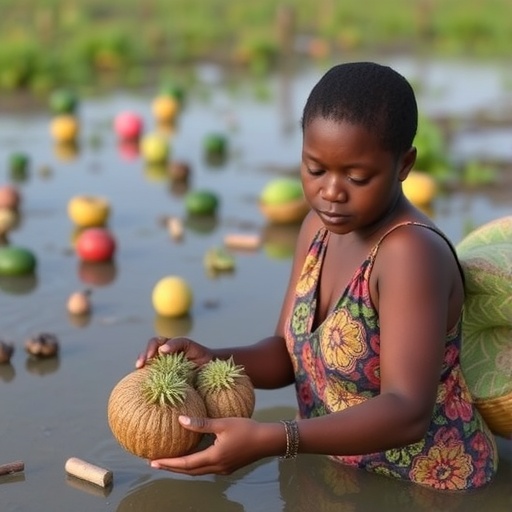
Small Island Developing States (SIDS) are experiencing climate impacts that are far more severe than global averages, even though they contribute less than 1% of greenhouse-gas emissions. Sea level rise, droughts, floods, and extreme heat are not just environmental threats—they are increasingly health and food security crises. A new Lancet Countdown report for 2025 brings these links into sharper focus by examining climate-related indicators specifically across SIDS.

One key analysis targets how the growing frequency of heatwaves and drought conditions affects access to food. Led by CMCC researcher Shouro Dasgupta and Professor Elizabeth Robinson at the Grantham Research Institute, the study connects climate signals to nutrition outcomes using an empirical approach. Heatwave-day and drought-month anomalies are calculated relative to a baseline period of 1981–2010, then matched with food security data to quantify shifting risk over time.

In 2023, the researchers estimate that an additional 2.7 million people—about 4.9% of the combined population of 26 SIDS, roughly 70 million people total—experienced moderate or severe food insecurity due to more frequent heatwaves and droughts. The results suggest a measurable climate-to-food pathway: higher heatwave-day frequency correlates with 5.74% higher moderate or severe food insecurity, while increasing drought frequency is associated with a 3.53% rise.

The report also highlights that vulnerability is amplified by structural constraints. Many SIDS rely heavily on food imports, so climate shocks that damage infrastructure or interrupt trade can rapidly translate into shortages and price spikes. In such settings, climate risk becomes an economic and health risk at the same time, particularly when fiscal space is limited.

Beyond food insecurity, climate impacts are showing up in broader health costs. In 2024, SIDS lost the equivalent of 1.27% of GDP due to reduced labor capacity—higher than the global figure of 0.99%. Over the early 2000s, heat-related mortality costs have increased by 432%, the steepest increase among tracked groups.

The study strengthens the case that climate action is not only about emissions but also about preventing cascading harms. It also aligns with the policy argument that limiting warming to 1.5°C is legally binding and that accountability may arise where causation to climate damage is established. For SIDS, the clock is accelerating—and the costs are showing up first.

Subject of Research: Health and climate impacts in Small Island Developing States, with a focus on climate-driven food insecurity
Article Title: 2025 Small Island Developing States report of the Lancet Countdown on health and climate change
News Publication Date: 2025
Web References: Not provided
References: Lancet Countdown (2025) report; FAO; CMCC / LSE research collaboration
Image Credits: Not provided

Keywords: Small Island Developing States, climate change, food insecurity, heatwaves, droughts, food imports, health costs, Lancet Countdown

Tags: climate changeclimate impacts on healthclimate-related food insecuritydroughtsempirical climate studiesextreme heatfloodsFood securityheatwavesnutrition outcomessea level risesmall island developing states
Share26Tweet16
Previous Post

Listening to Black Hole Ringing Reveals Path to Future Gravitational-Wave Astronomy

Next Post

Researchers Use Fast, Flat Simulations to Predict Outcomes in New Games

Related Posts

Study Says FIFA Should Cut Ticket Prices to Reduce Mega-Event Emissions
Athmospheric

Study Says FIFA Should Cut Ticket Prices to Reduce Mega-Event Emissions

July 16, 2026
Himalayan Forests Use Dual Approach to Capture and Store More Carbon
Athmospheric

Himalayan Forests Use Dual Approach to Capture and Store More Carbon

July 15, 2026
Greenland snow reveals industrial impact through rising atmospheric methane levels
Athmospheric

Greenland snow reveals industrial impact through rising atmospheric methane levels

July 15, 2026
Climate Impact Research Needs More Real-World Evidence
Athmospheric

Climate Impact Research Needs More Real-World Evidence

July 15, 2026
India’s monsoon rainfall varies with cleaner air in different regions
Athmospheric

India’s monsoon rainfall varies with cleaner air in different regions

July 15, 2026
New study maps climate measures for Berlin and heat protection for Tirana
Athmospheric

New study maps climate measures for Berlin and heat protection for Tirana

July 15, 2026
Next Post
Researchers Use Fast, Flat Simulations to Predict Outcomes in New Games

Researchers Use Fast, Flat Simulations to Predict Outcomes in New Games

  • Mothers who receive childcare support from maternal grandparents show more

    Mothers who receive childcare support from maternal grandparents show more parental warmth, finds NTU Singapore study

    27656 shares
    Share 11059 Tweet 6912
  • University of Seville Breaks 120-Year-Old Mystery, Revises a Key Einstein Concept

    1061 shares
    Share 424 Tweet 265
  • Bee body mass, pathogens and local climate influence heat tolerance

    682 shares
    Share 273 Tweet 171
  • Researchers record first-ever images and data of a shark experiencing a boat strike

    546 shares
    Share 218 Tweet 137
  • Groundbreaking Clinical Trial Reveals Lubiprostone Enhances Kidney Function

    531 shares
    Share 212 Tweet 133
Science

Embark on a thrilling journey of discovery with Scienmag.com—your ultimate source for cutting-edge breakthroughs. Immerse yourself in a world where curiosity knows no limits and tomorrow’s possibilities become today’s reality!

RECENT NEWS

  • Volcanic eruptions leave imprint on coupled reanalysis global overturning circulation
  • Residential Water Sources Predict Serum PFAS Levels in Contaminated Communities
  • Researchers Use Fast, Flat Simulations to Predict Outcomes in New Games
  • Climate Change Disproportionately Threatens Food Security in Small Island Developing States

Categories

  • Agriculture
  • Anthropology
  • Archaeology
  • Athmospheric
  • Biology
  • Biotechnology
  • Blog
  • Bussines
  • Cancer
  • Chemistry
  • Climate
  • Earth Science
  • Editorial Policy
  • Marine
  • Mathematics
  • Medicine
  • Pediatry
  • Policy
  • Psychology & Psychiatry
  • Science Education
  • Social Science
  • Space
  • Technology and Engineering

Subscribe to Blog via Email

Enter your email address to subscribe to this blog and receive notifications of new posts by email.

Join 5,146 other subscribers

© 2025 Scienmag - Science Magazine

Welcome Back!

Login to your account below

Forgotten Password?

Retrieve your password

Please enter your username or email address to reset your password.

Log In
No Result
View All Result
  • HOME
  • SCIENCE NEWS
  • CONTACT US

© 2025 Scienmag - Science Magazine

Discover more from Science

Subscribe now to keep reading and get access to the full archive.

Continue reading
