


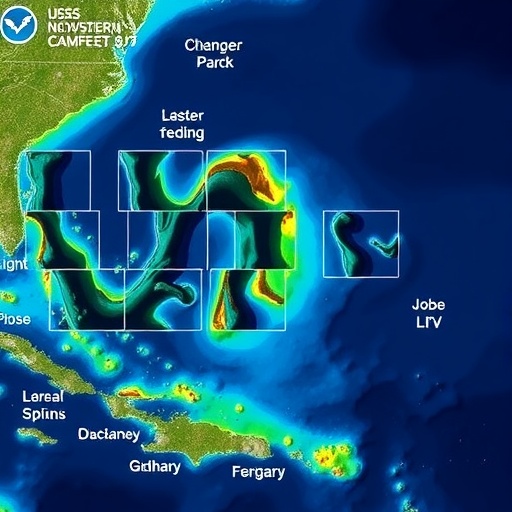
Atlantic tarpon are known for epic migrations along the Gulf and Atlantic coasts, yet the question of where they reliably find food during those journeys has largely stayed unanswered. A new University of South Florida–led study now maps the feeding geography that makes migration possible, turning a long-distance mystery into a set of identifiable biological “fuel stations.”
Researchers combined five years of electronic tracking with chemical signals preserved in tarpon tissues. Electronic tagging helped reveal movement, behaviors, and migration routes, while tissue chemistry offered a biological record of likely feeding locations over different time scales. By integrating these independent datasets, the team could infer not only where fish traveled, but where they most likely obtained energy.
The study, published in Movement Ecology, challenges the idea that tarpon feed randomly across their range. Instead, the results support a model in which tarpon concentrate their feeding in discrete foraging landscapes—regionally distinct habitats that repeatedly supply productive conditions during annual movement.
Three major feeding regions stood out: South Florida, the northern Gulf of Mexico, and the Mid-Atlantic coast. South Florida was especially important because it was used consistently across multiple migratory groups, suggesting it functions as a recurring anchor point within the broader migration network.
Using samples from 417 tarpon and linking them to 85 acoustically tagged fish, the researchers estimated that the most probable foraging areas are often hundreds of kilometers from capture sites. On average, likely feeding locations were about 300 kilometers (185 miles) away, highlighting how coastal fisheries may depend on habitat conditions far from where anglers take their catch.
Short-term blood chemistry reflected more recent, local feeding, while longer-term fin-clip tissues integrated feeding signals across several months. This temporal layering helped the team distinguish near-term foraging from broader migration-associated feeding patterns.
The conservation implications are immediate. If migration depends on a limited set of productive regions, then habitat loss, altered freshwater flows, coastal development, or climate-driven change can weaken tarpon populations across entire coastlines, not just in isolated hotspots.
Beyond tarpon, the authors argue that the framework can be adapted to other migratory marine species whose feeding grounds are difficult to observe directly. Identifying where energy comes from is a prerequisite for protecting the ecosystems that sustain both biodiversity and sustainable recreational fisheries.
Cite Scienmag News
Violet Maxwell. (July 15, 2026). USF Study Maps Hidden Feeding Grounds Fueling Iconic Ocean Sportfish. Scienmag. https://scienmag.com/usf-study-maps-hidden-feeding-grounds-fueling-iconic-ocean-sportfish/
Violet Maxwell. "USF Study Maps Hidden Feeding Grounds Fueling Iconic Ocean Sportfish." Scienmag, 15 July 2026, https://scienmag.com/usf-study-maps-hidden-feeding-grounds-fueling-iconic-ocean-sportfish/. Accessed 4 September 2026.
Violet Maxwell. "USF Study Maps Hidden Feeding Grounds Fueling Iconic Ocean Sportfish." Scienmag. July 15, 2026. https://scienmag.com/usf-study-maps-hidden-feeding-grounds-fueling-iconic-ocean-sportfish/


