

Wednesday, July 15, 2026
Science
No Result
View All Result
  • Login
  • HOME
  • SCIENCE NEWS
  • CONTACT US
  • HOME
  • SCIENCE NEWS
  • CONTACT US
No Result
View All Result
Scienmag
No Result
View All Result
Home Science News Space

SwRI Study Links Asteroid Collision to 800 Million-Year-Old Meteor Showers

July 15, 2026
in Space
Reading Time: 2 mins read
0
SwRI Study Links Asteroid Collision to 800 Million-Year-Old Meteor Showers

SwRI Study Links Asteroid Collision to 800 Million-Year-Old Meteor Showers

65
SHARES
587
VIEWS
Share on FacebookShare on Twitter
ADVERTISEMENT

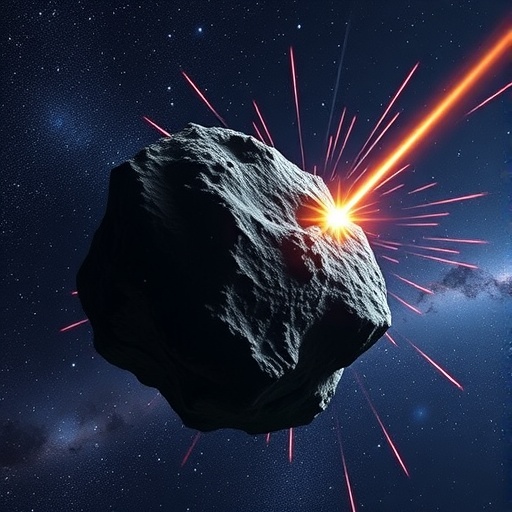
An asteroid-family breakup in the main belt may have triggered an inner-solar-system-wide “impact shower” roughly 800 million years ago, according to a new Southwest Research Institute-led study. The work links a catastrophic collision to a spike in cratering recorded on the Moon, offering a plausible cosmic source for a bombardment episode long suspected but difficult to trace.

The researchers focus on the Eulalia parent body, which fragmented after a collision involving a primitive carbonaceous-chondrite-like object. By combining collisional and dynamical models, the team argues that this breakup released fragments positioned to escape the asteroid belt through a specific orbital gateway near Jupiter.

That pathway is the J3:1 mean-motion resonance, a configuration in which an asteroid completes three orbits around the Sun for every one orbit of Jupiter. In effect, J3:1 acts as a gravitational “escape hatch,” delivering debris into planet-crossing regions where it can strike the inner planets. The study highlights that many near-Earth asteroids may ultimately trace back to this region.

Simulations indicate an immediate surge: about half of the breakup fragments reached the J3:1 resonance soon after the collision, rapidly scattering material across the inner solar system. The team also finds a delayed contribution—over the next 100–150 million years, another quarter of the fragments drifted into J3:1 through the Yarkovsky effect, a thermal-force process that slowly reshapes asteroid orbits.

Because the Moon preserves ancient impact records in a comparatively static surface, the cratering chronology there can be used as a “forensic archive” for what may have happened on Earth and Mars. The authors report that the Eulalia breakup can plausibly account for lunar crater formation around the same 800-million-year interval.

The study further estimates that for every large lunar impact, Earth experienced on the order of twenty similar-sized impacts or larger. This scaling suggests the bombardment on Earth could have been extensive enough to leave measurable geological and potential biological fingerprints, though direct evidence remains challenging to recover on a geologically active planet.

On Mars, frequent impacts would also imply strong seismic shaking and could coincide in time with episodes of heightened volcanic activity. The researchers emphasize that the timing—when crater ages cluster—makes the scenario especially compelling as a unified explanation for multiple planetary histories.

The findings appear in The Planetary Science Journal in an article titled “An 800-Million-Year-Old Impact Shower on the Terrestrial Planets from the Breakup of the Eulalia Parent Body.”

Subject of Research: Not applicable
Article Title: An 800-Million-Year-Old Impact Shower on the Terrestrial Planets from the Breakup of the Eulalia Parent Body
News Publication Date: 15-Jul-2026
Web References: https://www.swri.org/markets/earth-space/space-research-technology/space-science/planetary-science?&utm_medium=referral&utm_source=eurekalert!&utm_campaign=impact-forensics-pr
References: DOI 10.48550/arXiv.2606.05036
Image Credits: Southwest Research Institute/Don Davis

Keywords

asteroid belt; Eulalia; impact shower; lunar cratering; J3:1 resonance; Yarkovsky effect; planetary bombardment; Mars volcanism; cosmic forensics; planetary science

Tags: ancient meteor shower sourcesasteroid belt dynamicsasteroid collision and planetary bombardmentasteroid debris migration to inner solar systemAsteroid-family breakupcosmic impact eventsEulalia asteroid parent bodyimpact shower 800 million years agoJ3:1 mean-motion resonanceMoon cratering historynear-Earth asteroid originsprimitive carbonaceous-chondrite asteroid
Share26Tweet16
Previous Post

Study identifies Europe’s most critical wetlands for climate action

Next Post

Quality Improvement Project Enhances Neonatology Research Experience for Families

Related Posts

Faintest Earth-imaged planet found after decade-long cosmic search and pursuit
Space

Faintest Earth-imaged planet found after decade-long cosmic search and pursuit

July 15, 2026
Researchers Map Moon Regolith Thickness to Support Future Exploration Missions
Space

Researchers Map Moon Regolith Thickness to Support Future Exploration Missions

July 14, 2026
Space Launch Costs Drop 96% Over 65 Years, Could Fall More
Space

Space Launch Costs Drop 96% Over 65 Years, Could Fall More

July 14, 2026
Magnetic Fields and Colliding Ejecta in Precessing SS 433 Jets
Space

Magnetic Fields and Colliding Ejecta in Precessing SS 433 Jets

July 14, 2026
How Supermassive Black Holes Sustain Their Growth
Space

How Supermassive Black Holes Sustain Their Growth

July 14, 2026
Astronomers Discover Four Nearby White Dwarf Stars Hidden in Space
Space

Astronomers Discover Four Nearby White Dwarf Stars Hidden in Space

July 14, 2026
Next Post
Quality Improvement Project Enhances Neonatology Research Experience for Families

Quality Improvement Project Enhances Neonatology Research Experience for Families

  • Mothers who receive childcare support from maternal grandparents show more

    Mothers who receive childcare support from maternal grandparents show more parental warmth, finds NTU Singapore study

    27656 shares
    Share 11059 Tweet 6912
  • University of Seville Breaks 120-Year-Old Mystery, Revises a Key Einstein Concept

    1061 shares
    Share 424 Tweet 265
  • Bee body mass, pathogens and local climate influence heat tolerance

    682 shares
    Share 273 Tweet 171
  • Researchers record first-ever images and data of a shark experiencing a boat strike

    546 shares
    Share 218 Tweet 137
  • Groundbreaking Clinical Trial Reveals Lubiprostone Enhances Kidney Function

    531 shares
    Share 212 Tweet 133
Science

Embark on a thrilling journey of discovery with Scienmag.com—your ultimate source for cutting-edge breakthroughs. Immerse yourself in a world where curiosity knows no limits and tomorrow’s possibilities become today’s reality!

RECENT NEWS

  • UK lawmakers call for radical resident doctor training reform to cut prescribing errors
  • Hospital That Pays for Itself: Promise or Fairy Tale?
  • Loneliness Is Making People Sick, Doctors Say Can’t Cure It Alone
  • New Fungal Species Named After Sweden’s King Unveiled

Categories

  • Agriculture
  • Anthropology
  • Archaeology
  • Athmospheric
  • Biology
  • Biotechnology
  • Blog
  • Bussines
  • Cancer
  • Chemistry
  • Climate
  • Earth Science
  • Editorial Policy
  • Marine
  • Mathematics
  • Medicine
  • Pediatry
  • Policy
  • Psychology & Psychiatry
  • Science Education
  • Social Science
  • Space
  • Technology and Engineering

Subscribe to Blog via Email

Enter your email address to subscribe to this blog and receive notifications of new posts by email.

Join 5,146 other subscribers

© 2025 Scienmag - Science Magazine

Welcome Back!

Login to your account below

Forgotten Password?

Retrieve your password

Please enter your username or email address to reset your password.

Log In
No Result
View All Result
  • HOME
  • SCIENCE NEWS
  • CONTACT US

© 2025 Scienmag - Science Magazine

Discover more from Science

Subscribe now to keep reading and get access to the full archive.

Continue reading
