

Tuesday, July 14, 2026
Science
No Result
View All Result
  • Login
  • HOME
  • SCIENCE NEWS
  • CONTACT US
  • HOME
  • SCIENCE NEWS
  • CONTACT US
No Result
View All Result
Scienmag
No Result
View All Result
Home Science News Space

Space Launch Costs Drop 96% Over 65 Years, Could Fall More

July 14, 2026
in Space
Reading Time: 2 mins read
0
Space Launch Costs Drop 96% Over 65 Years, Could Fall More

Space Launch Costs Drop 96% Over 65 Years, Could Fall More

65
SHARES
587
VIEWS
Share on FacebookShare on Twitter
ADVERTISEMENT

The Cost of Space Launch Is Plummeting—And Could Drop Even Further by 2040

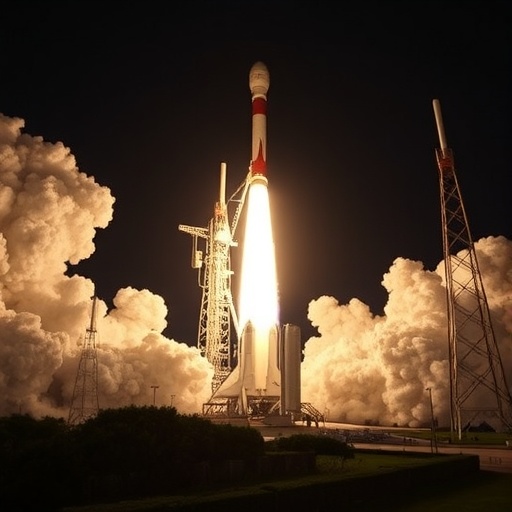
Since the dawn of the Space Age, the expense of sending mass into orbit has been a daunting barrier. In 1960, launching a single kilogram into orbit cost a staggering $87,000. Recent research now reveals that this figure has fallen dramatically, averaging less than $4,000 per kilogram today. More astonishingly, by 2040, this cost could shrink to a mere $300 per kilogram, thanks to rapid technological advancements and increasing operational experience.

A new study published in PNAS Nexus by Alessio Terzi and Francesco Nicoli offers an unprecedented analysis of over 4,400 orbital launches spanning six decades and multiple spacefaring nations. Their comprehensive dataset standardizes cost metrics to reveal a clear “experience curve” in space launch technology akin to learning curves observed in other high-tech sectors. For every doubling in cumulative payload sent into orbit, the cost per kilogram declines by approximately 21.2%, mirroring early-stage solar panel cost reductions.

This steep rate of cost reduction has profound implications for the future of space exploration and commercialization. If these trends continue, average launch costs could fall to around $1,600 per kilogram by 2030—bringing routine, economically viable access to Earth’s orbit within closer reach. The game changer in this trajectory could be SpaceX’s Starship. By leveraging full reusability and high flight cadence, Starship aims to push the cost per kilogram below the $1,000 threshold, potentially disrupting the entire launch market.

Nonetheless, realizing these reductions hinges on scaling up launch frequency significantly, something not without challenges. The study also highlights three critical factors that may slow or even reverse cost declines. The growing challenge of space debris increases risks and operational costs, complicating safe orbital access. Geopolitical fragmentation could fragment markets, with nations opting for independent launch capacities that reduce economies of scale. Additionally, heavy reliance on a single commercial western provider may introduce vulnerabilities to market disruption or policy changes.

Despite these headwinds, the trajectory toward cheaper orbital access appears robust and suggests an exciting era ahead for space-based industries. Lower launch costs could accelerate satellite deployment, space tourism, in-orbit services, and even lunar and Martian colonization efforts. This “learning curve” insight underscores the power of cumulative experience and innovation in driving down costs in one of humanity’s most complex and capital-intensive endeavors.

As launch providers refine reusable technologies and economies of scale grow, spaceflight may soon transform from an extraordinary technical feat into routine infrastructure. The era when orbiting a kilogram costs barely hundreds of dollars is on the horizon, fundamentally reshaping our relationship with space.

Subject of Research:
Article Title: From Sputnik to Starship: Estimating the experience curve of space launch technology
News Publication Date: 14-Jul-2026
Image Credits: Alessio Terzi

Keywords:
Space launch costs, technological learning curve, reusable rockets, SpaceX Starship, orbital payload economics, space debris, satellite deployment, space commercialization

Tags: cost per kilogram of space launchdeclining space launch expensesfuture of space exploration costsimpact of space launch cost declinelearning curve in space technologyorbital launch cost trendsrapid decrease in launch costsreusable rocket technologyspace commercialization economicsspace industry cost analysisspace launch cost reductiontechnological advancements in space launch
Share26Tweet16
Previous Post

Space launch costs may drop over 90% by 2040, revolutionizing space market

Next Post

Programmable Arene Ring Opening Enables Diverse Phenol Synthesis

Related Posts

Magnetic Fields and Colliding Ejecta in Precessing SS 433 Jets
Space

Magnetic Fields and Colliding Ejecta in Precessing SS 433 Jets

July 14, 2026
How Supermassive Black Holes Sustain Their Growth
Space

How Supermassive Black Holes Sustain Their Growth

July 14, 2026
Astronomers Discover Four Nearby White Dwarf Stars Hidden in Space
Space

Astronomers Discover Four Nearby White Dwarf Stars Hidden in Space

July 14, 2026
KAIST launches space sensors with fully electrically reconfigurable optical functions
Space

KAIST launches space sensors with fully electrically reconfigurable optical functions

July 14, 2026
Discovery of Sugar Molecules in Interstellar Space Revealed
Space

Discovery of Sugar Molecules in Interstellar Space Revealed

July 13, 2026
Multimessenger Universe Advances Frontier AI Training Techniques
Space

Multimessenger Universe Advances Frontier AI Training Techniques

July 10, 2026
Next Post
Programmable Arene Ring Opening Enables Diverse Phenol Synthesis

Programmable Arene Ring Opening Enables Diverse Phenol Synthesis

  • Mothers who receive childcare support from maternal grandparents show more

    Mothers who receive childcare support from maternal grandparents show more parental warmth, finds NTU Singapore study

    27656 shares
    Share 11059 Tweet 6912
  • University of Seville Breaks 120-Year-Old Mystery, Revises a Key Einstein Concept

    1061 shares
    Share 424 Tweet 265
  • Bee body mass, pathogens and local climate influence heat tolerance

    682 shares
    Share 273 Tweet 171
  • Researchers record first-ever images and data of a shark experiencing a boat strike

    546 shares
    Share 218 Tweet 137
  • Groundbreaking Clinical Trial Reveals Lubiprostone Enhances Kidney Function

    531 shares
    Share 212 Tweet 133
Science

Embark on a thrilling journey of discovery with Scienmag.com—your ultimate source for cutting-edge breakthroughs. Immerse yourself in a world where curiosity knows no limits and tomorrow’s possibilities become today’s reality!

RECENT NEWS

  • Iron’s Crucial Role in Shaping Major Upper Ocean Mesoplankton Size
  • Sensory Nerves Shape Neonatal Mouse Mouth for Suckling and Vocalization
  • Palliative Care Consultation Influences Neonatal End-of-Life Care Use
  • Word Choice Linked to Depression and Anxiety in 911 Dispatchers, Study Finds

Categories

  • Agriculture
  • Anthropology
  • Archaeology
  • Athmospheric
  • Biology
  • Biotechnology
  • Blog
  • Bussines
  • Cancer
  • Chemistry
  • Climate
  • Earth Science
  • Editorial Policy
  • Marine
  • Mathematics
  • Medicine
  • Pediatry
  • Policy
  • Psychology & Psychiatry
  • Science Education
  • Social Science
  • Space
  • Technology and Engineering

Subscribe to Blog via Email

Enter your email address to subscribe to this blog and receive notifications of new posts by email.

Join 5,146 other subscribers

© 2025 Scienmag - Science Magazine

Welcome Back!

Login to your account below

Forgotten Password?

Retrieve your password

Please enter your username or email address to reset your password.

Log In
No Result
View All Result
  • HOME
  • SCIENCE NEWS
  • CONTACT US

© 2025 Scienmag - Science Magazine

Discover more from Science

Subscribe now to keep reading and get access to the full archive.

Continue reading
