

Tuesday, July 14, 2026
Science
No Result
View All Result
  • Login
  • HOME
  • SCIENCE NEWS
  • CONTACT US
  • HOME
  • SCIENCE NEWS
  • CONTACT US
No Result
View All Result
Scienmag
No Result
View All Result
Home Science News Technology and Engineering

Space launch costs may drop over 90% by 2040, revolutionizing space market

July 14, 2026
in Technology and Engineering
Reading Time: 2 mins read
0
Space launch costs may drop over 90% by 2040, revolutionizing space market

Space launch costs may drop over 90% by 2040, revolutionizing space market

65
SHARES
587
VIEWS
Share on FacebookShare on Twitter
ADVERTISEMENT

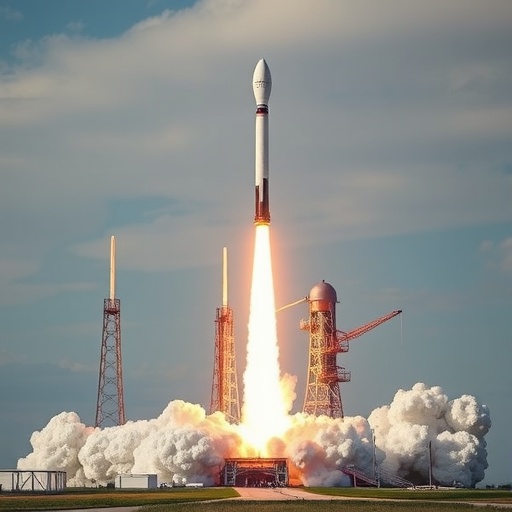
The cost of sending payloads into low Earth orbit is on the verge of a dramatic decline, set to revolutionize the economics of space travel within the next two decades. Recent research led by economists at the University of Cambridge forecasts that launch costs could fall by more than half by 2030 and plunge nearly 93% by 2040. This transformative drop could unlock a wide range of commercial and scientific space activities, from orbital manufacturing to space tourism.

Drawing on the most comprehensive dataset ever assembled — covering 4,405 launches from 1960 to 2025 with over 330 rocket configurations across major spacefaring nations — the study provides a detailed analysis of cost trajectories in space launch technology. Last year, the average cost to reach low Earth orbit stood at about $3,868 per kilogram. This is projected to fall to $1,569 per kilogram by 2030, and potentially as low as $273 per kilogram by 2040.

The underlying mechanism identified is an “experience curve” effect, whereby every doubling of the cumulative payload launches corresponds to a 21.2% reduction in cost per kilogram. This rate of cost decline outpaces even the historic improvements in steamship freight during the Industrial Revolution and rapidly advancing solar photovoltaic technology. The comparison underscores the vast potential for economies of scale and technological innovation in space launch markets.

Interestingly, the research also reveals how geopolitical and economic shifts have influenced launch costs. The Cold War era saw relatively stable prices, but the fall of the Berlin Wall in 1989 marked the start of faster cost reductions. Increased involvement from commercial entities, notably SpaceX—which now accounts for roughly 80% of global annual payload to orbit—has sharply accelerated this trend, altering the space economy from a government-driven sphere into a competitive, market-based frontier.

While declining launch costs hold enormous promise, the study also cautions about risks posed by monopolistic control and rising geopolitical competition. The dominance of a single launch provider could stifle price competition and delay broader industrial growth in orbit. Nonetheless, expanded capacity is expected to nearly double from 4,900 tonnes in 2025 to over 9,100 tonnes by 2030, with projections reaching 32,000 tonnes by 2040.

The implications are vast. Lower costs could enable in-orbit factories producing advanced fiber optics and bioprinted organs, off-planet solar power stations, asteroid mining ventures, and even permanent lunar bases. This technological and economic leap positions space colonization and externalization of polluting industries as feasible ventures within the coming decades. The study concludes that the era of space launch is entering a new phase, where economics, trade, and innovation drive exponential growth and open up unprecedented opportunities for humanity beyond Earth.


Subject of Research: Economics of space launch technology and cost trends
Article Title: From Sputnik to Starship: Estimating the experience curve of space launch technology
News Publication Date: 14-Jul-2026
Web References: http://dx.doi.org/10.1093/pnasnexus/pgag217
Image Credits: Dr Alessio Terzi

Keywords

space launch cost, low Earth orbit, space economy, experience curve, SpaceX, satellite launches, space commercialization, orbital manufacturing, space technology innovation

Tags: analysis of space launch cost datasetscommercial space activities growthcost trajectory of rocket launchesdeclining space launch costs forecastexperience curve in space technologyfuture of low Earth orbit accessimpact of lower space transportation expensesorbital manufacturing advancementsspace industry economic transformationspace launch cost reductionspace market revolution by 2040space tourism industry potential
Share26Tweet16
Previous Post

New Tick-Borne Viruses Evade Human Immune System Defense Mechanisms

Next Post

Space Launch Costs Drop 96% Over 65 Years, Could Fall More

Related Posts

Vacuum-Deposited Perovskite Solar Cells Enhanced by Controlled Crystallization
Technology and Engineering

Vacuum-Deposited Perovskite Solar Cells Enhanced by Controlled Crystallization

July 14, 2026
Europe advances integrated charging and energy systems for optimal V2G deployment
Technology and Engineering

Europe advances integrated charging and energy systems for optimal V2G deployment

July 14, 2026
Robot-Guided Surgery Advances Treatment of Complex Brain Abscesses
Technology and Engineering

Robot-Guided Surgery Advances Treatment of Complex Brain Abscesses

July 14, 2026
Engineering Principles Advance Battery Electrolyte Design for Better Performance
Technology and Engineering

Engineering Principles Advance Battery Electrolyte Design for Better Performance

July 14, 2026
Nonlinear Dynamics of Cube Net Cage in Jacket Foundation at Different Depths
Technology and Engineering

Nonlinear Dynamics of Cube Net Cage in Jacket Foundation at Different Depths

July 14, 2026
Flexible EV charging boosts cost efficiency in EU energy systems
Technology and Engineering

Flexible EV charging boosts cost efficiency in EU energy systems

July 14, 2026
Next Post
Space Launch Costs Drop 96% Over 65 Years, Could Fall More

Space Launch Costs Drop 96% Over 65 Years, Could Fall More

  • Mothers who receive childcare support from maternal grandparents show more

    Mothers who receive childcare support from maternal grandparents show more parental warmth, finds NTU Singapore study

    27656 shares
    Share 11059 Tweet 6912
  • University of Seville Breaks 120-Year-Old Mystery, Revises a Key Einstein Concept

    1061 shares
    Share 424 Tweet 265
  • Bee body mass, pathogens and local climate influence heat tolerance

    682 shares
    Share 273 Tweet 171
  • Researchers record first-ever images and data of a shark experiencing a boat strike

    546 shares
    Share 218 Tweet 137
  • Groundbreaking Clinical Trial Reveals Lubiprostone Enhances Kidney Function

    531 shares
    Share 212 Tweet 133
Science

Embark on a thrilling journey of discovery with Scienmag.com—your ultimate source for cutting-edge breakthroughs. Immerse yourself in a world where curiosity knows no limits and tomorrow’s possibilities become today’s reality!

RECENT NEWS

  • Iron’s Crucial Role in Shaping Major Upper Ocean Mesoplankton Size
  • Sensory Nerves Shape Neonatal Mouse Mouth for Suckling and Vocalization
  • Palliative Care Consultation Influences Neonatal End-of-Life Care Use
  • Word Choice Linked to Depression and Anxiety in 911 Dispatchers, Study Finds

Categories

  • Agriculture
  • Anthropology
  • Archaeology
  • Athmospheric
  • Biology
  • Biotechnology
  • Blog
  • Bussines
  • Cancer
  • Chemistry
  • Climate
  • Earth Science
  • Editorial Policy
  • Marine
  • Mathematics
  • Medicine
  • Pediatry
  • Policy
  • Psychology & Psychiatry
  • Science Education
  • Social Science
  • Space
  • Technology and Engineering

Subscribe to Blog via Email

Enter your email address to subscribe to this blog and receive notifications of new posts by email.

Join 5,146 other subscribers

© 2025 Scienmag - Science Magazine

Welcome Back!

Login to your account below

Forgotten Password?

Retrieve your password

Please enter your username or email address to reset your password.

Log In
No Result
View All Result
  • HOME
  • SCIENCE NEWS
  • CONTACT US

© 2025 Scienmag - Science Magazine

Discover more from Science

Subscribe now to keep reading and get access to the full archive.

Continue reading
