


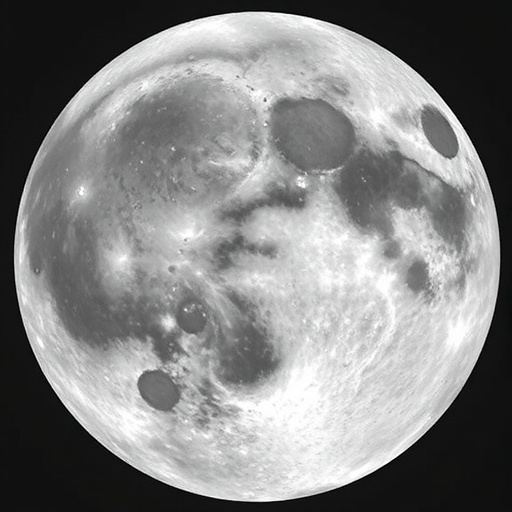
Planetary scientists from Brown University have produced a new global-style picture of how thick the Moon’s regolith—its blanket of loose dust and broken rock—tends to be across lunar terrain. The work focuses on the practical problem of where future missions will land, drill, walk, and potentially mine, because regolith thickness affects mobility, engineering risk, and access to more solid material beneath the surface.
To build their map, the team analyzed 346 relatively fresh, small impact craters scattered across the Moon. Fresh craters are especially valuable because their ejecta preserve clues about what lies underneath. When an impact excavates deeply enough to reach bedrock, the resulting boulders and debris behave differently on satellite images than ejecta produced when impacts remain within the regolith layer.
The researchers used established relationships between crater size and crater depth to translate observed crater geometry into a regional estimate of regolith thickness. They first distinguished crater sites that exposed bedrock from those that did not, then applied the diameter–depth scaling to infer how much material the impacts pierced on average.
The resulting pattern supports a long-standing expectation: ancient lunar highlands generally carry a thicker regolith than the younger, volcanic plains known as the maria. In quantitative terms, the team estimates an average of about six meters of regolith in the highlands and about four meters in the maria.
Beyond confirming broad trends, the study provides a dataset intended to be expanded. The authors released both mapping tools and data publicly, inviting other researchers to refine the map with additional observations and improved measurements. That collaborative approach is aimed at eventually achieving more detailed local resolution as new mission data arrives.
Regolith thickness also matters for science. Impacts are the main engine that continuously generates and reworks lunar surface material, and crater-by-crater constraints offer a way to test how the regolith evolved over time. By sampling fresh craters across varied terrains, the study adds structure to how scientists think the surface layer develops.
For mission planners, thinner regolith could simplify access to competent material for foundations, depending on how structures are built. Conversely, regolith can serve as a resource reservoir, potentially trapping volatiles such as water ice or solar-implanted species like helium-3.
The research was published in The Planetary Science Journal and supported by NASA funding under the Solar System Exploration Research Virtual Institute program.
Keywords
lunar regolith, impact craters, satellite mapping, crater scaling, lunar surface exploration
Cite Scienmag News
Grant Pearson. (July 14, 2026). Researchers Map Moon Regolith Thickness to Support Future Exploration Missions. Scienmag. https://scienmag.com/researchers-map-moon-regolith-thickness-to-support-future-exploration-missions/
Grant Pearson. "Researchers Map Moon Regolith Thickness to Support Future Exploration Missions." Scienmag, 14 July 2026, https://scienmag.com/researchers-map-moon-regolith-thickness-to-support-future-exploration-missions/. Accessed 4 September 2026.
Grant Pearson. "Researchers Map Moon Regolith Thickness to Support Future Exploration Missions." Scienmag. July 14, 2026. https://scienmag.com/researchers-map-moon-regolith-thickness-to-support-future-exploration-missions/


