

Thursday, September 3, 2026
Science
No Result
View All Result
  • Login
  • HOME
  • SCIENCE NEWS
  • CONTACT US
  • HOME
  • SCIENCE NEWS
  • CONTACT US
No Result
View All Result
Scienmag
No Result
View All Result
Home Science News Space

Faintest Earth-imaged planet found after decade-long cosmic search and pursuit

July 15, 2026
in Space
Grant Pearson
By Grant Pearson Scienmag Editorial Profile - Observational Astronomy
Reading Time: 2 mins read
0
Faintest Earth-imaged planet found after decade-long cosmic search and pursuit

Faintest Earth-imaged planet found after decade-long cosmic search and pursuit

65
SHARES
587
VIEWS
Share on FacebookShare on Twitter
ADVERTISEMENT

Astronomers have announced the discovery of a third exoplanet orbiting Beta Pictoris, a young nearby star that has become a benchmark for directly imaging worlds beyond our Solar System. The newly confirmed planet, named Beta Pictoris d, is extraordinarily faint compared with the star’s brighter companions, yet its presence can be inferred from the subtle signatures hidden in old observations.

The planet was first spotted using the European Southern Observatory’s Very Large Telescope (VLT). Researchers then noticed something unusual: instead of a fresh, isolated detection, Beta Pictoris d appeared to have been “there all along,” concealed by the glare of Beta Pictoris b, the first planet found in the system.

By reanalyzing archive data collected over more than a decade, the team confirmed that the planet appears in multiple images, including cases where it is only barely visible against the dominant light of its neighboring planet. This approach turned a time-consuming hunting effort into a retrospective revelation, highlighting the value of long-term astronomical archives.

What makes Beta Pictoris d especially notable is its brightness and mass. The planet is about 100 times fainter than Beta Pictoris b and, based on its infrared properties and color, appears to be a gas giant with roughly 2.4 times Jupiter’s mass. Despite being larger than Earth but far lighter than many directly imaged giants, it ranks among the lightest exoplanets ever captured from the ground.

The system’s geometry also helps interpret the observations. In the processed VLT image, the host star was subtracted to reveal a debris disc viewed edge-on—an extended ring of material left over from planetary formation. The planet’s mass and orbital location align with the disc’s particular structure, offering a physical clue that connects the planet to the system’s history.

Direct imaging is difficult because a planet’s light is dwarfed by its star’s brightness. Detecting a world as faint as Beta Pictoris d required both sensitive instrumentation and careful data processing to separate planetary signals from noise and glare.

An independent team reported the same planet using the James Webb Space Telescope (JWST), providing independent confirmation across facilities and observing platforms. Together, the results strengthen confidence in the detection and provide complementary constraints on the planet’s properties.

With Beta Pictoris now serving as a rare multi-planet directly imaged system, researchers can compare multiple worlds forming in the same environment—an opportunity that can refine models of how planets grow and evolve.

The discovery also suggests that more faint planets may be hiding in existing datasets, awaiting the right analysis strategy. Upcoming next-generation telescopes may be able to reveal additional low-mass companions that have so far remained invisible.


Keywords

Exoplanets; Beta Pictoris; direct imaging; VLT/ERIS; JWST; gas giant; archival data; debris disc

Subject of Research: Direct imaging of exoplanets in the Beta Pictoris system
Article Title: Discovery of Beta Pictoris d (third planet in the system)
News Publication Date: Not specified in the provided text
Web References: https://doi.org/10.3847/2041-8213/ae80a0
References: The Astrophysical Journal Letters (

Article Title: Faintest Earth-imaged planet found after decade-long cosmic search and pursuit

Article References: Original research article

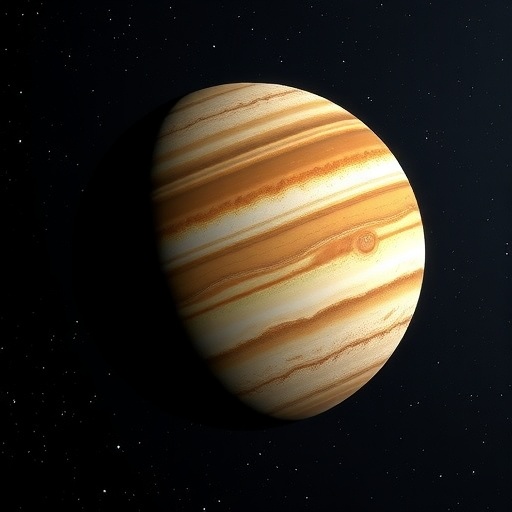
Image Credits: AI Generated

DOI: Not provided

Keywords: Beta Pictoris star system, celestial observation reanalysis, cosmic search for exoplanets, direct imaging techniques, directly imaged exoplanets, exoplanet discovery, faintest exoplanet detection, gas giant exoplanets, infrared properties of exoplanets, long-term astronomical archive analysis, planetary system evolution, VLT exoplanet imaging

Cite Scienmag News

Grant Pearson. (July 15, 2026). Faintest Earth-imaged planet found after decade-long cosmic search and pursuit. Scienmag. https://scienmag.com/faintest-earth-imaged-planet-found-after-decade-long-cosmic-search-and-pursuit/


Grant Pearson. "Faintest Earth-imaged planet found after decade-long cosmic search and pursuit." Scienmag, 15 July 2026, https://scienmag.com/faintest-earth-imaged-planet-found-after-decade-long-cosmic-search-and-pursuit/. Accessed 3 September 2026.

Grant Pearson. "Faintest Earth-imaged planet found after decade-long cosmic search and pursuit." Scienmag. July 15, 2026. https://scienmag.com/faintest-earth-imaged-planet-found-after-decade-long-cosmic-search-and-pursuit/

Tags: Beta Pictoris star systemcelestial observation reanalysiscosmic search for exoplanetsdirect imaging techniquesdirectly imaged exoplanetsexoplanet discoveryfaintest exoplanet detectiongas giant exoplanetsinfrared properties of exoplanetslong-term astronomical archive analysisplanetary system evolutionVLT exoplanet imaging
Share26Tweet16
Previous Post

Avocado Oil Chips Might Not Use Pure Avocado Oil

Next Post

Coral Metabolomes Reflect Human Land Use and Associated Contaminant Loads

Related Posts

Mercury’s crust formed by extreme volcanism
Space

Mercury’s crust formed by extreme volcanism

September 3, 2026
Warm inflation in a braneworld scenario
Space

Warm inflation in a braneworld scenario

September 3, 2026
Subauroral Flows and Arcs Rewrite the Rules of Space Electrodynamics
Space

Subauroral Flows and Arcs Rewrite the Rules of Space Electrodynamics

August 30, 2026
Early-type Be stars form via nonconservative mass transfer in close binaries
Space

Early-type Be stars form via nonconservative mass transfer in close binaries

August 30, 2026
Solar-Wind Density Fluctuations Mapped Worldwide via Scintillation Data, 2008–2022
Space

Solar-Wind Density Fluctuations Mapped Worldwide via Scintillation Data, 2008–2022

August 30, 2026
Downsampling speeds up likelihood approximations for simulated LISA data
Space

Downsampling speeds up likelihood approximations for simulated LISA data

August 30, 2026
Next Post
Coral Metabolomes Reflect Human Land Use and Associated Contaminant Loads

Coral Metabolomes Reflect Human Land Use and Associated Contaminant Loads

  • Mothers who receive childcare support from maternal grandparents show more optimized

    Mothers who receive childcare support from maternal grandparents show more parental warmth, finds NTU Singapore study

    27656 shares
    Share 11059 Tweet 6912
  • University of Seville Breaks 120-Year-Old Mystery, Revises a Key Einstein Concept

    1061 shares
    Share 424 Tweet 265
  • Bee body mass, pathogens and local climate influence heat tolerance

    682 shares
    Share 273 Tweet 171
  • Researchers record first-ever images and data of a shark experiencing a boat strike

    546 shares
    Share 218 Tweet 137
  • Groundbreaking Clinical Trial Reveals Lubiprostone Enhances Kidney Function

    531 shares
    Share 212 Tweet 133
Science

Embark on a thrilling journey of discovery with Scienmag.com—your ultimate source for cutting-edge breakthroughs. Immerse yourself in a world where curiosity knows no limits and tomorrow’s possibilities become today’s reality!

RECENT NEWS

  • Efficacy of venous coupler versus hand-sewn venous anastomosis in free-flap reconstruction: a single-centre randomized controlled trial
  • Gene family evolution and salivary gene expression track diet shifts in hemipterans
  • New Value-Chain Framework Reveals Where AI Creates and Destroys Public Value
  • Amodal completion enables 3D wheat reconstruction from a single image

Categories

  • Agriculture
  • Anthropology
  • Archaeology
  • Athmospheric
  • Biology
  • Biotechnology
  • Blog
  • Bussines
  • Cancer
  • Chemistry
  • Climate
  • Earth Science
  • Editorial Policy
  • Marine
  • Mathematics
  • Medicine
  • Pediatry
  • Policy
  • Psychology & Psychiatry
  • Science Education
  • Social Science
  • Space
  • Technology and Engineering

Subscribe to Blog via Email

Enter your email address to subscribe to this blog and receive notifications of new posts by email.

Join 5,151 other subscribers

© 2025 Scienmag - Science Magazine

Welcome Back!

Login to your account below

Forgotten Password?

Retrieve your password

Please enter your username or email address to reset your password.

Log In
No Result
View All Result
  • HOME
  • SCIENCE NEWS
  • CONTACT US

© 2025 Scienmag - Science Magazine

Discover more from Science

Subscribe now to keep reading and get access to the full archive.

Continue reading