


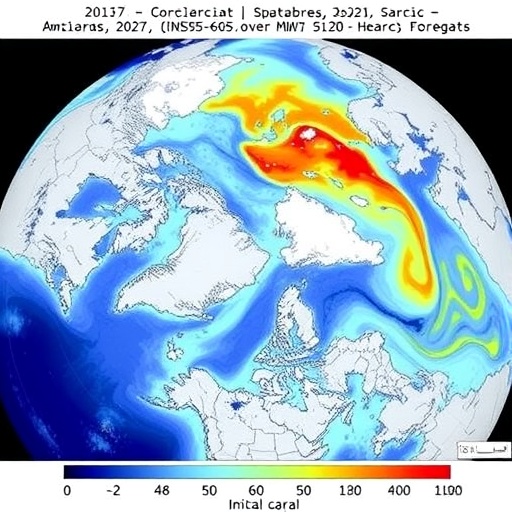
A groundbreaking study has unveiled a new level of accuracy in predicting Arctic sea ice changes over multiple years, focusing specifically on the Atlantic sector. This advancement promises to significantly enhance our understanding of the Arctic’s complex climate system and its connection to broader oceanic patterns, particularly the Atlantic Meridional Overturning Circulation (AMOC).
The research team, led by Li, Zhang, and Gu, employed state-of-the-art climate models combined with extensive observational data to develop a prediction system capable of skillfully forecasting sea ice conditions several years in advance. This is a notable departure from earlier models that struggled with reliable long-term Arctic ice projections due to the region’s intricate and variable climate dynamics.
Central to the study is the demonstrated link between the multiyear variations in Arctic sea ice extent and the AMOC—a large-scale ocean current system responsible for transporting warm water from the tropics toward the North Atlantic. The researchers found that fluctuations in AMOC intensity exert a pivotal influence on the volume and distribution of sea ice within the Atlantic sector of the Arctic, offering a predictive mechanism grounded in ocean circulation patterns.
The predictive skill achieved in this study appears to be driven by the persistence of oceanic conditions that modulate sea ice formation and melting processes. By capturing how variations in the AMOC influence heat transport into the Arctic Ocean, the model can simulate the resulting changes in sea ice cover with unprecedented confidence over multiyear timescales.
This advance has far-reaching implications for climate science and policy. Arctic sea ice plays a crucial role in regulating global climate systems by controlling albedo feedbacks and modulating atmospheric circulation. Enhanced predictive capabilities can inform navigation, ecosystem management, and strategies for mitigating climate change impacts at both regional and global scales.
The study also emphasizes the potential for coupling ocean and sea ice models to improve projection skill, highlighting the necessity of integrating diverse climate system components rather than treating sea ice as an isolated variable. Such integrated modeling frameworks mark a shift toward a more holistic approach in climate prediction science.
Looking ahead, the authors suggest that extending this methodology to other Arctic sectors could further refine our capability to anticipate changes in polar climates. Additionally, ongoing observational campaigns and satellite data will be vital to continuously validate and calibrate the models, ensuring their robustness as climate variability and change proceed.
This research represents a milestone in Arctic climate science, combining sophisticated modeling with a deep understanding of ocean-atmosphere interactions. As the Arctic continues to warm at an alarming rate, breakthroughs like these are critical for equipping humanity with the tools to anticipate and adapt to the rapidly evolving polar environment.
Li, Z., Zhang, L., Gu, Q. et al. Skillful multiyear prediction of Atlantic sector Arctic Sea ice and its link to AMOC variability.
Commun Earth Environ (2026). https://doi.org/10.1038/s43247-026-03811-6
Cite Scienmag News
Violet Maxwell. (July 14, 2026). Multiyear Arctic Sea Ice Forecast Linked to Atlantic Ocean Circulation Changes. Scienmag. https://scienmag.com/multiyear-arctic-sea-ice-forecast-linked-to-atlantic-ocean-circulation-changes/
Violet Maxwell. "Multiyear Arctic Sea Ice Forecast Linked to Atlantic Ocean Circulation Changes." Scienmag, 14 July 2026, https://scienmag.com/multiyear-arctic-sea-ice-forecast-linked-to-atlantic-ocean-circulation-changes/. Accessed 4 September 2026.
Violet Maxwell. "Multiyear Arctic Sea Ice Forecast Linked to Atlantic Ocean Circulation Changes." Scienmag. July 14, 2026. https://scienmag.com/multiyear-arctic-sea-ice-forecast-linked-to-atlantic-ocean-circulation-changes/


