

Tuesday, August 4, 2026
Science
No Result
View All Result
  • Login
  • HOME
  • SCIENCE NEWS
  • CONTACT US
  • HOME
  • SCIENCE NEWS
  • CONTACT US
No Result
View All Result
Scienmag
No Result
View All Result
Home Science News Technology and Engineering

Tri-layer substrates enable stress-free fabrication of stretchable integrated systems

July 14, 2026
in Technology and Engineering
Reading Time: 2 mins read
0
Tri-layer substrates enable stress-free fabrication of stretchable integrated systems

Tri-layer substrates enable stress-free fabrication of stretchable integrated systems

65
SHARES
587
VIEWS
Share on FacebookShare on Twitter
ADVERTISEMENT

In a groundbreaking advancement for wearable technology and flexible electronics, researchers have unveiled a novel graded-modulus tri-layer substrate designed to dramatically improve the fabrication of integrated stretchable systems. This innovation addresses one of the most persistent challenges in flexible electronics: managing mechanical stress during manufacturing while maintaining device performance.

Traditional substrates used for stretchable electronics often suffer from mechanical fatigue and failure due to the abrupt changes in stiffness between different materials. These mismatched mechanical properties induce stress concentrations, ultimately compromising the durability and reliability of the devices. The new tri-layer substrate offers a graded modulus design, where the elastic properties gradually transition across layers, effectively mitigating these stress points.

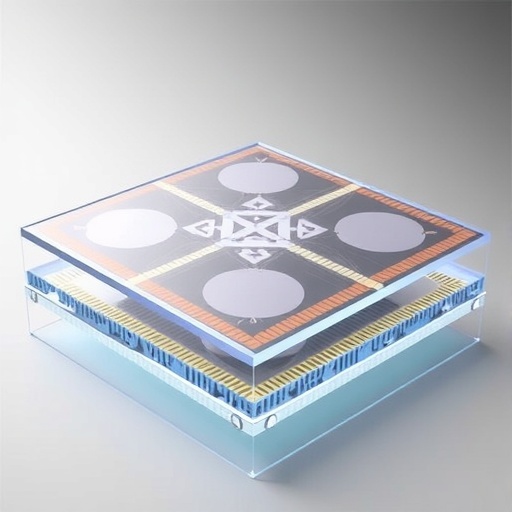
The research team achieved this by engineering a three-layered structure with progressively tuned stiffness—from a soft, compliant outer layer, through an intermediate gradient, to a stiffer base layer. This precise modulation in mechanical properties allows the substrate to absorb and distribute strain more evenly, reducing the risk of cracking or delamination during stretching cycles.

What distinguishes this work is the direct fabrication technique enabled by the graded-modulus substrate. Unlike conventional methods requiring complex transfer printing or additional protective layers, this substrate allows integrated circuits and components to be directly printed or deposited onto the stretchable platform. This simplification not only accelerates manufacturing but also enhances scalability for commercial applications.

Moreover, the graded substrate’s design is compatible with a broad spectrum of electronic materials, including conductive inks, semiconductors, and insulating polymers. This versatility paves the way for creating multifunctional integrated systems that can be robustly stretched, twisted, or bent without performance degradation—a critical advancement for next-generation flexible displays, bioelectronics, and soft robotics.

The tri-layer approach also shows promise in improving the longevity of wearable sensors, which must endure repeated mechanical deformation while maintaining consistent signal quality. By minimizing interfacial stress, the substrate prolongs device lifespan and reliability in real-world conditions, where durability is paramount.

From a materials science perspective, this work exemplifies how finely tuned mechanical gradients can unlock new design paradigms in flexible electronics. It highlights the importance of interdisciplinary approaches combining polymer chemistry, mechanical engineering, and microfabrication techniques to solve longstanding challenges.

As the wearable tech market continues its explosive growth, innovations like this graded-modulus substrate could be pivotal in bringing sophisticated, stretchable systems from the lab to everyday consumer use. This development not only elevates manufacturing efficiency but also enhances device robustness, potentially transforming how electronics interact with the human body and environment.

The study underscores a significant leap towards fully integrated, mechanically resilient flexible electronics, marking a major milestone in the future of human-machine interfaces and soft, implantable devices.


Subject of Research: Development of graded-modulus tri-layer substrates for integrated stretchable electronic systems fabrication.

Article Title: Graded-modulus tri-layer substrates for stress-relieved direct fabrication of integrated stretchable systems.

Article References:
Yamakoshi, S., Nakamura, F., Sato, S. et al. Graded-modulus tri-layer substrates for stress-relieved direct fabrication of integrated stretchable systems. npj Flex Electron (2026). https://doi.org/10.1038/s41528-026-00617-6

Image Credits: AI Generated

Tags: advanced manufacturing of flexible electronicscrack and delamination prevention in stretchable devicesdirect fabrication techniques for flexible electronicsdurable stretchable integrated systemsgraded modulus tri-layer materialsgradient stiffness design in flexible electronicsinnovation in wearable technology substrateslayered composite substrates for stretchabilitymechanical stress management in wearable devicesstrain distribution in multi-layer substratesstress-free fabrication of flexible electronicsstretchable electronic substrates
Share26Tweet16
Previous Post

Plant-Based Dressing Prevents Wound Infections Effectively

Next Post

New Catalysts Boost Sustainable Aviation Fuel Production from Butyl Butyrate

Related Posts

Naval leaders mark ONR anniversary, emphasizing personal impact over theory
Technology and Engineering

Naval leaders mark ONR anniversary, emphasizing personal impact over theory

August 4, 2026
Scientists map hydrology and drainage networks of South America’s atmospheric rivers
Technology and Engineering

Scientists map hydrology and drainage networks of South America’s atmospheric rivers

August 3, 2026
Georgia Tech to Lead National Cloud Lab for Advanced Manufacturing and Materials
Technology and Engineering

Georgia Tech to Lead National Cloud Lab for Advanced Manufacturing and Materials

August 3, 2026
Global Study Maps Mobile Network Vulnerability to Climate Hazards Using Open Data
Technology and Engineering

Global Study Maps Mobile Network Vulnerability to Climate Hazards Using Open Data

August 3, 2026
Targeting aryl hydrocarbon receptor signaling offers a promising strategy against necrotizing enterocolitis
Technology and Engineering

Targeting aryl hydrocarbon receptor signaling offers a promising strategy against necrotizing enterocolitis

August 3, 2026
AI measurements of local brain aging reveal new insights into dementia
Technology and Engineering

AI measurements of local brain aging reveal new insights into dementia

August 3, 2026
Next Post
New Catalysts Boost Sustainable Aviation Fuel Production from Butyl Butyrate

New Catalysts Boost Sustainable Aviation Fuel Production from Butyl Butyrate

  • Mothers who receive childcare support from maternal grandparents show more

    Mothers who receive childcare support from maternal grandparents show more parental warmth, finds NTU Singapore study

    27656 shares
    Share 11059 Tweet 6912
  • University of Seville Breaks 120-Year-Old Mystery, Revises a Key Einstein Concept

    1061 shares
    Share 424 Tweet 265
  • Bee body mass, pathogens and local climate influence heat tolerance

    682 shares
    Share 273 Tweet 171
  • Researchers record first-ever images and data of a shark experiencing a boat strike

    546 shares
    Share 218 Tweet 137
  • Groundbreaking Clinical Trial Reveals Lubiprostone Enhances Kidney Function

    531 shares
    Share 212 Tweet 133
Science

Embark on a thrilling journey of discovery with Scienmag.com—your ultimate source for cutting-edge breakthroughs. Immerse yourself in a world where curiosity knows no limits and tomorrow’s possibilities become today’s reality!

RECENT NEWS

  • Indigenous-led conservation efforts boost survival of endangered cockatoos
  • Naval leaders mark ONR anniversary, emphasizing personal impact over theory
  • Targeted therapy combinations may overcome treatment resistance in advanced prostate cancer
  • Scientists push the frontiers of ultracold neutral plasma research

Categories

  • Agriculture
  • Anthropology
  • Archaeology
  • Athmospheric
  • Biology
  • Biotechnology
  • Blog
  • Bussines
  • Cancer
  • Chemistry
  • Climate
  • Earth Science
  • Editorial Policy
  • Marine
  • Mathematics
  • Medicine
  • Pediatry
  • Policy
  • Psychology & Psychiatry
  • Science Education
  • Social Science
  • Space
  • Technology and Engineering

Subscribe to Blog via Email

Enter your email address to subscribe to this blog and receive notifications of new posts by email.

Join 5,147 other subscribers

© 2025 Scienmag - Science Magazine

Welcome Back!

Login to your account below

Forgotten Password?

Retrieve your password

Please enter your username or email address to reset your password.

Log In
No Result
View All Result
  • HOME
  • SCIENCE NEWS
  • CONTACT US

© 2025 Scienmag - Science Magazine

Discover more from Science

Subscribe now to keep reading and get access to the full archive.

Continue reading
