

Monday, July 13, 2026
Science
No Result
View All Result
  • Login
  • HOME
  • SCIENCE NEWS
  • CONTACT US
  • HOME
  • SCIENCE NEWS
  • CONTACT US
No Result
View All Result
Scienmag
No Result
View All Result
Home Science News Earth Science

Latitudinal Manganese Patterns Linked to Earth’s Major Ice Ages

July 13, 2026
in Earth Science
Reading Time: 2 mins read
0
Latitudinal Manganese Patterns Linked to Earth’s Major Ice Ages

Latitudinal Manganese Patterns Linked to Earth’s Major Ice Ages

65
SHARES
587
VIEWS
Share on FacebookShare on Twitter
ADVERTISEMENT

A groundbreaking study published in Nature Communications in 2026 is shedding new light on Earth’s climatic past by exploring the intricate relationship between manganese gradients and major ice ages. Researchers Wang, Pohl, Rickaby, and colleagues have uncovered how latitudinal fluctuations in manganese concentrations correlate with the planet’s profound glacial-interglacial cycles, offering a novel proxy for understanding ancient climate dynamics.

Manganese, a transition metal known for its sensitivity to redox conditions, serves as a critical geochemical indicator in marine sediments. It undergoes varying degrees of oxidation-reduction reactions depending on changes in ocean chemistry linked to environmental conditions. By analyzing sediment cores spanning multiple latitudes, the research team mapped shifts in manganese distribution that align closely with Earth’s historic ice age events.

Their approach involved high-resolution geochemical profiling across sediments deposited over millions of years, focusing on manganese content as a marker of oceanographic change. The study reveals that during glacial maxima, manganese accumulation patterns exhibit distinct latitudinal gradients, indicative of altered ocean circulation and oxygenation levels. In contrast, interglacial periods show a markedly different manganese signature, reflecting shifts in productivity and redox state.

These findings suggest manganese gradients are not only sensitive trackers of ice age-driven environmental transformations but also provide insights into the feedback mechanisms connecting ocean chemistry, climate shifts, and biogeochemical cycles. The team highlights that manganese’s redox chemistry makes it particularly effective for reconstructing past variations in ocean oxygen levels, which play a pivotal role in modulating marine ecosystems and carbon cycling.

Importantly, the research challenges previous assumptions that manganese variability was primarily governed by local sedimentation factors. Instead, the latitudinal consistency of these gradients points to large-scale climatic forcing shaping oceanic manganese distributions. This improved understanding aids in refining models that predict how marine geochemistry responds to global temperature changes and ice volume fluctuations.

Moreover, the study emphasizes how integrating metal geochemistry with paleoceanographic data sets enriches our comprehension of Earth’s climatic history. By coupling manganese data with isotopic and sedimentological records, the authors build a multi-faceted view of ice age dynamics, underscoring the interconnectedness of chemical, physical, and biological processes in the ocean.

This breakthrough paves the way for future research to harness manganese and similar trace elements as powerful proxies in climate reconstruction, offering refined timelines and mechanisms of glacial cycles. The potential applications extend beyond paleoclimate, informing contemporary assessments of ocean health in response to ongoing climate change.

As the planet faces unprecedented environmental shifts, understanding past ice age events through innovative geochemical markers like manganese gradients becomes crucial. This study not only enriches the scientific narrative of Earth’s climate system but also equips researchers with new tools to interrogate the ocean’s hidden archives and predict future transformations.


Subject of Research:
Latitudinal manganese gradient dynamics and their association with Earth’s major ice ages.

Article Title:
Latitudinal manganese gradient dynamics associated with Earth’s major ice ages.

Article References:
Wang, X., Pohl, A., Rickaby, R.E.M. et al. Latitudinal manganese gradient dynamics associated with Earth’s major ice ages. Nat Commun (2026). https://doi.org/10.1038/s41467-026-75597-2

Image Credits:
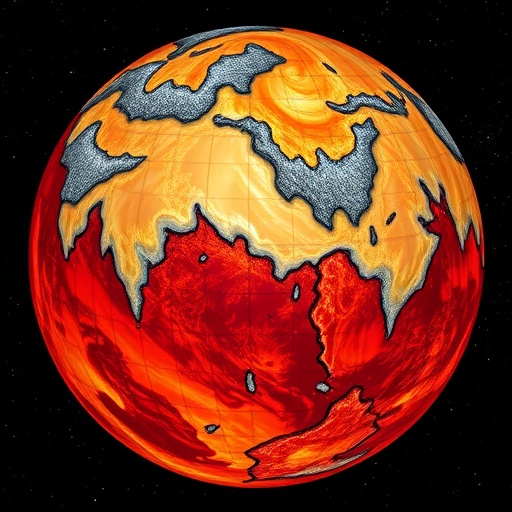
AI Generated

Tags: Earth's historical climate variabilityglacial maxima manganese patternsglacial-interglacial cyclesinterglacial period environmental shiftslatitudinal manganese distributionmanganese geochemical proxiesmarine sediment analysisocean circulation changesocean redox conditionspaleoclimate reconstructionredox-sensitive metal indicatorssediment core geochemistry
Share26Tweet16
Previous Post

Nrf2 Metabolic Shift Boosts Regulatory T Cells in Liver Cancer

Next Post

American Ornithological Society Grants Seven 2026 Kessel Research Fellowships

Related Posts

UH Mānoa Study Finds Hawaiian Hotspot Temperature Rising
Earth Science

UH Mānoa Study Finds Hawaiian Hotspot Temperature Rising

July 13, 2026
Vertebrate Paleontologists Call to Protect Fossils Before T. rex Auction
Earth Science

Vertebrate Paleontologists Call to Protect Fossils Before T. rex Auction

July 13, 2026
New AI Model Aids Water Management Amid Worsening National Drought
Earth Science

New AI Model Aids Water Management Amid Worsening National Drought

July 13, 2026
Human Activities Intensify Hydrometeorological Drought Across North Africa Over Time
Earth Science

Human Activities Intensify Hydrometeorological Drought Across North Africa Over Time

July 13, 2026
Indian Ocean Could Influence Mediterranean Climate Amid Super El Niño Event
Earth Science

Indian Ocean Could Influence Mediterranean Climate Amid Super El Niño Event

July 13, 2026
Urban Sulfate Aerosols Transported from Boundary Layer to Higher Altitudes
Earth Science

Urban Sulfate Aerosols Transported from Boundary Layer to Higher Altitudes

July 13, 2026
Next Post
American Ornithological Society Grants Seven 2026 Kessel Research Fellowships

American Ornithological Society Grants Seven 2026 Kessel Research Fellowships

  • Mothers who receive childcare support from maternal grandparents show more

    Mothers who receive childcare support from maternal grandparents show more parental warmth, finds NTU Singapore study

    27656 shares
    Share 11059 Tweet 6912
  • University of Seville Breaks 120-Year-Old Mystery, Revises a Key Einstein Concept

    1061 shares
    Share 424 Tweet 265
  • Bee body mass, pathogens and local climate influence heat tolerance

    682 shares
    Share 273 Tweet 171
  • Researchers record first-ever images and data of a shark experiencing a boat strike

    546 shares
    Share 218 Tweet 137
  • Groundbreaking Clinical Trial Reveals Lubiprostone Enhances Kidney Function

    531 shares
    Share 212 Tweet 133
Science

Embark on a thrilling journey of discovery with Scienmag.com—your ultimate source for cutting-edge breakthroughs. Immerse yourself in a world where curiosity knows no limits and tomorrow’s possibilities become today’s reality!

RECENT NEWS

  • CCNY Researchers Unveil Breakthrough in Quantum Materials Science
  • Groundbreaking Surgery Completed on Western Lowland Gorilla at San Diego Zoo
  • Study Links Rural-Urban Mortality Gap to Stress and Infrastructure Issues
  • UH Mānoa Study Finds Hawaiian Hotspot Temperature Rising

Categories

  • Agriculture
  • Anthropology
  • Archaeology
  • Athmospheric
  • Biology
  • Biotechnology
  • Blog
  • Bussines
  • Cancer
  • Chemistry
  • Climate
  • Earth Science
  • Editorial Policy
  • Marine
  • Mathematics
  • Medicine
  • Pediatry
  • Policy
  • Psychology & Psychiatry
  • Science Education
  • Social Science
  • Space
  • Technology and Engineering

Subscribe to Blog via Email

Enter your email address to subscribe to this blog and receive notifications of new posts by email.

Join 5,146 other subscribers

© 2025 Scienmag - Science Magazine

Welcome Back!

Login to your account below

Forgotten Password?

Retrieve your password

Please enter your username or email address to reset your password.

Log In
No Result
View All Result
  • HOME
  • SCIENCE NEWS
  • CONTACT US

© 2025 Scienmag - Science Magazine

Discover more from Science

Subscribe now to keep reading and get access to the full archive.

Continue reading
