

Monday, July 13, 2026
Science
No Result
View All Result
  • Login
  • HOME
  • SCIENCE NEWS
  • CONTACT US
  • HOME
  • SCIENCE NEWS
  • CONTACT US
No Result
View All Result
Scienmag
No Result
View All Result
Home Science News Space

Discovery of Sugar Molecules in Interstellar Space Revealed

July 13, 2026
in Space
Reading Time: 2 mins read
0
Discovery of Sugar Molecules in Interstellar Space Revealed

Discovery of Sugar Molecules in Interstellar Space Revealed

65
SHARES
587
VIEWS
Share on FacebookShare on Twitter
ADVERTISEMENT

Scientists Uncover First Interstellar Four-Carbon Sugar, Shedding Light on Origins of Life

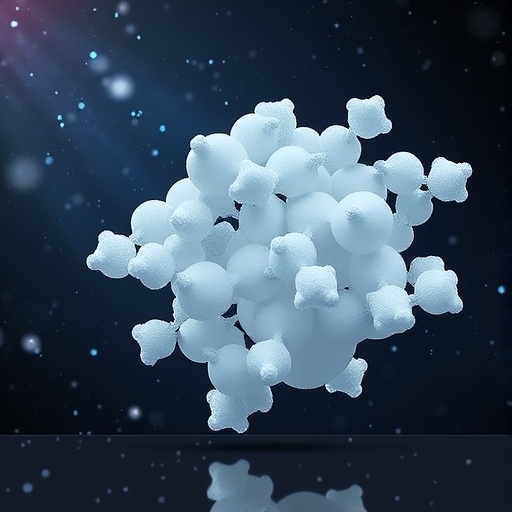
For decades, the elusive question of how life’s fundamental building blocks emerged has captivated scientists, particularly the genesis of sugars that form the backbone of DNA and RNA. While laboratory experiments have struggled to replicate prebiotic sugar synthesis on early Earth, recent space-based discoveries indicate these essential biomolecules may have extraterrestrial origins. Now, an international team led by researcher Izaskun Jiménez-Serra from the Centro de Astrobiología (CAB) has identified the first-ever four-carbon sugar, erythrulose, in interstellar space, marking a significant breakthrough in astrobiology.

Erythrulose, a ketose sugar commonly found in raspberries and some skin products on Earth, was detected in the molecular cloud G+0.693−0.027 near the Milky Way’s Galactic Center. Using ultra-sensitive, broadband spectroscopic data obtained from the 40-meter Yebes radio telescope in Spain and the 30-meter IRAM telescope in the French Alps, the team matched 12 distinct spectral lines to the laboratory spectrum of erythrulose recorded at the University of the Basque Country.

The discovery challenges prevailing astrochemical notions that larger interstellar molecules form primarily through the sequential addition of carbon atoms. Erythrulose’s abundance was found to be at least eight times greater than three-carbon sugars, none of which were detected in the same region. This unexpected finding hints at alternative chemical pathways for sugar formation in star-forming molecular clouds.

Collaborating with chemists from the University of Extremadura and Radboud University in the Netherlands, the researchers propose that erythrulose may form on interstellar ice grains through reactions involving simpler two-carbon alcohols and aldehydes. These ices act as chemical factories in space, facilitating the synthesis of complex organic molecules under cold, irradiated conditions.

Based on the measured concentrations, the team estimates that between 0.5 and 50 million tonnes of erythrulose could have been delivered to Earth’s surface during the Late Heavy Bombardment period approximately 4.1 to 3.8 billion years ago. This implies that interstellar sugar delivery may have contributed to the prebiotic chemical inventory necessary for the origin of metabolic and replication processes, laying the groundwork for life.

“This detection opens the exciting possibility of finding other critical sugars such as ribose, an integral component of RNA, in interstellar space,” says co-author Carlos Briones. The direct observation of sugars beyond our Solar System not only bridges gaps in understanding prebiotic chemistry but also strengthens the hypothesis that life’s molecular precursors are widespread throughout the cosmos.

This landmark study opens promising avenues for future astrochemical searches for biologically relevant molecules and deepens our grasp of how life might arise elsewhere in the universe. It underscores the importance of combining high-resolution astronomical observations with laboratory spectroscopy and chemistry to uncover the molecular complexity of space environments.

Subject of Research:
Article Title: Detection of a chiral four-carbon sugar in interstellar space
News Publication Date: 13-Jul-2026
Web References: http://dx.doi.org/10.1038/s41550-026-02905-7
Image Credits: Ashley Barnes / Izaskun Jiménez-Serra / Juan García de la Concepción

Keywords

Astrobiology, interstellar molecules, sugars, erythrulose, molecular clouds, Galactic Center, prebiotic chemistry, spectroscopic surveys, origin of life, astrochemistry

Tags: astrobiology discoveriesastrochemistry breakthroughsextraterrestrial origins of biomoleculesfour-carbon sugars in spaceimplications for origins of DNA and RNAinterstellar molecular cloudsinterstellar sugar moleculesmolecular cloud G+0.693−0.027origin of life in spaceprebiotic molecules in the galaxyrole of radio telescopes in space chemistryspectroscopic detection of amino sugars
Share26Tweet16
Previous Post

Hanyang University Develops Light-Powered Random Number Generator for Image Security

Next Post

Human Impact Shapes Urban Tree Species Diversity, Climate Influences Evolutionary Traits

Related Posts

Multimessenger Universe Advances Frontier AI Training Techniques
Space

Multimessenger Universe Advances Frontier AI Training Techniques

July 10, 2026
Isotopic Evidence Reveals Late Molecular Cloud Infall in Outer Solar System
Space

Isotopic Evidence Reveals Late Molecular Cloud Infall in Outer Solar System

July 10, 2026
Near-Earth Object Shows Comet-Like Non-Gravitational Acceleration
Space

Near-Earth Object Shows Comet-Like Non-Gravitational Acceleration

July 10, 2026
ASU Astronomers Uncover Cloud Effects on Common Exoplanet Interiors
Space

ASU Astronomers Uncover Cloud Effects on Common Exoplanet Interiors

July 9, 2026
Satellites Track Penguin Poo Color to Reveal Climate Change Impact
Space

Satellites Track Penguin Poo Color to Reveal Climate Change Impact

July 9, 2026
Uncovering the Mysterious Presence Within Orion’s Nebula Shell
Space

Uncovering the Mysterious Presence Within Orion’s Nebula Shell

July 9, 2026
Next Post
Human Impact Shapes Urban Tree Species Diversity, Climate Influences Evolutionary Traits

Human Impact Shapes Urban Tree Species Diversity, Climate Influences Evolutionary Traits

  • Mothers who receive childcare support from maternal grandparents show more

    Mothers who receive childcare support from maternal grandparents show more parental warmth, finds NTU Singapore study

    27656 shares
    Share 11059 Tweet 6912
  • University of Seville Breaks 120-Year-Old Mystery, Revises a Key Einstein Concept

    1061 shares
    Share 424 Tweet 265
  • Bee body mass, pathogens and local climate influence heat tolerance

    682 shares
    Share 273 Tweet 171
  • Researchers record first-ever images and data of a shark experiencing a boat strike

    546 shares
    Share 218 Tweet 137
  • Groundbreaking Clinical Trial Reveals Lubiprostone Enhances Kidney Function

    531 shares
    Share 212 Tweet 133
Science

Embark on a thrilling journey of discovery with Scienmag.com—your ultimate source for cutting-edge breakthroughs. Immerse yourself in a world where curiosity knows no limits and tomorrow’s possibilities become today’s reality!

RECENT NEWS

  • Researchers remotely achieve real-time autonomous control of nuclear reactor power
  • IU Study Links Obesity to Leukemia, Weight-Loss Drugs Could Halt It
  • CCNY Researchers Unveil Breakthrough in Quantum Materials Science
  • Groundbreaking Surgery Completed on Western Lowland Gorilla at San Diego Zoo

Categories

  • Agriculture
  • Anthropology
  • Archaeology
  • Athmospheric
  • Biology
  • Biotechnology
  • Blog
  • Bussines
  • Cancer
  • Chemistry
  • Climate
  • Earth Science
  • Editorial Policy
  • Marine
  • Mathematics
  • Medicine
  • Pediatry
  • Policy
  • Psychology & Psychiatry
  • Science Education
  • Social Science
  • Space
  • Technology and Engineering

Subscribe to Blog via Email

Enter your email address to subscribe to this blog and receive notifications of new posts by email.

Join 5,146 other subscribers

© 2025 Scienmag - Science Magazine

Welcome Back!

Login to your account below

Forgotten Password?

Retrieve your password

Please enter your username or email address to reset your password.

Log In
No Result
View All Result
  • HOME
  • SCIENCE NEWS
  • CONTACT US

© 2025 Scienmag - Science Magazine

Discover more from Science

Subscribe now to keep reading and get access to the full archive.

Continue reading
