

Tuesday, July 14, 2026
Science
No Result
View All Result
  • Login
  • HOME
  • SCIENCE NEWS
  • CONTACT US
  • HOME
  • SCIENCE NEWS
  • CONTACT US
No Result
View All Result
Scienmag
No Result
View All Result
Home Science News Technology and Engineering

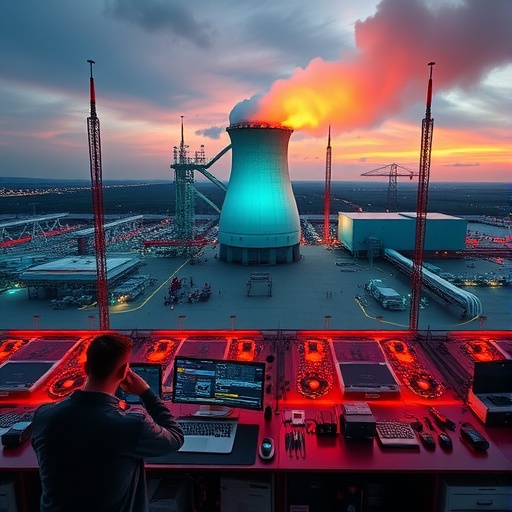
Researchers remotely achieve real-time autonomous control of nuclear reactor power

July 13, 2026
in Technology and Engineering
Reading Time: 2 mins read
0
Researchers remotely achieve real-time autonomous control of nuclear reactor power

Researchers remotely achieve real-time autonomous control of nuclear reactor power

65
SHARES
587
VIEWS
Share on FacebookShare on Twitter
ADVERTISEMENT

For the first time, a team of researchers from Idaho National Laboratory (INL), Purdue University, and the University of Illinois Urbana-Champaign has successfully demonstrated the remote, real-time autonomous control of a nuclear research reactor. Utilizing a geographically distributed system, the group adjusted the power of Purdue’s PUR1 reactor remotely, all while maintaining the reactor’s inherent safety protocols. This milestone represents a pivotal step toward integrating advanced computational models and artificial intelligence into nuclear reactor operation.

The experiment hinged on a digital control loop that automatically fine-tuned the power output of the PUR1 reactor. Researchers enhanced this loop by implementing a reinforcement learning algorithm that interacts with a sophisticated software model simulating the physical forces inside the reactor core. This setup integrated three distinct locations: high-performance computing resources at INL in Idaho, the PUR1 reactor in Indiana, and a Microsoft Azure cloud environment in Virginia, communicating seamlessly in real time.

“This advancement not only proves the feasibility of AI-assisted control in nuclear reactors but also ensures that intrinsic safety measures remain uncompromised,” explained Chris Ritter, director of INL’s Scientific Computing and AI division. The system computes and issues commands to move an auxiliary control rod, utilizing INL’s DeepLynx data and control platform linked with a digital twin of the PUR1 reactor. Notably, the entire process involved no manual rod manipulation onsite, highlighting the system’s robustness and reliability.

Stylianos Chatzidakis, assistant professor and associate reactor director at Purdue, emphasized how this new capability expands experimental possibilities and control system research at PUR1. Such collaborations between national labs and universities not only accelerate technology development but also prepare the next generation of nuclear engineers for emerging challenges.

Building on previous demonstrations of digital twins and secure communications, this achievement is supported by INL’s Laboratory Directed Research and Development program. The autonomous control system actively monitors conditions, predicts reactor behavior, and adjusts power output, all without overriding essential safety controls. This arrangement aligns with Nuclear Regulatory Commission guidelines, as it operates alongside the reactor’s safety systems, ensuring that safety remains paramount.

Industry leaders see this technology as transformative. Timothy Grunloh from the Illinois Nuclear Power Institute highlighted its potential to optimize how novel reactor designs integrate with broader energy infrastructure. Meanwhile, Microsoft’s commitment to harnessing AI for practical, sustainable energy solutions was underscored by Nelli Babayan, emphasizing the fusion of advanced computation and real-world applications.

This demonstration marks a significant stride toward the Department of Energy’s Genesis Mission, which aims to accelerate nuclear energy innovation through AI-driven design, licensing, manufacturing, and operation. By proving the viability of remote, autonomous nuclear reactor control, the team has set the stage for safer, more efficient energy generation that could reshape the future of nuclear power.

Subject of Research:
Article Title:
News Publication Date:
Web References: https://inlsoftware.inl.gov/product/deeplynx-nexus, https://www.purdue.edu/newsroom/2025/Q2/at-indianas-only-nuclear-reactor-engineers-conduct-the-first-experiments-of-their-kind-in-the-u-s/, https://inl.gov/feature-story/going-digital-idaho-students-engineers-demonstrate-first-nuclear-reactor-digital-twin/, https://inl.gov/ldrd/, https://www.energy.gov/undersecretaryforscience/genesis-mission/genesis-mission
References:
Image Credits: Idaho National Laboratory

Keywords

remote nuclear reactor control, autonomous reactor operation, digital twin, reinforcement learning, high-performance computing, nuclear safety, AI in nuclear energy, Idaho National Laboratory, PUR1 reactor, Department of Energy Genesis Mission

Tags: advancement in nuclear reactor control systemsAI reinforcement learning in nuclear safetyAI-assisted control of research reactorsdigital twin and simulation models for nuclear safetydistributed cloud-based nuclear reactor managementintegration of high-performance computing and AI in nuclear energyreal-time digital control loop for reactorsRemote autonomous nuclear reactor controlremote operation of nuclear research reactorsremote reactor power adjustment technologysafety protocols in autonomous nuclear control systemsuse of Microsoft Azure for nuclear reactor simulation
Share26Tweet16
Previous Post

IU Study Links Obesity to Leukemia, Weight-Loss Drugs Could Halt It

Next Post

Beginner’s Guide to Fast Neutron Detection Using EJ-309 Detector

Related Posts

KAIST Advances Development of Microbial Cell Factories
Technology and Engineering

KAIST Advances Development of Microbial Cell Factories

July 14, 2026
Soil Nitrogen Controls Biochar’s Effect on Carbon Storage, Study Shows
Technology and Engineering

Soil Nitrogen Controls Biochar’s Effect on Carbon Storage, Study Shows

July 13, 2026
WVU engineers create AI to accelerate wildfire satellite tracking
Technology and Engineering

WVU engineers create AI to accelerate wildfire satellite tracking

July 13, 2026
Screen Use to Calm Children: Benefits and Risks Explored
Technology and Engineering

Screen Use to Calm Children: Benefits and Risks Explored

July 13, 2026
New electrochemical device captures CO2 from air to fight climate change
Technology and Engineering

New electrochemical device captures CO2 from air to fight climate change

July 13, 2026
Hanyang University Develops Light-Powered Random Number Generator for Image Security
Technology and Engineering

Hanyang University Develops Light-Powered Random Number Generator for Image Security

July 13, 2026
Next Post
Beginner’s Guide to Fast Neutron Detection Using EJ-309 Detector

Beginner's Guide to Fast Neutron Detection Using EJ-309 Detector

  • Mothers who receive childcare support from maternal grandparents show more

    Mothers who receive childcare support from maternal grandparents show more parental warmth, finds NTU Singapore study

    27656 shares
    Share 11059 Tweet 6912
  • University of Seville Breaks 120-Year-Old Mystery, Revises a Key Einstein Concept

    1061 shares
    Share 424 Tweet 265
  • Bee body mass, pathogens and local climate influence heat tolerance

    682 shares
    Share 273 Tweet 171
  • Researchers record first-ever images and data of a shark experiencing a boat strike

    546 shares
    Share 218 Tweet 137
  • Groundbreaking Clinical Trial Reveals Lubiprostone Enhances Kidney Function

    531 shares
    Share 212 Tweet 133
Science

Embark on a thrilling journey of discovery with Scienmag.com—your ultimate source for cutting-edge breakthroughs. Immerse yourself in a world where curiosity knows no limits and tomorrow’s possibilities become today’s reality!

RECENT NEWS

  • KAIST launches space sensors with fully electrically reconfigurable optical functions
  • KAIST Advances Development of Microbial Cell Factories
  • SPOP Double-Donut Structure Reveals Cause of Cancer Mutations
  • Scientists reverse “silly sprinklers” to solve decades-old physics mystery

Categories

  • Agriculture
  • Anthropology
  • Archaeology
  • Athmospheric
  • Biology
  • Biotechnology
  • Blog
  • Bussines
  • Cancer
  • Chemistry
  • Climate
  • Earth Science
  • Editorial Policy
  • Marine
  • Mathematics
  • Medicine
  • Pediatry
  • Policy
  • Psychology & Psychiatry
  • Science Education
  • Social Science
  • Space
  • Technology and Engineering

Subscribe to Blog via Email

Enter your email address to subscribe to this blog and receive notifications of new posts by email.

Join 5,146 other subscribers

© 2025 Scienmag - Science Magazine

Welcome Back!

Login to your account below

Forgotten Password?

Retrieve your password

Please enter your username or email address to reset your password.

Log In
No Result
View All Result
  • HOME
  • SCIENCE NEWS
  • CONTACT US

© 2025 Scienmag - Science Magazine

Discover more from Science

Subscribe now to keep reading and get access to the full archive.

Continue reading
