


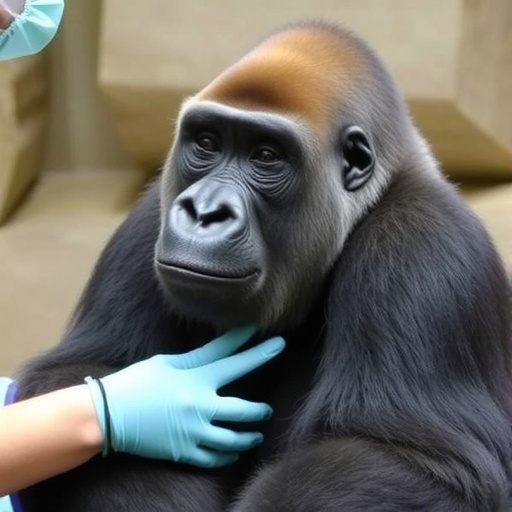
In a groundbreaking veterinary surgery, Mizani, a 12-year-old male western lowland gorilla housed at the San Diego Zoo Safari Park, underwent the world’s first reported mastoidectomy performed on a gorilla to treat a severe skull infection. The procedure was a collaboration between wildlife health specialists and human surgeons from UC San Diego Health, showcasing an innovative convergence of veterinary and human medical expertise.
Mizani’s condition was first suspected in March 2026 when caretakers observed symptoms including reluctance to fully open his mouth, reduced appetite, and behaviors indicative of head pain, such as holding his head and squinting. Diagnostic CT imaging revealed sinusitis compounded by mastoiditis—an infection of the mastoid bone located behind the ear. The infection had progressed deeply into cranial bone structures, posing a grave health risk.
Otolarngologist Dr. Jeffrey Harris and resident fellow Dr. Kris Suresh brought essential human surgical skills to this complex case, adapting intricate mastoidectomy techniques typically reserved for humans. Although human and gorilla cranial anatomies share notable similarities, variations required meticulous preoperative planning and intraoperative adjustments. The absence of any prior documented cases meant that the team had no established protocols to follow.
The operation involved a lateral incision on Mizani’s head, granting access to the infected mastoid region. Surgeons carefully excised necrotic bone and infected tissue, while preserving critical neurovascular structures. The delicate microsurgery lasted approximately five hours, with a multidisciplinary team of over 20 veterinarians, physicians, and support staff ensuring successful anesthesia, surgical precision, and post-operative care.
Mastoidectomy, a procedure designed to eradicate deep-seated infections within the temporal bone, is standard in human otolaryngology but had never before been adapted for primates in zoological medicine. This pioneering case underscores the potential for translational medicine—the application of human medical advances to animal health—particularly for species with close anatomical parallels.
Postoperative monitoring indicated significant clinical improvement. Mizani exhibited restored appetite and normal behavior, with no signs of residual infection or surgical complications at his most recent checkup in early June 2026. He has since been reintegrated with his troop, returning to typical physical activity and diet. Scheduled follow-up exams will continue to ensure sustained recovery.
This historic surgery reflects the ongoing commitment of the San Diego Zoo Wildlife Alliance’s Harter Veterinary Medical Center to innovation in wildlife health care. Since its opening in 2001, the center has provided expert treatment to tens of thousands of animals and remains at the forefront of complex veterinary interventions.
Dr. Ryan Sadler, senior veterinarian at the Safari Park, emphasized the rarity of mastoiditis in gorillas and the exceptional educational value of the case. The partnership between human and veterinary medicine exemplifies a growing interdisciplinary approach to treating diseases normally confined to one species but manifesting across biological boundaries.
Mizani’s successful surgery not only saves a valued member of the western lowland gorilla population but also expands the horizons of veterinary surgery, offering new hope for managing intricate cranial infections in non-human primates and other wildlife.
Cite Scienmag News
Ophelia Keating. (July 13, 2026). Groundbreaking Surgery Completed on Western Lowland Gorilla at San Diego Zoo. Scienmag. https://scienmag.com/groundbreaking-surgery-completed-on-western-lowland-gorilla-at-san-diego-zoo/
Ophelia Keating. "Groundbreaking Surgery Completed on Western Lowland Gorilla at San Diego Zoo." Scienmag, 13 July 2026, https://scienmag.com/groundbreaking-surgery-completed-on-western-lowland-gorilla-at-san-diego-zoo/. Accessed 3 September 2026.
Ophelia Keating. "Groundbreaking Surgery Completed on Western Lowland Gorilla at San Diego Zoo." Scienmag. July 13, 2026. https://scienmag.com/groundbreaking-surgery-completed-on-western-lowland-gorilla-at-san-diego-zoo/


