


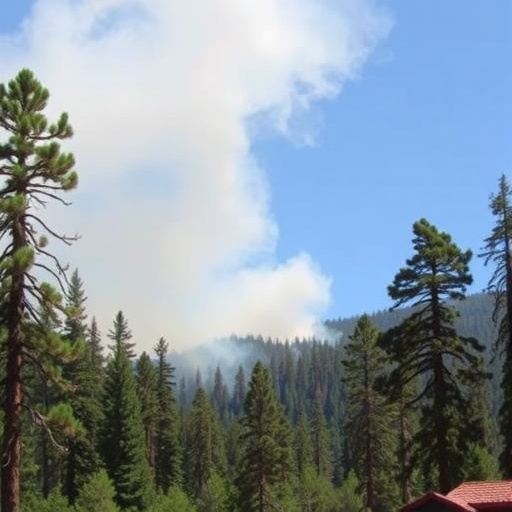
Ancient sequoias, iconic giants of the forest, have long captivated scientists and nature lovers alike with their majestic presence and remarkable resilience. However, recent decades have seen increasingly severe wildfires pose an unprecedented threat to these ancient trees. A groundbreaking study published in Nature Communications reveals that a strategic approach—prescribed burning—has been crucial in protecting thousands of these towering sequoias during some of the most destructive wildfire seasons on record.
Prescribed burning, also known as controlled burning, involves deliberately igniting small, manageable fires under carefully monitored conditions. This practice reduces excess underbrush and accumulated dead organic matter, which otherwise fuel larger, uncontrollable wildfires. Dixon, Das, Dong, and colleagues analyzed wildfire impacts during historically severe fire events, comparing areas subjected to previous prescribed burns with untreated regions.
The research demonstrates that areas where prescribed burns were previously conducted exhibited dramatically higher survival rates for ancient sequoias. By thinning combustible vegetation and lowering fire intensity, prescribed fires effectively create a protective buffer around these trees, which, despite their fire-adapted features like thick bark, are vulnerable when wildfires escalate beyond natural intensity. The study utilized satellite imagery, on-the-ground surveys, and fire behavior modeling to quantify the differences in tree mortality.
One key insight from the study is the role of fire regimes that mimic natural fire cycles. Historically, sequoia groves experienced frequent, low-intensity fires that cleared out undergrowth, maintaining an ecosystem balance. However, fire suppression policies in the 20th century disrupted this cycle, leading to dense fuel loads and ultimately intensifying wildfires. Prescribed burns aim to restore this balance, reducing the likelihood of catastrophic fires.
The findings also highlight the urgency of adopting prescribed burning as a forest management tool amid escalating climate change impacts. Rising temperatures and prolonged dry spells have increased wildfire frequency and severity, threatening not only sequoias but entire forest ecosystems. By strategically applying controlled burns, forest managers can safeguard ancient trees, protect biodiversity, and reduce carbon emissions from uncontrollable fires.
Furthermore, the interdisciplinary approach employed in this study integrates ecological data with advanced fire modeling, providing a comprehensive framework for wildfire mitigation. The research underscores that proactive land management must be prioritized to preserve these natural monuments for future generations.
While prescribed burning carries inherent risks, the study emphasizes rigorous planning and monitoring to ensure safety and maximize ecological benefits. This nuanced perspective challenges prior hesitations about controlled fires and offers a science-based path forward to mitigate one of the greatest challenges facing forest conservation today.
In summary, the work by Dixon and colleagues presents compelling evidence that prescribed burns are a vital defense against the unprecedented wildfire threats posed to ancient sequoias. Their research not only informs forest management practices but also serves as a rallying call for implementing evidence-based strategies in the face of growing wildfire crises globally.
Cite Scienmag News
Violet Maxwell. (July 13, 2026). Past Prescribed Burns Protected Thousands of Ancient Sequoias in Record Wildfires. Scienmag. https://scienmag.com/past-prescribed-burns-protected-thousands-of-ancient-sequoias-in-record-wildfires/
Violet Maxwell. "Past Prescribed Burns Protected Thousands of Ancient Sequoias in Record Wildfires." Scienmag, 13 July 2026, https://scienmag.com/past-prescribed-burns-protected-thousands-of-ancient-sequoias-in-record-wildfires/. Accessed 4 September 2026.
Violet Maxwell. "Past Prescribed Burns Protected Thousands of Ancient Sequoias in Record Wildfires." Scienmag. July 13, 2026. https://scienmag.com/past-prescribed-burns-protected-thousands-of-ancient-sequoias-in-record-wildfires/


