


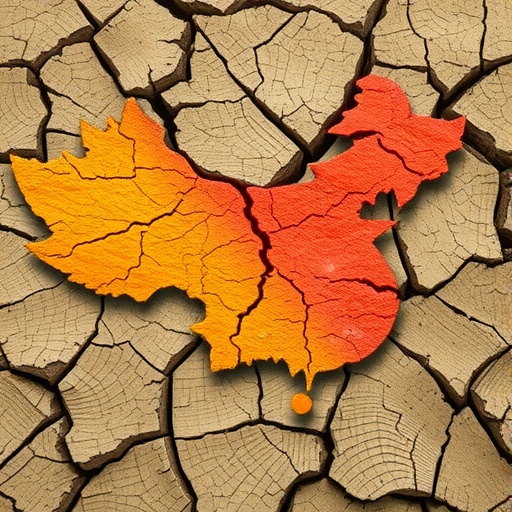
In a groundbreaking study set to reshape our understanding of soil dynamics under the pressures of climate change, researchers Wang, Tang, Zeng, and colleagues have identified key drivers behind the alarming increase in soil cracking risk across China. Published in Communications Earth & Environment, this work presents some of the first comprehensive projections of soil stability threats over the coming decades, signaling potential widespread impacts on agriculture, infrastructure, and ecosystems.
Soil cracking, a phenomenon where drying soil forms extensive fissures, significantly alters water retention, root growth, and nutrient cycling. The team’s multifaceted analysis reveals that the dominant factors accelerating this risk are not uniformly distributed but are instead influenced by a complex interplay of climatic variables, land use, and soil type heterogeneity. Rising temperatures and more erratic precipitation patterns emerge as central contributors, intensifying drying cycles and thus increasing the likelihood of severe soil desiccation.
Employing high-resolution climate data and sophisticated soil moisture modeling, the study integrates projections from multiple global climate models to forecast soil cracking tendencies with remarkable spatial granularity. Their results indicate that northern and western regions of China are particularly vulnerable due to their arid and semi-arid climates, where even marginal shifts in rainfall can dramatically amplify soil drying processes.
Beyond climate alone, human activities such as expansive agricultural practices and urbanization exacerbate these natural trends. Soil compaction, irrigation management, and vegetation loss create feedback loops heightening susceptibility to cracking. The team highlights that these anthropogenic pressures could suppress soil resilience, effectively lowering the threshold at which cracking occurs under stress.
Technically, the study advances previous methodologies by incorporating not only static soil properties but dynamic environmental interactions, including evapotranspiration rates and soil organic matter content fluctuations. This holistic approach provides a more accurate risk landscape, revealing hotspots previously underrecognized in risk assessments.
The implications are vast. Increased soil cracking jeopardizes crop yields by restricting root systems and altering nutrient availability, posing food security concerns in a country where millions depend on fragile agricultural systems. Infrastructure resting on these soils may face heightened risks of subsidence and damage, necessitating adaptive engineering solutions. Additionally, ecosystem functions such as carbon storage and water regulation could be impaired, influencing broader environmental stability.
While the projections remain inherently uncertain given the variability of climate trajectories and human responses, the study’s robust framework offers a crucial tool for policymakers and land managers. Early detection of high-risk areas and targeted interventions can mitigate some of the looming consequences.
Ultimately, this research underscores the urgent need to integrate soil health considerations into climate adaptation strategies. As environmental conditions evolve, protecting the foundation beneath our feet may prove as critical as addressing atmospheric changes themselves.
Cite Scienmag News
Violet Maxwell. (July 13, 2026). Key Factors Driving Soil Cracking Risk Rising Across China. Scienmag. https://scienmag.com/key-factors-driving-soil-cracking-risk-rising-across-china/
Violet Maxwell. "Key Factors Driving Soil Cracking Risk Rising Across China." Scienmag, 13 July 2026, https://scienmag.com/key-factors-driving-soil-cracking-risk-rising-across-china/. Accessed 5 September 2026.
Violet Maxwell. "Key Factors Driving Soil Cracking Risk Rising Across China." Scienmag. July 13, 2026. https://scienmag.com/key-factors-driving-soil-cracking-risk-rising-across-china/


