

Saturday, July 11, 2026
Science
No Result
View All Result
  • Login
  • HOME
  • SCIENCE NEWS
  • CONTACT US
  • HOME
  • SCIENCE NEWS
  • CONTACT US
No Result
View All Result
Scienmag
No Result
View All Result
Home Science News Earth Science

Volcanism Alters Carbon Cycle and Oxygen Levels in Mesoproterozoic Era

July 11, 2026
in Earth Science
Reading Time: 2 mins read
0
Volcanism Alters Carbon Cycle and Oxygen Levels in Mesoproterozoic Era

Volcanism Alters Carbon Cycle and Oxygen Levels in Mesoproterozoic Era

65
SHARES
587
VIEWS
Share on FacebookShare on Twitter
ADVERTISEMENT

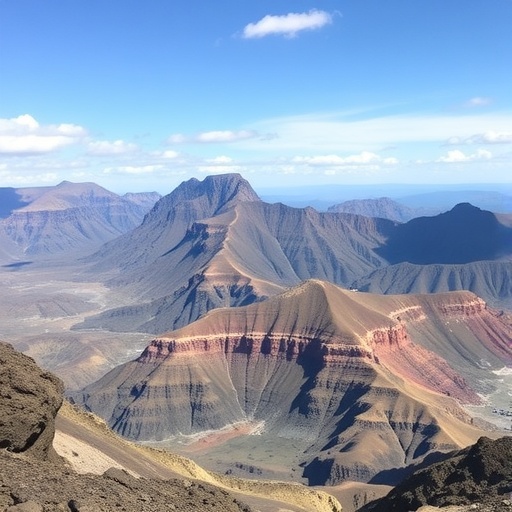
A groundbreaking new study reveals how volcanic activity instigated a profound shift in the Earth’s carbon cycle and oxygen levels during the Mesoproterozoic era, some 1.6 to 1 billion years ago. Published in Communications Earth & Environment, the research provides compelling evidence that ancient volcanism played a pivotal role in reshaping the planet’s atmospheric and oceanic chemistry, setting the stage for major evolutionary milestones.

By analyzing geochemical signatures embedded in sedimentary rock formations dating back to the Mesoproterozoic, researchers uncovered fluctuations in carbon isotopes that align closely with episodes of intense volcanic activity. These volcanic events released substantial quantities of greenhouse gases and nutrients into the environment, disturbing the long-term carbon cycle and triggering changes in oxygen production and distribution.

The Mesoproterozoic has often been regarded as a relatively stable period in Earth’s history, sandwiched between the Great Oxidation Event and the rise of complex multicellular life. However, this new evidence challenges that view, suggesting dynamic environmental shifts driven by geological forces were occurring beneath the surface. The influx of volcanic gases not only enriched the atmosphere with carbon dioxide but also altered ocean chemistry, potentially enhancing primary productivity.

One of the key findings is the link between volcanism and pulses in oxygen levels, which may have modulated the availability of oxygen in both the atmosphere and oceans. These oxygen fluctuations had profound implications for microbial ecosystems, including the early evolution of eukaryotes. The study proposes that volcanically induced shifts in redox conditions helped create ecological niches that fostered biological innovation.

Technically, the research team employed state-of-the-art isotopic analysis and sophisticated geochemical modeling to reconstruct the ancient interactions between volcanic emissions and biogeochemical cycles. Their approach allowed them to parse out subtle variations in the isotopic composition of carbon in carbonates and organic matter, revealing patterns consistent with episodic volcanic forcing.

This revelation sheds new light on the interplay between Earth’s interior geological processes and surface environmental conditions. The findings imply that internal Earth dynamics, such as tectonic activity, could exert significant control over global biogeochemical cycles far beyond what was previously appreciated.

As the field pushes forward, this research opens pathways for reevaluating other intervals in Earth’s deep history where volcanism might have been a critical driver of environmental and evolutionary change. Understanding how ancient carbon and oxygen cycles responded to volcanic perturbations is crucial for decoding the complex feedbacks that govern Earth’s habitability over geological time scales.

In sum, the study reshapes our understanding of the Mesoproterozoic era by highlighting the central role of volcanism in steering the carbon cycle and oxygen dynamics, laying groundwork for the eventual rise of complex lifeforms. It underscores the intricate connections between volcanic activity and life on Earth, providing a fresh perspective on the forces that shaped our planet’s early environment.


Subject of Research: Volcanism’s impact on Earth’s Mesoproterozoic carbon cycle and oxygen dynamics

Article Title: Volcanism driven shift in the Mesoproterozoic carbon cycle and oxygen dynamics

Article References:

Jiang, Z., Cai, C., Dou, L. et al. Volcanism driven shift in the Mesoproterozoic carbon cycle and oxygen dynamics.
Commun Earth Environ (2026). https://doi.org/10.1038/s43247-026-03798-0

Image Credits: AI Generated

DOI: 10.1038/s43247-026-03798-0

Tags: carbon cycle disruptionEarth's early atmospheric evolutionfluctuations in carbon isotopesgeochemical evidence for ancient volcanic activitygeochemical signatures in sedimentary rocksimpact of volcanic gases on ancient atmosphereimplications for understanding Precambrian environmental shiftsinfluence of volcanic nutrients on primary productivityMesoproterozoic volcanic activityocean chemistry alterations during Mesoproterozoicrelation between volcanic events and major evolutionary milestonesrole of volcanism in oxygen level changes
Share26Tweet16
Previous Post

Wild Carnivores in Netherlands Reveal West Nile and Usutu Virus Infection

Next Post

Glycocholic Acid Accelerates Colitis by Suppressing Intestinal Stem Cells

Related Posts

Widespread Nitrous Oxide Undersaturation Found in U.S. Lakes This Summer
Earth Science

Widespread Nitrous Oxide Undersaturation Found in U.S. Lakes This Summer

July 11, 2026
Agroforestry Shapes Flower Visitor Behavior Boosting Cocoa Production
Earth Science

Agroforestry Shapes Flower Visitor Behavior Boosting Cocoa Production

July 11, 2026
Microbial Communities Reveal Genomic Potential in TNT-Contaminated Submarine Sediments
Earth Science

Microbial Communities Reveal Genomic Potential in TNT-Contaminated Submarine Sediments

July 11, 2026
Overview of Public Soil Moisture Data and the UB-SMDC Portal
Earth Science

Overview of Public Soil Moisture Data and the UB-SMDC Portal

July 10, 2026
Iron oxide melts transform structurally under Earth’s outer-core pressures
Earth Science

Iron oxide melts transform structurally under Earth’s outer-core pressures

July 10, 2026
Indian Slab Underthrusting Drives Exhumation Differences in Tibet Regions
Earth Science

Indian Slab Underthrusting Drives Exhumation Differences in Tibet Regions

July 10, 2026
Next Post
Glycocholic Acid Accelerates Colitis by Suppressing Intestinal Stem Cells

Glycocholic Acid Accelerates Colitis by Suppressing Intestinal Stem Cells

  • Mothers who receive childcare support from maternal grandparents show more

    Mothers who receive childcare support from maternal grandparents show more parental warmth, finds NTU Singapore study

    27656 shares
    Share 11059 Tweet 6912
  • University of Seville Breaks 120-Year-Old Mystery, Revises a Key Einstein Concept

    1061 shares
    Share 424 Tweet 265
  • Bee body mass, pathogens and local climate influence heat tolerance

    682 shares
    Share 273 Tweet 171
  • Researchers record first-ever images and data of a shark experiencing a boat strike

    546 shares
    Share 218 Tweet 137
  • Groundbreaking Clinical Trial Reveals Lubiprostone Enhances Kidney Function

    531 shares
    Share 212 Tweet 133
Science

Embark on a thrilling journey of discovery with Scienmag.com—your ultimate source for cutting-edge breakthroughs. Immerse yourself in a world where curiosity knows no limits and tomorrow’s possibilities become today’s reality!

RECENT NEWS

  • Brain Connectivity Shifts in OCD After Exposure and Response Therapy
  • Glycocholic Acid Accelerates Colitis by Suppressing Intestinal Stem Cells
  • Volcanism Alters Carbon Cycle and Oxygen Levels in Mesoproterozoic Era
  • Wild Carnivores in Netherlands Reveal West Nile and Usutu Virus Infection

Categories

  • Agriculture
  • Anthropology
  • Archaeology
  • Athmospheric
  • Biology
  • Biotechnology
  • Blog
  • Bussines
  • Cancer
  • Chemistry
  • Climate
  • Earth Science
  • Editorial Policy
  • Marine
  • Mathematics
  • Medicine
  • Pediatry
  • Policy
  • Psychology & Psychiatry
  • Science Education
  • Social Science
  • Space
  • Technology and Engineering

Subscribe to Blog via Email

Enter your email address to subscribe to this blog and receive notifications of new posts by email.

Join 5,146 other subscribers

© 2025 Scienmag - Science Magazine

Welcome Back!

Login to your account below

Forgotten Password?

Retrieve your password

Please enter your username or email address to reset your password.

Log In
No Result
View All Result
  • HOME
  • SCIENCE NEWS
  • CONTACT US

© 2025 Scienmag - Science Magazine

Discover more from Science

Subscribe now to keep reading and get access to the full archive.

Continue reading
