


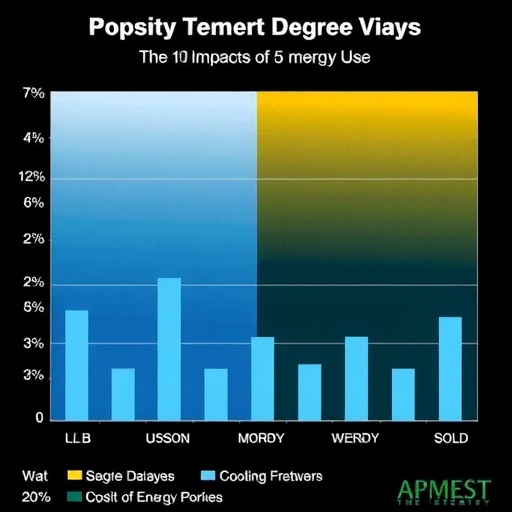
A groundbreaking study published in Nature Communications introduces a novel metric that reshapes our understanding of how climate variables influence energy consumption. Researchers Casselman and Karamperidou have developed the “efficiency-weighted cooling degree days” (EWCDD), a refined index that integrates both temperature and humidity factors to more accurately predict energy demand related to cooling systems.
Traditional cooling degree days (CDD) have long been used as a proxy to estimate energy usage for cooling based solely on ambient temperature. However, this approach overlooks the significant role that humidity plays in human thermal comfort and consequently on the activation and efficiency of cooling appliances. The new EWCDD metric accounts for the dynamic interplay between temperature and humidity, revealing that their effects on energy consumption are not just additive but sometimes opposing.
Through comprehensive climate and energy data analysis, the authors demonstrate that while rising temperatures generally increase the need for air conditioning, higher humidity can alter the efficiency of cooling systems and affect ventilation strategies. Paradoxically, in some conditions elevated humidity levels can reduce the energy demand by impacting the thermal regulation of indoor environments, a nuance missed by conventional degree day calculations.
The methodological advancement lies in weighting cooling degree days by an efficiency function that models the diminishing returns of energy use as humidity increases. This refinement allows for a more realistic representation of energy consumption patterns across diverse climatic zones. The findings underscore the complexity of thermal comfort management and suggest that policies and infrastructure planning based solely on temperature metrics might lead to suboptimal or even counterproductive outcomes.
This fresh perspective opens new avenues for energy modeling and demand forecasting, particularly in the face of climate change, where heat and humidity extremes are becoming more frequent. By integrating humidity into energy demand assessments, utility companies, urban planners, and policymakers can better anticipate peak loads and design resilient systems that optimize energy use without compromising comfort.
Furthermore, the EWCDD model can inform the development of adaptive strategies in building design and air conditioning technology. For example, humidity-sensitive algorithms could enhance smart thermostat controls, leading to energy savings and reduced greenhouse gas emissions.
The research not only challenges existing paradigms but also highlights the importance of multidisciplinary approaches combining meteorology, engineering, and energy economics. This holds profound implications for global efforts to manage cooling demand sustainably, especially as the global population continues to urbanize in increasingly warm and humid climates.
As climate dynamics evolve, metrics like EWCDD represent crucial tools to navigate the complex energy-environment nexus, ensuring that future cooling needs are met more efficiently and equitably.
Cite Scienmag News
Violet Maxwell. (July 13, 2026). Cooling Degree Days Show Opposite Temperature and Humidity Impacts on Energy Use. Scienmag. https://scienmag.com/cooling-degree-days-show-opposite-temperature-and-humidity-impacts-on-energy-use/
Violet Maxwell. "Cooling Degree Days Show Opposite Temperature and Humidity Impacts on Energy Use." Scienmag, 13 July 2026, https://scienmag.com/cooling-degree-days-show-opposite-temperature-and-humidity-impacts-on-energy-use/. Accessed 4 September 2026.
Violet Maxwell. "Cooling Degree Days Show Opposite Temperature and Humidity Impacts on Energy Use." Scienmag. July 13, 2026. https://scienmag.com/cooling-degree-days-show-opposite-temperature-and-humidity-impacts-on-energy-use/


