


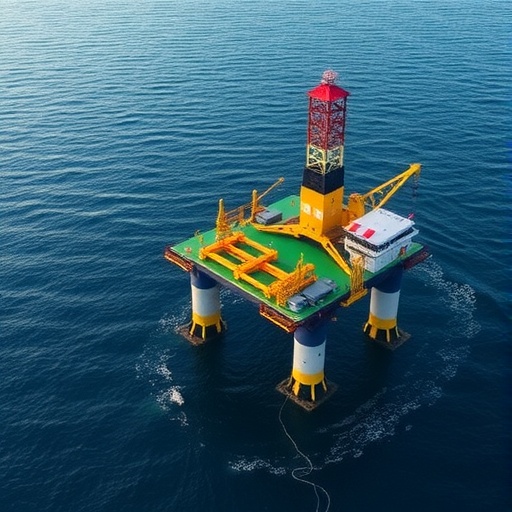
A groundbreaking study published in Communications Earth & Environment offers an unprecedented analysis of the feasibility of achieving net-zero emissions on offshore oil and gas platforms under varying decarbonization policies. As the energy sector faces mounting pressure to reduce its carbon footprint, this research delivers critical insights into how offshore operations—long considered difficult to decarbonize—can transition towards sustainability while maintaining productivity.
Using advanced modeling that integrates emission data, energy consumption patterns, and regulatory scenarios, the researchers provide a road map for offshore platforms to meet stringent climate targets. The study evaluates multiple policy frameworks, ranging from moderate emissions reductions to aggressive net-zero mandates, and assesses the technical viability and economic impacts of each scenario.
Central to these findings is the identification of key pathways to decarbonization. The research highlights the potential of electrification of platform operations, powered by renewable energy sources such as offshore wind and solar, as a transformative strategy. Additionally, the integration of carbon capture and storage (CCS) technologies is emphasized as a vital option, particularly for managing residual emissions that cannot be eliminated through operational efficiency alone.
The authors also address the challenges posed by the inherently remote and harsh offshore environment, which complicates the deployment of new technologies. Through sensitivity analysis, the study quantifies the risks and uncertainties involved, underscoring the need for adaptive policy mechanisms that can evolve alongside technological advancements.
Importantly, the research delves into the interplay between regulatory pressures and market forces. It reveals that stringent decarbonization policies not only drive technology adoption but also reshape economic incentives, potentially resulting in new business models that prioritize sustainability. However, some scenarios project increased operational costs and require significant upfront investment, suggesting a transition period marked by economic trade-offs.
One of the study’s most striking conclusions is the affirmation that net-zero targets are achievable without entirely abandoning offshore oil and gas production. Instead, the future landscape envisions hybrid systems where fossil fuel extraction coexists with low-carbon technologies, aiming to minimize environmental impact without sacrificing energy security.
By offering a comprehensive, data-driven framework, this work equips policymakers, industry leaders, and environmental advocates with actionable strategies to guide the offshore sector’s decarbonization journey. It exemplifies the power of interdisciplinary research in tackling complex environmental challenges and sets a precedent for future studies exploring sustainable energy futures.
As the global community intensifies its commitment to combat climate change, this research stands out as a pioneering effort, shedding light on the often-overlooked offshore oil and gas platforms and their potential role in a net-zero world.
Cite Scienmag News
Sloane Callahan. (July 11, 2026). Assessing Net-Zero Potential of Offshore Oil Platforms under New Policies. Scienmag. https://scienmag.com/assessing-net-zero-potential-of-offshore-oil-platforms-under-new-policies/
Sloane Callahan. "Assessing Net-Zero Potential of Offshore Oil Platforms under New Policies." Scienmag, 11 July 2026, https://scienmag.com/assessing-net-zero-potential-of-offshore-oil-platforms-under-new-policies/. Accessed 3 September 2026.
Sloane Callahan. "Assessing Net-Zero Potential of Offshore Oil Platforms under New Policies." Scienmag. July 11, 2026. https://scienmag.com/assessing-net-zero-potential-of-offshore-oil-platforms-under-new-policies/


