


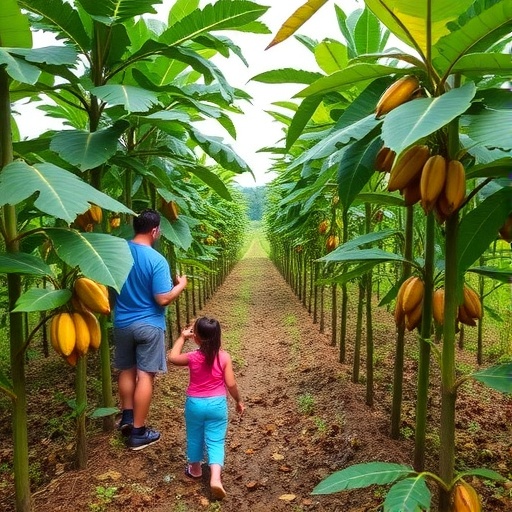
In a groundbreaking study that bridges ecology, agriculture, and cutting-edge technology, researchers have unveiled how the intricate dance of flower visitors directly influences cocoa production. Utilizing advanced computer vision techniques, the team decoded the complex interactions between pollinators and agroforestry management systems, shedding new light on sustainable cocoa yield optimization.
Cocoa, the cornerstone of global chocolate production, relies heavily on the activity of flower visitors—primarily pollinators such as bees—and their interactions with the environment. Traditional studies have struggled to capture these dynamics at scale due to the complexity and variability of tropical agroforestry ecosystems. However, by harnessing computer vision algorithms, the researchers automated the identification and quantification of flower visitors with unprecedented precision.
The study revealed that agroforestry management practices profoundly affect pollinator behavior. Different arrangements and species compositions within cocoa agroforestry systems mediate flower visitor interactions, leading to variations in pollination effectiveness. The ability to visualize and analyze these interactions in real-time provided insights into how landscape management can be strategically manipulated to boost cocoa yield.
Technically, the researchers employed high-resolution imaging combined with machine learning models trained to recognize various pollinator species and their activity patterns. This integration of artificial intelligence and ecological monitoring marks a significant advancement in the capability to study biodiversity-function relationships on an operational scale.
By mapping flower visitor dynamics against yield outcomes, the study demonstrated a clear correlation: agroforestry systems optimized for diverse and active pollinator communities tend to produce higher cocoa yields. This finding not only underscores the ecological importance of pollinators but also offers practical guidance for farmers aiming to increase productivity sustainably.
Moreover, the use of computer vision allowed for non-invasive, continuous monitoring that minimized human error and labor intensity traditionally associated with ecological fieldwork. This methodological leap could revolutionize agricultural research by enabling scalable, real-time ecosystem assessments in diverse cropping systems worldwide.
Climate change and habitat loss threaten many pollinator populations, making the insights gained from this research particularly urgent. Understanding how agroforestry influences pollinator activity provides a pathway to design resilient agricultural landscapes that support biodiversity while enhancing food security.
This innovative intersection of technology and ecology exemplifies the potential for interdisciplinary approaches to tackle global challenges. As the demand for cocoa continues to grow, such studies pave the way for intelligent farming systems that harmonize productivity with environmental stewardship.
Cite Scienmag News
Blake Davidson. (July 11, 2026). Agroforestry Shapes Flower Visitor Behavior Boosting Cocoa Production. Scienmag. https://scienmag.com/agroforestry-shapes-flower-visitor-behavior-boosting-cocoa-production/
Blake Davidson. "Agroforestry Shapes Flower Visitor Behavior Boosting Cocoa Production." Scienmag, 11 July 2026, https://scienmag.com/agroforestry-shapes-flower-visitor-behavior-boosting-cocoa-production/. Accessed 5 September 2026.
Blake Davidson. "Agroforestry Shapes Flower Visitor Behavior Boosting Cocoa Production." Scienmag. July 11, 2026. https://scienmag.com/agroforestry-shapes-flower-visitor-behavior-boosting-cocoa-production/


