


China’s Solar Expansion Policy Is Linked to a Decline in Bird Diversity
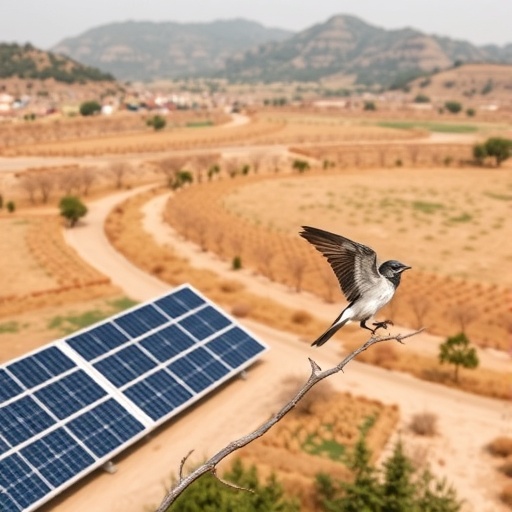
The global transition to solar power is widely viewed as essential for reducing greenhouse-gas emissions, but a new study suggests that the clean-energy revolution may carry an overlooked ecological cost. An analysis of more than 2,300 counties across China has found that stronger government policies promoting solar development were associated with measurable declines in bird diversity. The researchers attribute much of the decline to the conversion of croplands and grasslands into developed areas, where photovoltaic installations and related infrastructure can replace or fragment habitats. The findings highlight a growing challenge for climate policy: renewable energy can reduce carbon emissions while simultaneously placing pressure on ecosystems that support biodiversity.
The study, led by Huiming Zhang and colleagues, examined 2,344 Chinese counties over the period from 2014 to 2023. China provides an unusually valuable setting for investigating the ecological effects of solar expansion because the country’s renewable-energy infrastructure has been shaped strongly by national and regional policy. Government incentives, construction targets, land-use rules, and investment programs have influenced where solar facilities are built and how quickly they expand. By combining information on these policies with bird observations, environmental conditions, land-use changes, agricultural productivity, and socioeconomic indicators, the researchers were able to assess how variations in solar-policy intensity corresponded with changes in local bird diversity.
The central result was striking. A one-standard-deviation increase in the intensity of policies promoting solar expansion was associated with a 2.10 percent reduction in the bird biodiversity index. The study does not suggest that every solar installation produces the same ecological effect, nor does it establish that policy-driven solar construction alone caused every observed change. However, the pattern remained significant after the researchers accounted for a range of environmental and socioeconomic factors. The results indicate that the location and scale of renewable-energy development can influence biodiversity outcomes, particularly when large infrastructure projects are placed in landscapes that already provide diverse vegetation, nesting sites, and food resources.
Birds are especially useful indicators of these changes because they respond rapidly to alterations in habitat structure and ecological productivity. Different species depend on specific combinations of vegetation height, water availability, nesting cover, insects, seeds, and agricultural conditions. When fields, grasslands, or mixed habitats are replaced by construction sites, access roads, fencing, substations, and rows of solar panels, the resulting landscape may become less suitable for some species even if it still appears green from above. The researchers found that geographically widespread bird species were disproportionately affected, suggesting that solar-related land conversion may influence not only rare or highly specialized birds but also common species that occupy broad areas.
The strongest effects appeared in wealthier regions and in areas outside China’s desert landscapes. This geographic pattern is important because deserts and other sparsely vegetated regions are often considered attractive locations for solar development. In more productive agricultural and grassland regions, however, solar projects may compete directly with ecosystems that support a greater variety of plants and animals. Wealthier areas may also have more extensive energy infrastructure, greater development pressure, and stronger capacity to attract large investments. As solar capacity grows, these regional differences could determine whether the technology is deployed primarily on low-conflict land or in ecologically valuable landscapes.
The study points to land-use conversion as a major pathway connecting solar policy to biodiversity loss. Croplands and grasslands can contain substantial ecological variation, including field margins, uncultivated patches, seasonal vegetation, and areas that provide breeding or feeding habitat. Converting these landscapes into developed land can reduce habitat area and divide remaining natural or semi-natural areas into smaller fragments. Fragmentation can make it more difficult for birds to move between feeding and breeding sites, expose nests to disturbance, and reduce access to insects and other prey. Even where solar facilities preserve some vegetation beneath or between panels, changes in lighting, maintenance, fencing, human activity, and vegetation management may alter the habitat’s value.
One of the study’s most provocative findings involves what the researchers describe as “inferior greening.” In satellite-based environmental monitoring, an increase in Leaf Area Index, or LAI, can make a landscape appear greener. LAI estimates the amount of leaf material covering a given area and is widely used to evaluate vegetation growth, agricultural productivity, and ecosystem change. But a higher LAI does not necessarily mean that an ecosystem has become more diverse or healthier. A landscape dominated by uniform vegetation, irrigated crops, or managed plant growth may register as greener while offering fewer ecological niches than a mixed grassland or varied agricultural mosaic. In this case, the researchers argue that apparent gains in vegetation cover could conceal a decline in habitat quality and species diversity.
This distinction has implications far beyond China. Solar power is expanding rapidly across continents, and installations are increasingly being proposed on agricultural land, grasslands, rangelands, and other open areas. The climate benefits of replacing coal- and gas-fired generation with solar electricity can be substantial, but those benefits do not automatically eliminate local environmental impacts. Solar facilities require land, transmission connections, access roads, drainage systems, and ongoing maintenance. Their ecological effects depend on project design, previous land use, vegetation management, wildlife movement, and the availability of alternative habitats. The new findings therefore support a more precise approach to renewable-energy planning—one that evaluates not only carbon reductions but also habitat quality and biodiversity costs.
In a related Perspective, Yuanning Liang argues that the next step should be to connect measured changes in bird diversity with ecosystem services and conservation values. Birds contribute to ecological processes such as insect control, seed dispersal, pollination, scavenging, and nutrient cycling, while also holding cultural and recreational importance. Without estimates of these benefits, conventional cost-benefit analyses may treat biodiversity loss as an unpriced side effect of development. Liang compares this challenge with the effort to calculate the social cost of carbon, which seeks to quantify the economic damages associated with greenhouse-gas emissions. A credible assessment of biodiversity values could help policymakers compare different solar sites, avoid high-value habitats, and design projects that deliver climate benefits without imposing unnecessary ecological damage.
The study does not argue that solar energy should be abandoned. Instead, it shows why the energy transition must be planned with ecological detail. Policies could prioritize rooftops, parking areas, degraded land, industrial sites, and other locations where new generation would require less habitat conversion. Where ground-mounted projects are necessary, developers could preserve wildlife corridors, maintain native vegetation, reduce fencing barriers, and monitor bird populations before and after construction. Transparent data and reproducible analytical methods will also be essential as governments balance emissions targets with conservation goals. As China and other nations build increasingly large solar networks, the success of the renewable-energy transition may ultimately be judged not only by the electricity it produces or the carbon it avoids, but also by whether it protects the living systems that make those gains sustainable.
News Publication Date: 20-Aug-2026
Web References: http://dx.doi.org/10.1126/science.aee0747
References: Zhang et al., “China’s solar expansion policy reduces bird diversity,” Science, DOI: 10.1126/science.aee0747.
Cite Scienmag News
Faith Mcneil. (August 20, 2026). China’s Solar Expansion Policy Linked to Reduced Bird Diversity. Scienmag. https://scienmag.com/chinas-solar-expansion-policy-linked-to-reduced-bird-diversity/
Faith Mcneil. "China’s Solar Expansion Policy Linked to Reduced Bird Diversity." Scienmag, 20 August 2026, https://scienmag.com/chinas-solar-expansion-policy-linked-to-reduced-bird-diversity/. Accessed 4 September 2026.
Faith Mcneil. "China’s Solar Expansion Policy Linked to Reduced Bird Diversity." Scienmag. August 20, 2026. https://scienmag.com/chinas-solar-expansion-policy-linked-to-reduced-bird-diversity/


