


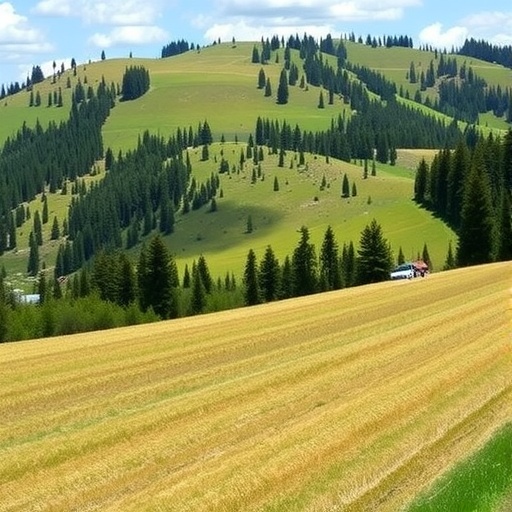
Colorado’s irrigated mountain hayfields may be doing far more than producing forage for livestock. A three-year study led by Colorado State University has found that these high-elevation agricultural landscapes can function as expansive natural filtration systems, reducing sediment, phosphorus and other contaminants as irrigation water moves through the fields. In some cases, researchers found that water leaving the hayfields contained lower concentrations of nutrients than the water used to irrigate them, suggesting that carefully managed mountain meadows can improve surface-water quality rather than degrade it.
The research was conducted through CSU’s Agricultural Water Quality Program in the Yampa, Gunnison and Colorado River basins. It was initiated at the request of the Colorado Ag Water Alliance, a producer-led organization focused on protecting the state’s water resources while sustaining agricultural production. Researchers monitored several working properties, with participating producers volunteering land in each basin. At every site, irrigation water was tested before it entered the fields and again after it had passed through the hay-producing system. This allowed the team to examine whether agricultural activity was adding nutrients to the water or whether the vegetated fields were absorbing and retaining them.
The results showed consistently low nutrient concentrations in runoff from the mountain hayfields. Levels of nitrogen and phosphorus generally remained below thresholds considered concerning for water quality, and in some locations the water leaving the fields contained fewer nutrients than the incoming irrigation water. The fields also reduced sediment, a major pollutant that can cloud streams, transport attached nutrients and damage aquatic habitat. Although the degree of filtration varied among sites and depended on local conditions and management practices, the overall pattern was clear: irrigated mountain meadows appeared to have a very low environmental impact during the study period.
“These irrigated ag lands in the mountains are essentially large grass filter strips,” said Erik Wardle, director of CSU’s Agricultural Water Quality Program and the study’s lead researcher. “Their impacts are very low, and in some cases, they even have the potential to clean the water, depending on management and localized conditions.” The comparison to filter strips reflects the physical and biological processes taking place within the fields. Dense perennial grasses slow the movement of water, allowing suspended soil particles to settle. Their roots stabilize the soil and reduce erosion, while plants and microorganisms in the soil can absorb, transform or retain nutrients before they reach downstream waterways.
Nutrients such as nitrogen and phosphorus are essential for plant growth, but excessive amounts can destabilize aquatic ecosystems. When these compounds enter lakes, rivers or reservoirs in high concentrations, they can stimulate algal blooms. Dense blooms may reduce water clarity, consume oxygen as they decompose and, in some cases, produce toxins harmful to people, livestock and wildlife. Nutrients can originate from fertilizers, animal waste, wastewater, urban stormwater and natural sources. Agricultural fields are therefore often evaluated as potential contributors to nutrient pollution, particularly where soil is exposed, fertilizer is applied heavily or runoff moves rapidly into nearby streams.
Mountain meadow hay systems differ substantially from many row-crop operations. The Colorado fields examined in the study are dominated by perennial grasses that remain rooted in place for years, rather than being replanted annually. Their short growing season limits crop production, and producers typically apply relatively little fertilizer because of the expense and the modest amount of time available for plant growth. This permanent vegetation provides continuous ground cover, reducing the opportunity for rainfall or irrigation water to detach soil. The result is a landscape that can combine agricultural production with several of the same water-protection functions associated with engineered or deliberately planted conservation buffers.
The study also examined how management decisions influenced both productivity and water quality. Producers were able to test different approaches to fertilizer use, irrigation and field management while monitoring the resulting water chemistry. The research provided baseline measurements that can help farmers, ranchers and state agencies distinguish between expected background nutrient levels and conditions that may indicate a serious pollution problem. It also demonstrated the value of voluntary best management practices, which can include applying nutrients according to crop needs, maintaining vigorous perennial vegetation, limiting unnecessary fertilizer and managing irrigation to reduce runoff and erosion.
For producers, the findings offered reassurance at a time when agricultural nutrient pollution is receiving increasing regulatory attention. Colorado’s Regulation 85 establishes nutrient-control requirements intended to protect water quality, while the state’s Water Quality Control Division oversees wastewater treatment plants and certain industrial sources. Most agricultural systems are not currently regulated in the same way, but they remain subject to evaluation, and the division has the authority to recommend additional controls if water-quality protections are judged inadequate. By documenting the low nutrient concentrations associated with mountain hay production, the CSU study gives producers evidence that responsible management can protect waterways without imposing unnecessary restrictions on longstanding agricultural operations.
Greg Peterson, executive director of the Colorado Ag Water Alliance, said the project was the first of its kind to focus specifically on mountain meadow hay operations and their relationship to surface-water quality. Some producers initially worried that monitoring could expose problems and lead to penalties. Instead, the project gave them an opportunity to investigate their own operations and identify practices that benefited both their businesses and the surrounding environment. At one monitored location, researchers found little difference between water associated with a ranch and water from nearby open space, an observation that underscored how closely some agricultural meadows can resemble functioning natural grasslands.
The results were especially meaningful for Colorado Farm Bureau President Carlyle Currier, who selected the portion of his ranch he believed had the greatest potential for contamination. The monitoring showed that water leaving the field was generally of better quality than the irrigation water entering it. Currier said the outcome reinforced the dependence of farming and ranching on healthy ecosystems, clean water and functioning soils. Hay production and forage pastures are central to livestock agriculture, Colorado’s leading agricultural commodity, and mountain ranches often have operated on the same landscapes for a century or more. The study’s findings have now contributed to a new Colorado Water Plan project in the Yampa River Basin, where researchers and producers will demonstrate and evaluate additional best management practices. The next phase could reveal which techniques most reliably preserve the filtration capacity of mountain hayfields—and whether these working landscapes can become an increasingly important part of Colorado’s strategy for protecting water in a changing climate.
Cite Scienmag News
Violet Maxwell. (August 20, 2026). Mountain hayfields filter nutrients, helping protect clean water. Scienmag. https://scienmag.com/mountain-hayfields-filter-nutrients-helping-protect-clean-water/
Violet Maxwell. "Mountain hayfields filter nutrients, helping protect clean water." Scienmag, 20 August 2026, https://scienmag.com/mountain-hayfields-filter-nutrients-helping-protect-clean-water/. Accessed 3 September 2026.
Violet Maxwell. "Mountain hayfields filter nutrients, helping protect clean water." Scienmag. August 20, 2026. https://scienmag.com/mountain-hayfields-filter-nutrients-helping-protect-clean-water/


