


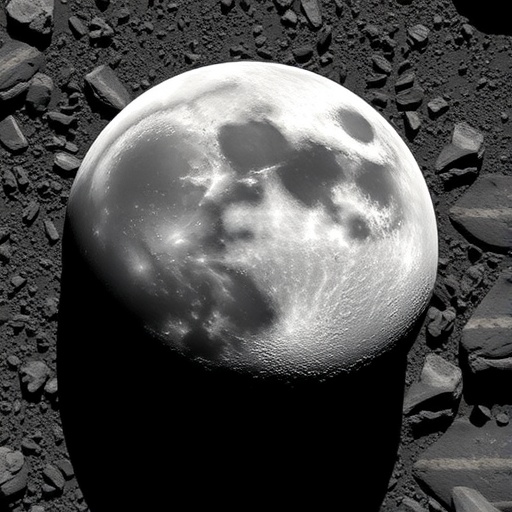
The Moon may look like the ultimate sterilizing environment, but its rugged polar landscape could shelter Earth microbes for far longer than scientists once thought. A NASA-led modeling study has identified shaded lunar depressions where bacteria and fungi carried from Earth could potentially remain viable for at least seven days. The finding does not mean that microbes could thrive or reproduce on the Moon. Instead, it suggests that some organisms may enter a dormant, cryptobiotic state and endure the lunar environment long enough to complicate future searches for life, ancient chemistry and biological contamination. The study, published in Science Advances, focuses on regions near the lunar south pole, where shallow sunlight, extreme topography and permanently shadowed terrain create a patchwork of unexpectedly diverse environments.
The lunar surface is hostile to conventional biology for several reasons. Temperatures can swing dramatically between daylight and darkness, liquid water is not available at the surface under ordinary conditions, and the Moon has no substantial atmosphere to block ultraviolet radiation or moderate the climate. Solar ultraviolet photons can damage DNA, proteins and cell membranes, while the vacuum promotes dehydration and exposes organisms to temperature extremes. Earlier estimates of microbial survival on the Moon often concentrated on broad regional conditions or on equatorial sites visited during the Apollo era. Those models generally did not capture the detailed effects of craters, ridges, boulders and slopes. At the poles, however, even a small change in elevation can determine whether a surface receives direct sunlight, reflected light or no sunlight at all.
The new study addresses that complexity by combining high-resolution elevation and temperature information from NASA’s Lunar Reconnaissance Orbiter with computer models of solar illumination. Researcher Stefano Bertone of the University of Maryland used ray tracing, a computational technique commonly applied in computer graphics and optical physics, to calculate how sunlight travels across the lunar terrain. The model followed rays from the Sun toward the surface while accounting for the position of the Sun, local slopes, surface roughness, brightness and obstacles that can block, reflect or redirect light. This approach allowed the researchers to estimate not only whether a location was illuminated, but also the total ultraviolet energy, or UV fluence, received over a 24-hour period. That distinction is critical because microbial damage depends on cumulative radiation exposure rather than sunlight alone.
The calculations revealed that lunar darkness is not always absolute. Permanently shadowed regions, or PSRs, receive no direct sunlight, but indirect ultraviolet radiation can still arrive after scattering from nearby terrain or reflecting off illuminated surfaces. In other locations, a ridge or crater wall may block direct solar rays for much of the day while allowing brief, low-angle exposure. These subtle differences produce a mosaic of conditions rather than a simple division between light and darkness. The researchers converted those modeled conditions into maps of “survivable niches,” comparing local UV exposure and maximum summer temperatures with laboratory-derived tolerance limits for five microbes commonly associated with human skin or spacecraft environments. The resulting maps showed colored patches of possible survival distributed around polar craters and candidate landing zones.
The team examined three areas near the lunar south pole that have been considered for NASA’s Artemis III mission. Each simulated region contained places where at least one of the studied organisms could remain viable for up to a week. The most striking result involved the fungus Aspergillus, a widespread genus that includes species frequently encountered in soil, air, food and human-associated environments. According to the model, exceptionally UV-resistant Aspergillus could potentially survive in 15% to 30% of areas receiving some sunlight during the lunar winter. Across the mapped landscapes, the fungus retained a possible seven-day survival zone covering about 3% of the terrain. The exact outcome would depend on the organism’s physiological state, shielding by dust or rock and the microenvironment in which it arrived.
The results also indicated that all five microbes could have survivable locations in each of the three regions examined. Near the De Gerlache Rim, portions of permanently shadowed terrain could potentially protect every organism in the study when scattered ultraviolet radiation is included in the calculations. This does not imply that those areas are biologically habitable in the usual sense. A microbe that survives there would most likely be dormant, with its metabolism reduced to an extremely low level. Growth would require a combination of liquid water, suitable temperatures, chemical energy sources and other resources that have not been demonstrated on the lunar surface. Survival and reproduction are therefore separate questions: the Moon may preserve microbial cells without providing the conditions needed to sustain a lunar ecosystem.
That distinction is central to the study’s implications for exploration. Astronauts constantly release biological material, including skin cells, bacteria, fungal spores and other microorganisms. A piece of skin roughly the size of a fingernail can carry around a million bacterial cells, and a single astronaut’s movements could deposit enormous numbers of organisms into soil, dust and boot prints. Sterilization can reduce contamination but cannot eliminate every microbe associated with a human mission. If some of those organisms persist in shaded lunar niches, future researchers could mistake them for evidence of an ancient lunar process—or, in more distant missions, for signs of indigenous life on Mars. The problem is especially serious for astrobiology, where extremely small amounts of biological material may influence interpretations of samples returned to Earth.
The study does not claim that microbes are currently living on the Moon, nor does it report organisms recovered from lunar soil. Its conclusions are based on simulations that compare environmental conditions with previously measured microbial tolerance thresholds. Those thresholds are themselves influenced by factors such as cell dehydration, protective pigments, spore formation, clumping, dust coverage and the duration of exposure. A laboratory estimate obtained under one set of conditions may not perfectly describe what happens to a cell lying on an irregular lunar surface. The authors therefore present their maps as risk and planning tools rather than as proof of actual survival. The findings identify places where survival is physically plausible and where future experiments could test the limits directly.
For mission planners, the maps could help guide biological protection protocols, landing-site selection and the placement of scientific instruments. Areas with high potential for microbial persistence may deserve stricter contamination controls, especially if they are targeted for sampling water ice or studying volatile chemicals. They could also become natural laboratories for controlled experiments in which selected microbes are exposed to the lunar environment and monitored over time. Such tests would help determine how much protection is provided by dust, terrain, shadow and indirect illumination. The researchers plan to improve the model with more detailed illumination calculations, higher-resolution terrain reconstructed through “shape from shading,” and additional experiments involving microbes relevant to spacecraft and human biology.
The Moon’s polar regions are often portrayed as uniformly frozen and lifeless, but this research suggests a more intricate reality: a landscape where a few centimeters of elevation may separate lethal exposure from temporary microbial refuge. As humans return to the Moon and prepare for Mars, the question will not simply be whether life can survive in space. Scientists will also need to determine where Earth life might endure, how long it could remain detectable and how to distinguish contamination from discovery. The study’s colorful maps of microbial survival zones offer an early warning that lunar exploration may leave behind a biological signature—even in a world that appears, at first glance, incapable of supporting life.
News Publication Date: 19-Aug-2026
Web References: NASA Lunar Reconnaissance Orbiter: https://science.nasa.gov/mission/lro/ ; NASA press release: https://science.nasa.gov/humans-in-space/human-related-microbes-may-survive-moons-south-pole-nasa-finds/
References: “Potential survivable niches for microbial life on the lunar south pole,” Science Advances, DOI: 10.1126/sciadv.aec0811
Cite Scienmag News
Reid Dalton. (August 20, 2026). Earth microbes may survive on the Moon—but only in shade. Scienmag. https://scienmag.com/earth-microbes-may-survive-on-the-moon-but-only-in-shade/
Reid Dalton. "Earth microbes may survive on the Moon—but only in shade." Scienmag, 20 August 2026, https://scienmag.com/earth-microbes-may-survive-on-the-moon-but-only-in-shade/. Accessed 4 September 2026.
Reid Dalton. "Earth microbes may survive on the Moon—but only in shade." Scienmag. August 20, 2026. https://scienmag.com/earth-microbes-may-survive-on-the-moon-but-only-in-shade/


