


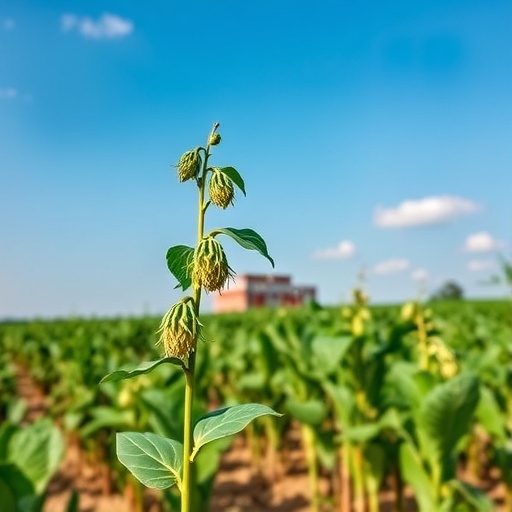
As China’s appetite for animal-sourced foods continues to surge, its dependence on soybean imports has reached unprecedented levels, placing increasing strain on global agricultural systems. Once fully self-sufficient in soybean production in the early 1960s, China’s soybean self-sufficiency rate (SSR) has plummeted to a mere 17% by 2022, with projections suggesting a further decline to 12% by 2050 if no strategic interventions are made. This decline has significant environmental consequences, as the nation increasingly relies on imports that drive deforestation and land-use change in tropical frontiers.
Addressing this challenge, a new integrated policy framework evaluated through scenario-based modeling suggests that combining three key interventions could drastically boost China’s soybean SSR. These interventions include rehabilitating salt-affected lands, adopting genetically modified (GM) soybeans for enhanced yield, and encouraging a shift towards healthier dietary patterns with reduced animal protein consumption. Importantly, each approach individually offers only modest improvements; however, their combined implementation could transform China’s soybean landscape.
Rehabilitating salt-affected soils—a degraded land category unsuitable for conventional agriculture—emerged as a promising avenue. The study estimates that for each 10% restoration of such lands, the soybean SSR could increase by approximately 1.4%. While modest on its own, this intervention represents a strategic reclaiming of otherwise marginal lands for soybean cultivation without expanding into untouched ecosystems.
Genetically modified soybeans, designed to thrive under suboptimal climatic and soil conditions or resist pests, could further raise self-sufficiency by around 1.0% per 10% adoption. The policy scenario considers regulatory approval and scaling efforts for GM crops to enhance yields sustainably, reducing the need for import reliance.
Dietary transition toward healthier consumption patterns—specifically reducing reliance on animal-sourced foods—plays a pivotal role by easing soybean demand linked to animal feed production. Notably, a 50% implementation of such dietary shifts could increase SSR to 17% independently, highlighting the intricate link between food choices and agricultural pressures.
The synergy of these three interventions, however, presents a striking prospect. Model projections show that their integrated application could elevate China’s soybean SSR to 74% by 2030 and stabilize around 80% by 2050. This outcome would not only improve national food security but also alleviate pressure on global soybean production, freeing cropland on a vast scale.
Such liberation of agricultural land has profound environmental benefits. The avoided expansion into tropical agricultural frontiers would permit reforestation efforts and enhanced carbon sequestration, contributing to climate mitigation goals. Moreover, the potential to produce enough soybeans to feed an estimated additional 1.89 billion people worldwide underscores the global ripple effects of China’s domestic policy decisions.
This research offers a compelling case for integrated, multifaceted policy strategies in tackling complex food security and environmental challenges. By aligning land restoration, biotechnology, and consumer behavior, China could reshape its soybean landscape while fostering sustainable global food systems.
As the world grapples with mounting environmental crises and burgeoning populations, such data-driven insights pave the way for holistic interventions that transcend agricultural borders—underscoring that the path to food security is as much about what we eat as where and how it is produced.
Cite Scienmag News
Ophelia Keating. (July 10, 2026). Integrated policies may boost China’s soybean self-sufficiency and reduce land strain. Scienmag. https://scienmag.com/integrated-policies-may-boost-chinas-soybean-self-sufficiency-and-reduce-land-strain/
Ophelia Keating. "Integrated policies may boost China’s soybean self-sufficiency and reduce land strain." Scienmag, 10 July 2026, https://scienmag.com/integrated-policies-may-boost-chinas-soybean-self-sufficiency-and-reduce-land-strain/. Accessed 4 September 2026.
Ophelia Keating. "Integrated policies may boost China’s soybean self-sufficiency and reduce land strain." Scienmag. July 10, 2026. https://scienmag.com/integrated-policies-may-boost-chinas-soybean-self-sufficiency-and-reduce-land-strain/


