


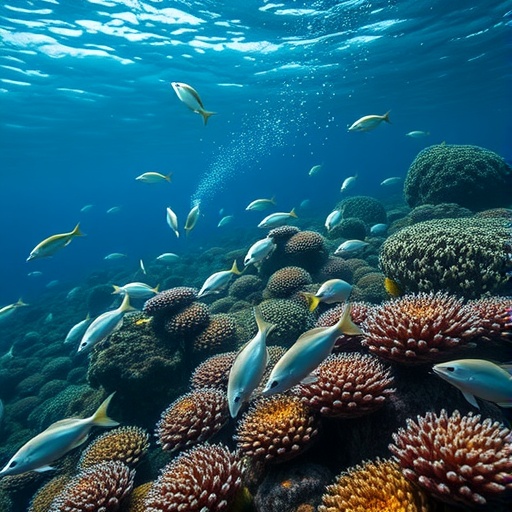
A comprehensive study analyzing nearly 9,000 instances of body size change in marine animals over the past 450 million years reveals that shrinking body sizes are a universal response to environmental crises. Drawing from fossil records, historical data, and modern observations, the research emphasizes how climate-induced stress shapes marine ecosystems fundamentally, suggesting serious implications for the future of ocean life.
Marine species, ranging across diverse taxa, exhibit a consistent pattern: during periods of environmental upheaval, body size reduction is observed both as a shift toward smaller species dominating communities and as dwarfing within individual species. This phenomenon is not isolated but appears as a general biological response signaling ecosystem distress. The breadth of data, examined by researchers from FAU and the University of Warsaw, underscores the robustness of this pattern across geologic eras and marine biodiversity.
The strongest size reductions occur in association with warming episodes. Dr. Kenneth De Baets highlights that although body size decreases happen in various crises, those linked to pronounced warming cause changes that are twice as intense, manifesting as true dwarfing within species. These findings establish a direct connection between temperature anomalies and evolutionary as well as ecological shifts, suggesting that heat stress precipitates rapid physiological and community-level adaptations.
Professor Wolfgang Kießling further points to a striking correlation: the magnitude of body size decrease scales with the degree of temperature increase. This relationship cements the idea that rising global temperatures serve as a critical stressor, pushing marine organisms toward smaller, less energy-demanding states. Given Earth’s extensive history of climate cycles, these data serve as a stark warning: modern anthropogenic warming may induce similar widespread diminutions across marine fauna.
The current trend observed in many fish and invertebrates—favoring smaller size classes—echoes these ancient patterns. Long-term, this size reduction could disrupt marine food webs, altering predator-prey dynamics and nutrient cycling. Economically, fisheries could face declines in stock biomass and yield, affecting food security worldwide. The interaction between smaller body size and ecosystem function remains a critical area for further investigation, particularly as warming persists.
This study integrates paleoenvironmental analysis with cutting-edge climate science to provide a multi-million-year perspective on biological responses to environmental stress. It challenges the notion that modern marine ecosystem changes are anomalous, instead positioning them within a deep-time context that highlights the persistent influence of temperature on evolutionary trajectories.
In essence, marine dwarfism during warming events acts as both a symptom and signal: a biological barometer reflecting the health of oceanic ecosystems. As the climate crisis accelerates, understanding these patterns becomes vital for predicting ecological outcomes and crafting adaptive conservation strategies.
Ultimately, the research published in the Proceedings of the National Academy of Sciences underscores the urgency of addressing global warming to mitigate its cascading impacts on marine biodiversity and ecosystem services. The clear link between temperature rise and body size reduction illuminates an essential, yet often overlooked, consequence of environmental change.
Cite Scienmag News
Gavin Prescott. (July 9, 2026). Climate Change Causes Marine Animals to Shrink in Size. Scienmag. https://scienmag.com/climate-change-causes-marine-animals-to-shrink-in-size/
Gavin Prescott. "Climate Change Causes Marine Animals to Shrink in Size." Scienmag, 9 July 2026, https://scienmag.com/climate-change-causes-marine-animals-to-shrink-in-size/. Accessed 4 September 2026.
Gavin Prescott. "Climate Change Causes Marine Animals to Shrink in Size." Scienmag. July 9, 2026. https://scienmag.com/climate-change-causes-marine-animals-to-shrink-in-size/


