

Thursday, July 9, 2026
Science
No Result
View All Result
  • Login
  • HOME
  • SCIENCE NEWS
  • CONTACT US
  • HOME
  • SCIENCE NEWS
  • CONTACT US
No Result
View All Result
Scienmag
No Result
View All Result
Home Science News Social Science

Scientists Uncover Evolutionary Origins of Ant Parenting Behavior

July 9, 2026
in Social Science
Reading Time: 2 mins read
0
Scientists Uncover Evolutionary Origins of Ant Parenting Behavior

Scientists Uncover Evolutionary Origins of Ant Parenting Behavior

65
SHARES
587
VIEWS
Share on FacebookShare on Twitter
ADVERTISEMENT

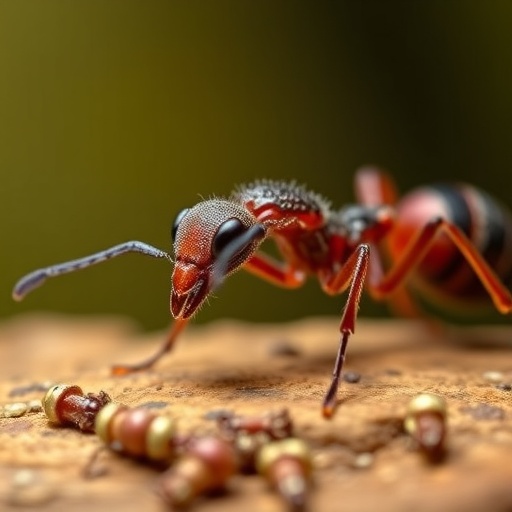
Long before mammals cradled their young, parental care was virtually nonexistent in ancestral species—eggs were laid, then forsaken. However, new research published in Nature unveils how evolution ingeniously converted neglect into nurturing behavior without inventing entirely new brain circuits. In clonal raider ants, scientists discovered that ancient neural systems originally regulating hunger were repurposed to trigger social caregiving behaviors.

Ants and mammals share evolutionarily conserved neuropeptide signaling pathways linked to parental care. Intriguingly, the social behaviors exhibited by ants change as they age, providing a natural model to explore these mechanisms. The study’s authors, led by Daniel Kronauer at Rockefeller University, demonstrated that caregiving in ants depends on the modulation of neuropeptides deeply rooted in ancient feeding circuits.

Unlike traditional neuroscience models such as fruit flies or roundworms—which lack parental care—or mammals with complex brains, the clonal raider ant offers a uniquely accessible brain architecture of roughly 60,000 cells. This simpler system permits detailed mapping of molecular and neural underpinnings governing caregiving and foraging, age-dependent behaviors that co-exist in this eusocial insect.

The research team engineered an automated assay to monitor hundreds of interactions between individual ants and larvae. Chemical analyses identified 70 neuropeptides within the ants’ brains, with particular focus on two molecules exhibiting opposing roles: Neuropeptide F (NPF) and Allatostatin A (AstA). NPF actively promotes caregiving behaviors, while AstA encourages foraging and disengagement from larvae. Young ants displayed higher NPF and lower AstA levels, aligning with their nurturing roles, whereas older ants showed the reverse pattern as they transition to foraging.

Manipulation experiments further confirmed the functional significance of these neuropeptides. Increasing NPF shifted ants toward caregiving even under starvation, while elevating AstA levels suppressed parental behaviors. This demonstrates how hunger-regulating pathways have been evolutionarily co-opted to balance internal needs with social responsibilities in a context-dependent manner.

These findings echo mammalian studies linking similar neuropeptides to parenting, hinting at a shared evolutionary blueprint across distantly related species. This convergence offers a compelling route to decipher the neural circuitry of parental care by leveraging the ant model’s relative simplicity.

Moreover, because ants naturally switch from caregivers to foragers as they mature, the study opens avenues to investigate how aging reorganizes brain function and behavior. Understanding these age-dependent neuromodulatory dynamics could illuminate fundamental processes relevant to healthy brain aging and social behavior in humans.

In sum, this groundbreaking research reveals that the roots of parental care lie not in novel inventions but in the innovative rewiring of ancient feeding circuits. The clonal raider ant thus emerges as a powerful model system to unravel the evolutionary and neural bases of social caregiving and age-related brain plasticity—paving the way for broader insights into the biology of parenting.


Subject of Research: Neural mechanisms underlying the evolution of parental care in clonal raider ants
Article Title: Evolution repurposes ancient hunger circuits to regulate caregiving behavior in ants
Web References: https://www.nature.com/articles/s41586-026-10747-6
Image Credits: Laboratory of Social Evolution and Behavior at The Rockefeller University
Keywords: Parenting, Evolution, Neuropeptides, Social Behavior, Clonal Raider Ant, Neural Circuits, Aging, Neuromodulation

Tags: age-dependent social behaviorsancestral neural systemsant parental care evolutionbrain architecture of clonal raider antseusocial insect neurobiologyevolution of nurturing behaviorsinsect model for studying parental caremolecular mechanisms of parental careneural circuits in antsneuropeptide signaling pathwaysneuropeptides in social behaviorsocial caregiving behavior in insects
Share26Tweet16
Previous Post

ECNP Notes Growing Citations Highlight Interest in Mental Health Biology

Next Post

Educational Mobility Drives Breakthroughs in Innovation

Related Posts

USC Rossier Traces 250 Years of Youth-Led Educational Change
Social Science

USC Rossier Traces 250 Years of Youth-Led Educational Change

July 9, 2026
HSE Study Identifies Internet Users Most Likely to Fact-Check Online
Social Science

HSE Study Identifies Internet Users Most Likely to Fact-Check Online

July 8, 2026
Storm Daniel Flooding in Libya Highlights Urgent Need for Rapid Assessments
Social Science

Storm Daniel Flooding in Libya Highlights Urgent Need for Rapid Assessments

July 8, 2026
UNM Student Discovers New Insights into Ancient Maize Farming Practices
Social Science

UNM Student Discovers New Insights into Ancient Maize Farming Practices

July 8, 2026
Virtual patients offer real-world medical training
Social Science

Virtual patients offer real-world medical training

July 8, 2026
Study finds low usage of gambling addiction treatment in Quebec
Social Science

Study finds low usage of gambling addiction treatment in Quebec

July 6, 2026
Next Post
Educational Mobility Drives Breakthroughs in Innovation

Educational Mobility Drives Breakthroughs in Innovation

  • Mothers who receive childcare support from maternal grandparents show more

    Mothers who receive childcare support from maternal grandparents show more parental warmth, finds NTU Singapore study

    27656 shares
    Share 11059 Tweet 6912
  • University of Seville Breaks 120-Year-Old Mystery, Revises a Key Einstein Concept

    1061 shares
    Share 424 Tweet 265
  • Bee body mass, pathogens and local climate influence heat tolerance

    682 shares
    Share 273 Tweet 171
  • Researchers record first-ever images and data of a shark experiencing a boat strike

    546 shares
    Share 218 Tweet 137
  • Groundbreaking Clinical Trial Reveals Lubiprostone Enhances Kidney Function

    531 shares
    Share 212 Tweet 133
Science

Embark on a thrilling journey of discovery with Scienmag.com—your ultimate source for cutting-edge breakthroughs. Immerse yourself in a world where curiosity knows no limits and tomorrow’s possibilities become today’s reality!

RECENT NEWS

  • USC Rossier Traces 250 Years of Youth-Led Educational Change
  • California Gray Wolves Mainly Consume Cattle, Raising Human-Wildlife Conflicts
  • GLP-1 Receptor Agonists Aid Weight Management in Mental Illness
  • BET inhibition reveals glycolytic vulnerability via HIF1α in triple-negative breast cancer

Categories

  • Agriculture
  • Anthropology
  • Archaeology
  • Athmospheric
  • Biology
  • Biotechnology
  • Blog
  • Bussines
  • Cancer
  • Chemistry
  • Climate
  • Earth Science
  • Editorial Policy
  • Marine
  • Mathematics
  • Medicine
  • Pediatry
  • Policy
  • Psychology & Psychiatry
  • Science Education
  • Social Science
  • Space
  • Technology and Engineering

Subscribe to Blog via Email

Enter your email address to subscribe to this blog and receive notifications of new posts by email.

Join 5,147 other subscribers

© 2025 Scienmag - Science Magazine

Welcome Back!

Login to your account below

Forgotten Password?

Retrieve your password

Please enter your username or email address to reset your password.

Log In
No Result
View All Result
  • HOME
  • SCIENCE NEWS
  • CONTACT US

© 2025 Scienmag - Science Magazine

Discover more from Science

Subscribe now to keep reading and get access to the full archive.

Continue reading
