


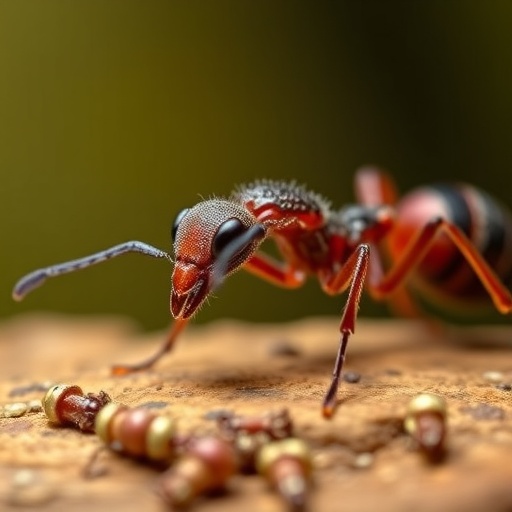
Long before mammals cradled their young, parental care was virtually nonexistent in ancestral species—eggs were laid, then forsaken. However, new research published in Nature unveils how evolution ingeniously converted neglect into nurturing behavior without inventing entirely new brain circuits. In clonal raider ants, scientists discovered that ancient neural systems originally regulating hunger were repurposed to trigger social caregiving behaviors.
Ants and mammals share evolutionarily conserved neuropeptide signaling pathways linked to parental care. Intriguingly, the social behaviors exhibited by ants change as they age, providing a natural model to explore these mechanisms. The study’s authors, led by Daniel Kronauer at Rockefeller University, demonstrated that caregiving in ants depends on the modulation of neuropeptides deeply rooted in ancient feeding circuits.
Unlike traditional neuroscience models such as fruit flies or roundworms—which lack parental care—or mammals with complex brains, the clonal raider ant offers a uniquely accessible brain architecture of roughly 60,000 cells. This simpler system permits detailed mapping of molecular and neural underpinnings governing caregiving and foraging, age-dependent behaviors that co-exist in this eusocial insect.
The research team engineered an automated assay to monitor hundreds of interactions between individual ants and larvae. Chemical analyses identified 70 neuropeptides within the ants’ brains, with particular focus on two molecules exhibiting opposing roles: Neuropeptide F (NPF) and Allatostatin A (AstA). NPF actively promotes caregiving behaviors, while AstA encourages foraging and disengagement from larvae. Young ants displayed higher NPF and lower AstA levels, aligning with their nurturing roles, whereas older ants showed the reverse pattern as they transition to foraging.
Manipulation experiments further confirmed the functional significance of these neuropeptides. Increasing NPF shifted ants toward caregiving even under starvation, while elevating AstA levels suppressed parental behaviors. This demonstrates how hunger-regulating pathways have been evolutionarily co-opted to balance internal needs with social responsibilities in a context-dependent manner.
These findings echo mammalian studies linking similar neuropeptides to parenting, hinting at a shared evolutionary blueprint across distantly related species. This convergence offers a compelling route to decipher the neural circuitry of parental care by leveraging the ant model’s relative simplicity.
Moreover, because ants naturally switch from caregivers to foragers as they mature, the study opens avenues to investigate how aging reorganizes brain function and behavior. Understanding these age-dependent neuromodulatory dynamics could illuminate fundamental processes relevant to healthy brain aging and social behavior in humans.
In sum, this groundbreaking research reveals that the roots of parental care lie not in novel inventions but in the innovative rewiring of ancient feeding circuits. The clonal raider ant thus emerges as a powerful model system to unravel the evolutionary and neural bases of social caregiving and age-related brain plasticity—paving the way for broader insights into the biology of parenting.
Cite Scienmag News
Gavin Prescott. (July 9, 2026). Scientists Uncover Evolutionary Origins of Ant Parenting Behavior. Scienmag. https://scienmag.com/scientists-uncover-evolutionary-origins-of-ant-parenting-behavior/
Gavin Prescott. "Scientists Uncover Evolutionary Origins of Ant Parenting Behavior." Scienmag, 9 July 2026, https://scienmag.com/scientists-uncover-evolutionary-origins-of-ant-parenting-behavior/. Accessed 3 September 2026.
Gavin Prescott. "Scientists Uncover Evolutionary Origins of Ant Parenting Behavior." Scienmag. July 9, 2026. https://scienmag.com/scientists-uncover-evolutionary-origins-of-ant-parenting-behavior/


