


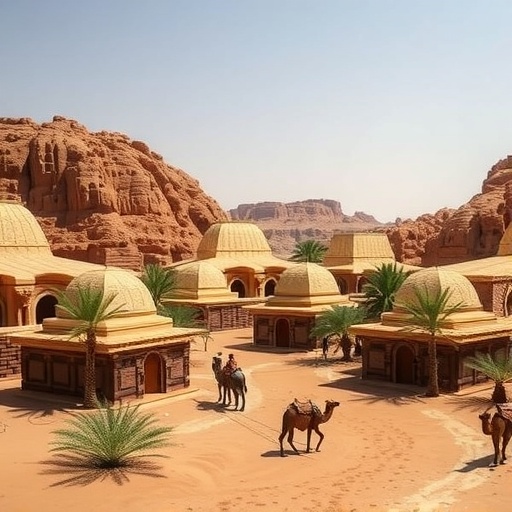
For thousands of years, the most recognizable products in the ancient world were not stamped with logos, protected by trademarks or promoted through advertising. Yet a new study suggests that one Bronze Age pottery tradition achieved many of the same effects as a modern commercial brand. In the oasis of Qurayyah, in northwestern Arabia, ceramic vessels were produced with a distinctive visual style, made according to consistent technical procedures, circulated across long-distance trade networks and imitated by other communities. Their combination of appearance, quality and reputation was so powerful, researchers argue, that the pottery should be understood as an ancient brand—created more than 3,200 years ago, long before the emergence of capitalism or modern consumer markets.
The discovery comes from an international research team led by Marta Luciani of the University of Vienna, working with specialists from the Austrian Archaeological Institute at the Austrian Academy of Sciences, TU Wien, the Massachusetts Institute of Technology, the Harvard Museum of the Ancient Near East and the University of Sydney. Their study examines vessels known for decades as “Midianite Pottery,” a term that has often obscured their true origin. By combining archaeological evidence with ceramic technology, petrography and chemical analysis, the researchers have demonstrated that the pottery was produced in the Qurayyah oasis. The findings, published in PLOS One under the title “Creating a brand. Genesis, transformation and diffusion of Qurayyah Painted Ware,” provide a rare view of how reputation and commercial identity could develop in an ancient economy.
Qurayyah was an unlikely place for a large-scale craft tradition to emerge. The oasis lies in an arid environment where clay, water and fuel—three essential resources for pottery production—were limited. Nevertheless, the community developed a specialized ceramic industry capable of creating elaborately painted vessels. The earliest known examples of Qurayyah Painted Ware date to approximately 3,600 years ago. Over the following centuries, potters maintained the tradition while changing its designs, shapes and imagery. By about 3,200 years ago, the vessels featured a flourishing repertoire of painted animals, human figures and scenes that may have represented rituals or other culturally meaningful activities.
The pottery’s appeal was not based on decoration alone. The study identifies eight characteristics that together distinguish an ancient brand: a recognizable visual identity, consistency in the materials used, continuity in production technology, centralized manufacture, circulation beyond the place of origin, local imitation, an intentional commercial purpose and a strong cultural reputation. Qurayyah Painted Ware appears to meet all of these criteria. Its colors and motifs made it visually identifiable, while the recurring technical features of its manufacture helped preserve a recognizable product identity. The vessels were also exported hundreds of kilometers from the oasis, indicating that people beyond the immediate community valued and sought them out.
To establish where the vessels were made, the researchers examined their clay and mineral components in detail. Petrographic analysis involves cutting extremely thin sections from ceramic fragments and studying them under a polarizing microscope. This reveals the mineral grains, rock fragments and other inclusions embedded in the clay, allowing scientists to compare the geological signature of a vessel with potential source regions. The team also used chemical fingerprinting, including Neutron Activation Analysis, to measure trace elements in the ceramics. Because different geological environments contain different proportions of elements, these chemical profiles can help identify whether vessels were produced locally or transported from elsewhere.
The technical evidence supported the archaeological conclusion that Qurayyah was the production center. The vessels displayed material and manufacturing patterns consistent with a local pottery tradition rather than a collection of unrelated imports. Their repeated forms and decorative conventions suggest that production was not sporadic or limited to individual experiments. Instead, potters maintained a shared technological system over generations. This continuity is especially significant because it indicates that the pottery’s identity was reproduced deliberately, even as its designs evolved. In modern terms, the makers preserved the core features of a product while introducing new versions that could attract consumers and reinforce recognition.
The distribution of the pottery reveals how the brand moved through ancient trade networks. Qurayyah Painted Ware has been identified at sites in the Southern Levant, including Tell el-Kheleifeh, and at the Timna sanctuary associated with the Egyptian goddess Hathor. Examples also traveled southward into regions of North Arabia. Such movement demonstrates that the oasis was not an isolated settlement on the edge of the desert. It was connected to wider systems of exchange that linked Arabia with the Levant and Syria. Through those networks, Qurayyah’s pottery reached communities that may never have visited the oasis but could recognize, acquire or imitate its distinctive vessels.
Imitation is one of the strongest clues that a product had acquired cultural and commercial value. When communities copied the appearance of Qurayyah Painted Ware, they were not simply reproducing a convenient design. They were responding to an established style that already carried meaning and appeal. Local imitation suggests that the pottery had become recognizable enough for its visual language to be borrowed, perhaps because consumers associated it with prestige, ritual importance or access to distant connections. In this sense, the vessels functioned much like branded goods today: their appearance signaled origin and desirability, while copies revealed the influence of the original.
The study also challenges assumptions about ancient economies and desert societies. Long-distance exchange is often imagined as being driven primarily by necessities such as metals, food or raw materials. Qurayyah Painted Ware shows that aesthetic preference, social identity and reputation could also shape trade. The vessels were not merely functional containers. Their decoration and technical consistency transformed them into objects with a social life extending far beyond their place of manufacture. The community’s ability to sustain production in a resource-constrained oasis further demonstrates that technological innovation was not confined to large urban centers. Oasis-dwellers developed specialized knowledge, managed scarce resources and participated in regional economic networks on their own terms.
Most remarkably, the Qurayyah tradition did not disappear after its peak in the Late Bronze Age. According to the researchers, painted pottery production continued in the oasis for roughly another thousand years, extending into the final Iron Age. The designs and techniques changed, but the tradition remained rooted in the same production center. This long history suggests that the brand-like identity of the pottery was not a short-lived fashion. It was maintained through repeated production, adaptation and recognition across changing political and economic conditions. By tracing that evolution, the researchers show that branding is not exclusively a modern phenomenon but can emerge wherever producers create distinctive goods, consumers value them and networks spread their reputation.
The findings offer a new way to think about the relationship between technology, trade and human behavior in the ancient world. Qurayyah Painted Ware demonstrates that producers in a non-capitalistic economy could cultivate a recognizable identity, compete for attention and build demand across substantial distances. Its story connects microscopic evidence from ceramic fragments with broader questions about how people made choices, trusted products and transmitted cultural preferences. A painted vessel from the desert may therefore represent more than an archaeological artifact: it may be evidence of one of the earliest known examples of brand creation, showing that the desire to make, recognize and seek out distinctive products is far older than modern commerce.
Article Publication Date: 19-Aug-2026
References: PLOS One; study led by Marta Luciani, University of Vienna.
Cite Scienmag News
Courtney Benton. (August 20, 2026). Pioneering study shows Bronze Age Arabian oases already created brands. Scienmag. https://scienmag.com/pioneering-study-shows-bronze-age-arabian-oases-already-created-brands/
Courtney Benton. "Pioneering study shows Bronze Age Arabian oases already created brands." Scienmag, 20 August 2026, https://scienmag.com/pioneering-study-shows-bronze-age-arabian-oases-already-created-brands/. Accessed 3 September 2026.
Courtney Benton. "Pioneering study shows Bronze Age Arabian oases already created brands." Scienmag. August 20, 2026. https://scienmag.com/pioneering-study-shows-bronze-age-arabian-oases-already-created-brands/


