

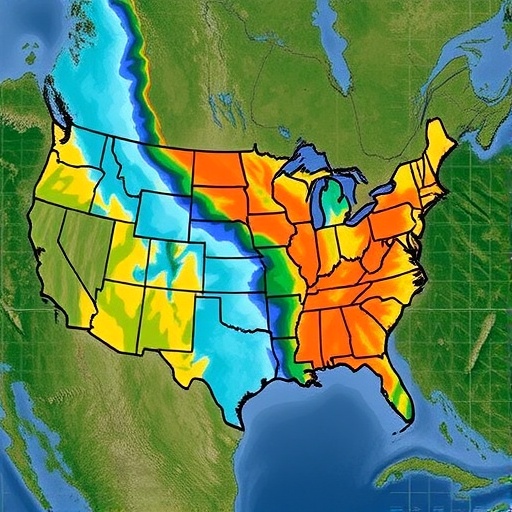
The nation’s rivers are shedding their deep, slow memories of snowmelt and ancient groundwater, replacing them with a rapid pulse of recent rainfall. A sweeping new analysis reveals that streamflow composition across the United States is tilting decisively toward precipitation that fell only weeks earlier, a hydrological shift with profound consequences for floods, droughts, and water security. The study, published in Communications Earth & Environment, provides the most comprehensive evidence yet that the continental plumbing is being rewired—and the old buffers are vanishing.
Researchers Chen and Husic tracked the age of water coursing through hundreds of rivers by exploiting subtle isotopic fingerprints. Every raindrop and snowflake carries a unique ratio of stable oxygen and hydrogen isotopes, which changes with temperature, season, and origin. When water percolates into the ground and spends decades in an aquifer, its isotopic signature reflects a long-lost climate. By comparing the isotopic composition of river water to that of contemporary precipitation, the team calculated the “young water fraction”—the proportion of streamflow that originated as rain or snow within the previous two to three months. This technique allowed them to peer into the hidden transit times of water across the landscape.
What they found marks a departure from hydrologic normalcy. Across vast swaths of the country, the young water fraction is swelling, while the contribution of older, stored water is shrinking. In the eastern United States and the Pacific Northwest, where humid climates once guaranteed steady baseflow from large groundwater reserves, rivers are increasingly dominated by quick-flushing storm runoff. Even in regions with historically deep snowpacks, the meltwater pulse now arrives earlier and leaves less behind to sustain summer flows. The watercourts are essentially living more in the present tense, with less historic savings.
The underlying drivers are a tangled web of climate change and land surface alteration. More intense downpours, a hallmark of a warming atmosphere capable of holding more moisture, send water racing to the channel rather than soaking into the ground. Declining snowpack and earlier snowmelt erode the natural reservoir that once metered out water over dry months. Meanwhile, urbanization replaces spongy soils with impervious surfaces, and agricultural drainage networks shunt water swiftly downstream. Together, these forces conspire to shorten the average transit time of a water molecule from cloud to sea, sidelining the subsurface storage that had historically sustained rivers through dry spells.
This shift from old to young water is not merely an academic curiosity—it reprograms the very behavior of floods and droughts. A river fed primarily by recent rainfall reacts violently to storms, surging higher and faster. The same system, deprived of the slow-release cushion of groundwater, then crashes to anemic levels when the rain stops. Water quality suffers too: young water has had little time to interact with soil and rock, so it carries a different cocktail of pollutants and is often warmer, stressing aquatic life. Ecosystems adapted to stable thermal and flow regimes may find themselves lurching between extremes.
For water managers, the findings sound an urgent alarm. Dams, reservoirs, and irrigation districts were designed under the assumption that a reliable fraction of streamflow would arrive months or years after the water fell from the sky. If rivers become mere mirrors of the last storm, infrastructure tuned to historical rhythms may fail. Reservoirs might overflow in winter, only to be drawn down dangerously low in summer. The study suggests that traditional drought forecasting and water allocation models, which lean heavily on lagged groundwater contributions, need to incorporate these accelerating dynamics.
The research team synthesized river gauge records with isotopic data from a national network of precipitation sampling stations, spanning a diversity of climates and watershed sizes. By linking the isotopic signals to physical drivers such as soil moisture, evaporation rates, and catchment topography, they untangled where and why the water age is changing fastest. Their work demonstrates that the proportion of young water is not a fixed trait of a watershed but a sensitive indicator of a system under climate stress—one that could be used to diagnose vulnerability before it becomes visible in stream gauges alone.
As the atmosphere continues to warm, the isotopic clock in rivers will tick ever faster. The country’s waterways are becoming less like a trust fund that doles out water gradually and more like a checking account tied directly to the last paycheck. Adapting to this new hydrological reality means reimagining everything from floodplain zoning to how we recharge aquifers. The plumbing of the continent, once thought to be a slow and steady backdrop, is turning out to be alarmingly responsive to the weather of the here and now.
Subject of Research: Shifting streamflow composition in U.S. rivers toward recent precipitation
Article Title: Streamflow composition in U.S. rivers is shifting toward recent precipitation
Article References: Chen, C., Husic, A. Streamflow composition in U.S. rivers is shifting toward recent precipitation. Commun Earth Environ (2026). https://doi.org/10.1038/s43247-026-03788-2
Image Credits: AI Generated
DOI: 10.1038/s43247-026-03788-2
Keywords: young water fraction, streamflow, stable isotopes, groundwater, precipitation, climate change, hydrology, water age


