

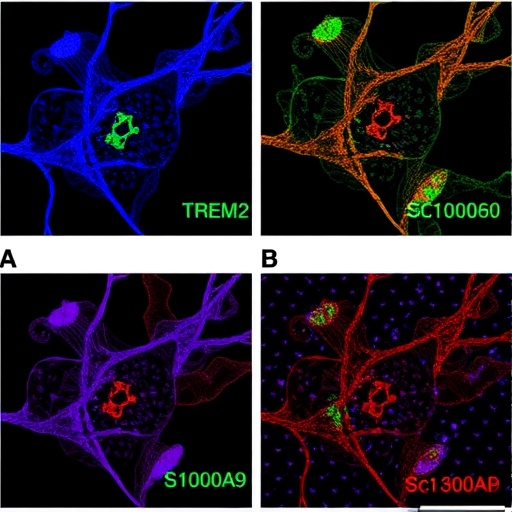
A groundbreaking study published in Cell Death Discovery has unveiled a previously unknown molecular conversation between a macrophage receptor and a damage-associated alarmin, a dialogue that drives the immune system to shield rather than destroy ovarian clear cell carcinoma. The research pins down a non-canonical TREM2-S100A9 signaling axis that actively instructs tumor-associated macrophages to adopt a pro-tumorigenic identity, effectively building a microscopic fortress around malignant cells. More importantly, the team demonstrated that disrupting this axis with an IL-17 blockade reshapes the immune landscape, dramatically sensitizing one of the most chemoresistant ovarian cancers to therapeutic intervention. The findings crack open a new frontier in immunotherapy for a malignancy that has stubbornly evaded the checkpoint inhibitor revolution.
Ovarian clear cell carcinoma is a rare but notoriously aggressive subtype, prevalent in East Asian populations and infamously unresponsive to standard platinum-based chemotherapies. Unlike high-grade serous ovarian cancer, it carries a low mutational burden and a cold immune microenvironment, leaving most immunotherapeutic options ineffective. Researchers have long sought the biological levers that could flip this immune desert into a hostile terrain for tumors. The new study, led by Zhang and colleagues, illuminates a completely unexpected mechanism: instead of relying on canonical TREM2 ligands like phospholipids or apolipoproteins, the receptor on macrophages directly engages with S100A9, a calcium-binding protein typically released during tissue damage and inflammation.
TREM2, or triggering receptor expressed on myeloid cells 2, has been a molecule of intense interest in neurodegenerative diseases, where it functions as a lipid sensor and orchestrates microglial clearance of debris. In the tumor setting, its role has remained contentious—sometimes fueling anti-tumor immunity, other times suppressing it. The team’s proteomic and biophysical analyses revealed that S100A9 binds to TREM2 with high affinity at an interface distinct from known ligand-docking sites. This non-canonical interaction triggers an intracellular signaling cascade that phosphorylates Syk and Akt, ultimately pushing macrophages toward an M2-like, reparative program characterized by high expression of CD163, IL-10, and arginase-1. Rather than attacking cancer cells, these re-educated macrophages secrete growth factors and matrix-remodeling enzymes that foster tumor expansion and metastasis.
The researchers used a combination of co-culture systems, syngeneic mouse models, and clinical specimens to dissect this pathway. Single-cell RNA sequencing of tumors from patients with ovarian clear cell carcinoma confirmed that macrophages co-expressing TREM2 and sensing S100A9 were abundant within the tumor bed, and their gene signature correlated with poorer survival outcomes. Mechanistically, the S100A9-TREM2 complex upregulated the transcription factor c-Maf, which in turn bound to the promoter region of IL-17A, sparking autocrine IL-17 signaling within the macrophages themselves. This closed loop further solidified the immunosuppressive polarization, creating a self-reinforcing circuit that kept killer T cells at bay.
The discovery of IL-17 as the downstream linchpin immediately suggested a therapeutic vulnerability. IL-17 inhibitors, already used in autoimmune conditions like psoriasis, could theoretically snap the circuit. When the team treated tumor-bearing mice with an anti-IL-17 monoclonal antibody, they witnessed a striking remodeling of the tumor microenvironment. Pro-tumorigenic macrophages reverted to a pro-inflammatory state, and the tumors became infiltrated with cytotoxic CD8+ T cells. Tumor growth was significantly blunted, and in combination with low-dose chemotherapy, nearly complete regression was achieved in a subset of animals. The effect was specific: blocking TREM2 or silencing S100A9 produced similar results, confirming the axis as a master regulator.
Perhaps the most compelling translational insight came from patient-derived organoids and fresh tumor slice cultures. Ovarian clear cell carcinoma samples that were unresponsive to PD-1 checkpoint blockade alone regained sensitivity when co-treated with an IL-17 blocker. This suggests that the TREM2-S100A9-IL-17 pathway represents a dominant immune escape mechanism, one that can be pharmacologically dismantled. The team also identified a serum biomarker signature—elevated S100A9 coupled with soluble TREM2—that could serve as a non-invasive method to stratify patients for this type of combinatorial immunotherapy, paving the way for precision medicine in a cancer that has long been a therapeutic black box.
While the findings are preclinical, they mark a conceptual leap. The identification of a non-canonical ligand for TREM2 upends the textbook view of this receptor’s function and places S100A9, typically considered a generic danger signal, at the heart of a specific immune-suppressive circuit. It also explains why so many ovarian clear cell carcinomas are awash in IL-17 yet fail to mount an effective T-cell response—the cytokine is being commandeered by macrophages for a nefarious purpose. Clinical trials combining IL-17 blockers with existing immunotherapies are now a logical next step, and several biotechnology firms are already eyeing TREM2-targeting agents for oncology.
This study underscores a broader principle that is reshaping cancer immunology: the language of cell-to-cell communication in tumors is vastly more complex than previously appreciated, with receptors and ligands moonlighting in unexpected partnerships. By decoding one such hidden conversation, Zhang and colleagues have not only illuminated the dark biology of a lethal ovarian cancer but also handed researchers a precise molecular map to guide the next generation of immune-based therapies. For patients facing a diagnosis with few effective options, that map could one day lead out of a therapeutic dead end.
Subject of Research: A non-canonical TREM2-S100A9 signaling axis driving pro-tumorigenic macrophage polarization and immune evasion in ovarian clear cell carcinoma.
Article Title: Discovery of a non-canonical TREM2-S100A9 axis that drives pro-tumorigenic macrophage polarization and sensitizes ovarian clear cell carcinoma to IL-17 blockade.
Article References:
Zhang, S.t., Zhang, Sm., Jiang, F. et al. Discovery of a non-canonical TREM2-S100A9 axis that drives pro-tumorigenic macrophage polarization and sensitizes ovarian clear cell carcinoma to IL-17 blockade.
Cell Death Discov. (2026). https://doi.org/10.1038/s41420-026-03244-2
Image Credits: AI Generated
DOI: https://doi.org/10.1038/s41420-026-03244-2
Keywords: Ovarian clear cell carcinoma, TREM2, S100A9, macrophage polarization, tumor microenvironment, IL-17 blockade, immunotherapy, immune evasion, non-canonical signaling, protein-protein interaction.


