

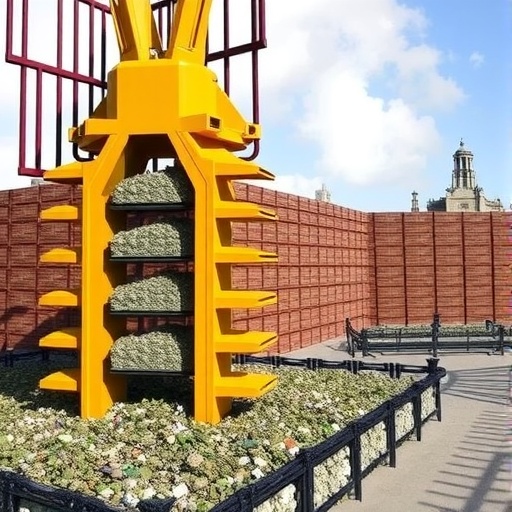
Construction sites are notorious for generating mountains of leftover soil, a bulky waste stream that often ends up dumped illegally, triggering landslides, groundwater contamination, and sinking residential neighborhoods. At the same time, engineers designing foundations for wind turbines, transmission towers, and other lifeline infrastructure constantly battle uplift forces—the powerful upward pull that can wrench structures out of the ground during storms. Now, a Japanese research team has found a way to turn that problematic surplus soil into a critical component of stronger, more sustainable foundations, elegantly solving two construction headaches with one recycled pile.
The challenge is especially acute in Japan, where national statistics reveal that on-site reuse of excavated soil dramatically lags behind the repurposing of other construction byproducts such as concrete or asphalt. Thousands of tons of soil are hauled off-site every year, burdening roads, consuming fuel, and sometimes ending up in unregulated fills that have caused severe environmental damage. Simultaneously, modern building codes demand ever-higher uplift resistance for lightweight steel structures that are increasingly vulnerable to extreme wind events. Yet the technical playbook for designing expanded-base piles—foundations with wing-like protrusions that anchor against uplift—remains sparse, particularly when the backfill material is not pristine engineered sand but low-strength recycled soil.
Professor Shinya Inazumi and his team at the Shibaura Institute of Technology set out to close this gap by developing a winged composite pile system. The concept is deceptively simple: a steel pipe pile fitted with a flared wing is lowered into a permanent steel casing, and the annular space around the pile is packed not with imported granular material but with the very soil that was excavated to create the borehole. The wing acts like a buried anchor, mobilizing a vast cone of surrounding earth to resist upward movement, while the recycled soil inside the casing provides confinement and load transfer. Crucially, the system does not ask the surplus soil to perform beyond its natural, often loose, condition; instead, the geometry is engineered to match the backfill’s modest strength.
To quantify how such foundations actually behave, the researchers built a massive simulation campaign: 224 three-dimensional elasto-plastic finite element models. They systematically varied pile length (10, 15, and 20 meters), shaft diameter (0.2 to 0.6 meters), and wing diameter, all embedded in dense sandy ground typical of a construction site, with the annular backfill modeled as loose sandy soil mirroring freshly excavated surplus material. The goal was not just to see if the system worked, but to map out the precise geometric sweet spots where uplift resistance peaks.
The simulation results revealed a non-intuitive relationship between wing size and holding power. For 10-meter piles, the optimal wing diameter settled around 1.6 to 1.7 meters. As pile length increased to 15 or 20 meters, the ideal wing diameter shifted upward to roughly 1.9 to 2.0 meters. Push the wing beyond these optima, and uplift capacity actually began to degrade: the gap between the wing’s edge and the surrounding casing became so narrow that the soil shear zone could not fully develop, choking off the very resistance mechanism the wing was meant to exploit. This finding gives engineers a clear, length-dependent design ceiling rather than a vague “bigger is better” guideline.
Even more surprising was what did not matter. Shaft diameter, long assumed to contribute significantly to uplift resistance through skin friction, proved almost negligible. Across the full range of 0.2 to 0.6 meters, the variation in maximum uplift capacity stayed within a slender 10 percent band. For structural designers, this is a liberating result: it means the shaft can be made thinner—saving steel, reducing cost, and freeing up more internal volume for surplus soil—without meaningfully compromising the pile’s ability to resist being pulled out of the ground. The wing does the heavy lifting; the shaft is essentially there to hold the wing in place and to provide a conduit for backfill.
The implications extend quickly from simulation to real-world application. Transmission towers, wind turbine foundations, and other tall, slender structures subjected to high overturning moments and uplift can now be anchored using foundations that actively clean up the mess they create. Instead of trucking excavated soil away and trucking in quarry sand or gravel, construction teams can keep the soil right where it is, using the winged composite pile as both a structural element and an on-site recycling device. This is especially attractive for greenfield infrastructure projects where land is available but access is difficult, or for upgrades to aging power and telecommunications networks that cannot afford large-scale site disturbance.
Professor Inazumi emphasizes that the work was born from conversations with industry partners who wanted both structural reliability and genuine progress toward sustainable site management. “Our research demonstrates that high-performance foundations and responsible soil management can coexist, countering the trend of off-site surplus soil disposal that harms the environment,” he notes. The system plugs directly into circular economy principles, slashing transport emissions, preserving virgin material stocks, and eliminating a persistent disposal liability that has caused real harm to communities.
Beyond the immediate structural performance, the study provides something the field has sorely lacked: quantitative, mechanism-based design guidance for expanded-base piles in recycled backfill. With 224 data points mapping the interplay between geometry and uplift resistance, future foundation engineers can select pile dimensions knowing exactly where the point of diminishing returns lies. As climate-intensified storms place greater demands on infrastructure anchors, such precision is not a luxury—it is a prerequisite for building resilience into the skeleton of the energy and communication networks society depends on. The winged composite pile proves that solving a waste crisis can also mean building stronger, smarter, and cleaner from the ground down.
Subject of Research: Not applicable
Article Title: On-site recycling of construction surplus soil in winged composite piles for enhanced uplift resistance
News Publication Date: 5-Jun-2026
Web References: http://dx.doi.org/10.1016/j.clet.2026.101244
References: Cleaner Engineering and Technology, Vol. 33, 2026, 10.1016/j.clet.2026.101244
Image Credits: Professor Shinya Inazumi from Shibaura Institute of Technology, Japan
Keywords: Civil engineering, Construction engineering, Waste management, Waste disposal, Materials engineering, Environmental engineering, Environmental management, Uplift resistance, Surplus soil recycling, Winged composite pile, Finite element analysis, Circular economy


