


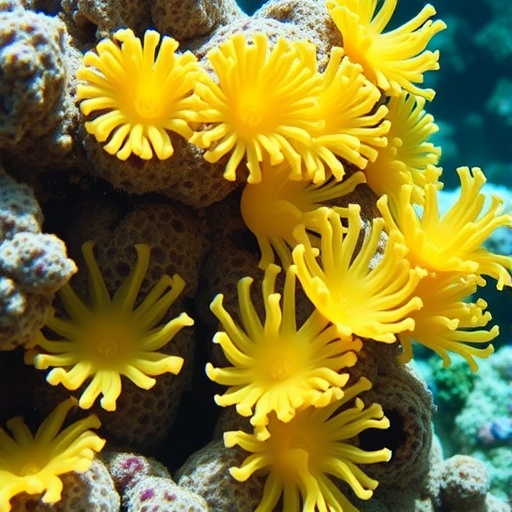
In the enigmatic depths of marine ecosystems, sponges have long been recognized as voracious consumers—filtering and siphoning nutrients from the surrounding seawater. However, revolutionary findings from the Institute for Biodiversity and Ecosystem Dynamics (IBED) at the University of Amsterdam now reveal that these ancient benthic organisms are not merely passive feeders. Instead, they engage in a remarkable symbiotic relationship that enables them to harness solar energy through photosynthesis, a process primarily associated with plants. This newfound understanding could fundamentally alter our perception of energy flow and productivity in tropical coral reefs and beyond, underscoring sponges’ significant ecological contributions.
Traditionally, sponges have been categorized as suspension feeders, adept at filtering bacteria, plankton, and dissolved organic matter from seawater. Researcher Michelle Achlatis, a benthic ecologist, has been at the forefront of exploring these sedentary creatures fixed to the ocean floor. Her investigations delve into their feeding strategies, revealing a complex biological system where specialized cells, called choanocytes, pump vast volumes of water through intricate canal networks. This mechanism traps edible particles, which are then absorbed to meet their nutritional needs. Despite this well-documented filtering ability, the nutritional versatility of sponges has provoked curiosity regarding other potential energy acquisition methods.
One of the most captivating discoveries arises from the symbiosis between sponges and photosynthetic microbes inhabiting their tissues. These microscopic partners, similar to algae or cyanobacteria, utilize sunlight to manufacture organic compounds via photosynthesis, simultaneously generating oxygen as a byproduct. While previous studies acknowledged photosynthetic activity in a handful of sponge species, the scope remained largely limited, hindering a comprehensive understanding of its ecological footprint. The current study led by Achlatis and collaborators sought to expand this knowledge by embracing a broader taxonomic perspective and integrating measurements at the ecosystem scale.
The research team conducted exhaustive fieldwork around the Caribbean island of Curaçao, selecting 24 sponge species emblematic of tropical reef assemblages. For eight of these species, they meticulously quantified photosynthetic output using advanced respirometry and oxygen flux techniques, capturing both gross primary productivity and respiration rates. To bridge species-specific data with broader reef dynamics, they incorporated three-dimensional habitat mapping to accurately estimate sponge biomass and spatial distribution. This integrative methodology allowed them to extrapolate individual photosynthetic contributions to reef-wide productivity, facilitating robust comparisons with traditionally recognized primary producers like algae and corals.
Their analyses uncovered a paradigm-shifting revelation: approximately half of the sponge species assessed contributed significantly to gross primary productivity, accounting for roughly 11% of the total organic carbon generated within the reef ecosystem. This proportion is staggering considering that sponges have historically been excluded from primary producer classifications in coral reef food web models. Achlatis expressed surprise not only at the number of photosynthetically active species but also at their collective magnitude of contribution. These findings suggest that sponges exhibit remarkable metabolic plasticity, capable of blending heterotrophic feeding with autotrophic energy assimilation, effectively ‘multitasking’ in their nutritional strategy.
The ecological implications of sponge photosynthesis are profound. Coral reefs are among the most productive and biodiverse ecosystems on Earth, with complex trophic interactions sustaining myriad species. The recognition that sponges can supplement their energy demand through photosynthesis challenges existing paradigms and calls for a reassessment of carbon cycling models within these habitats. Sponge symbionts’ photosynthetic capacity potentially augments primary productivity, influencing nutrient availability and habitat resilience. In times of environmental stress, such versatility could provide sponges with a crucial survival advantage, buffering against food scarcity and contributing to reef ecosystem stability.
Moreover, this revelation has broader ramifications beyond localized reef systems. Many sponge-rich environments, including temperate and deep-sea habitats, may harbor similar photosynthetic partnerships, underscoring a hitherto underestimated global role in biogeochemical cycling. Researchers advocate for the inclusion of sponges in carbon sequestration assessments, given their ability to fix carbon, even if at lower rates relative to plants or algae. This integration could refine our estimates of oceanic carbon sinks and enhance strategies aimed at mitigating climate change impacts.
Interestingly, sponges occupy a unique biological niche that defies conventional classification. Jasper de Goeij, associate professor of marine benthic ecology and co-author of the study, emphasizes that sponges are neither typical animals nor plants. Their close association with photosynthetic microbes challenges the rigid binary of terrestrial biology and encourages a nuanced appreciation of marine life forms. This fluidity in life strategies exemplifies the complexity and innovation inherent in oceanic ecosystems, inviting further multidisciplinary research to unravel the mechanisms and evolutionary advantages of such partnerships.
Methodologically, the team’s approach combined sophisticated in situ measurements with ecosystem modeling to generate quantitative insights previously unattainable. Employing oxygen evolution metrics under controlled light and dark conditions enabled the disentanglement of photosynthetic rates from respiratory consumption in sponge tissues. Background ecological data from comprehensive reef surveys provided spatial context, revealing that sponges are often more abundant than superficially apparent due to their three-dimensional morphology, which traditional two-dimensional assessments underestimate. This rigorous methodological framework sets a new standard for studying benthic primary productivity and symbioses.
The study also sheds light on the diversity of sponge species involved in photosynthesis, ranging from high microbial abundance (HMA) sponges with dense symbiont populations to low microbial abundance (LMA) species with fewer symbionts, demonstrating that photosynthetic potential is distributed across diverse taxa. This interspecific variation hints at complex ecological and evolutionary dynamics, where environmental factors and symbiont composition modulate photosynthetic efficacy. Future research will be vital to unravel the functional genomics underpinning these relationships, potentially revealing novel biochemical pathways and resilience mechanisms relevant to marine conservation.
While conducted primarily in the tropics, the implications suggest that photosynthetic symbioses within sponges could be ubiquitous across various marine ecosystems, contingent on light availability and microbial community structure. Such ubiquity would redefine the conceptual boundaries of benthic autotrophy and necessitate revised ecological models that incorporate these hybrid nutritional modes. Enhanced understanding could inform marine protected area management, ensuring that sponge populations and their symbiotic partners receive adequate conservation attention given their role in sustaining reef productivity and resilience.
Ultimately, this groundbreaking investigation illuminates the intricate interplay between marine organisms and their environments, showcasing sponges as multifaceted entities capable of blurring ecological categories. Their unexpected contribution to photosynthetic productivity underscores the ongoing need to reevaluate ecological roles within ocean ecosystems, embracing complexity and adaptive ingenuity. As we strive to comprehend and protect our planet’s vital marine habitats, recognizing the versatile lifestyles of key species like sponges offers a richer and more integrated narrative of life beneath the waves.
Cite Scienmag News
Gavin Prescott. (July 1, 2026). Sponges Enhance Productivity of Tropical Coral Reefs Through Photosynthesis. Scienmag. https://scienmag.com/sponges-enhance-productivity-of-tropical-coral-reefs-through-photosynthesis/
Gavin Prescott. "Sponges Enhance Productivity of Tropical Coral Reefs Through Photosynthesis." Scienmag, 1 July 2026, https://scienmag.com/sponges-enhance-productivity-of-tropical-coral-reefs-through-photosynthesis/. Accessed 1 September 2026.
Gavin Prescott. "Sponges Enhance Productivity of Tropical Coral Reefs Through Photosynthesis." Scienmag. July 1, 2026. https://scienmag.com/sponges-enhance-productivity-of-tropical-coral-reefs-through-photosynthesis/


