

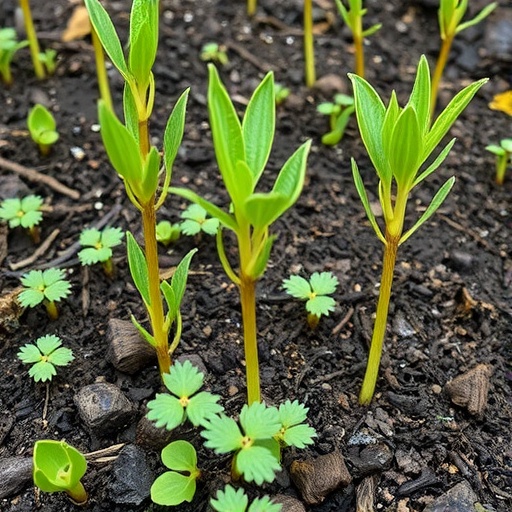
In recent years, the fragile ecosystems of the northern permafrost regions have captured global attention due to their sensitivity to climate change. A paradigm-shifting study now reveals new insights into how vegetation in these cold landscapes experiences browning, a phenomenon typically associated with stress and decay. The research, conducted by Wu, Sonnentag, Lara, and colleagues, meticulously dissects the combined effects of soil and atmospheric dryness – a compound drought scenario – on these vital ecosystems. Published in Nature Communications in 2026, their findings underline a complex interplay between hydrological and atmospheric components that accelerate ecological degradation in ways previously underestimated.
Vegetation browning in northern permafrost zones has often been linked to increases in temperature, but this study highlights that dryness simultaneously affecting soil and air layers plays a formidable role in driving these changes. The researchers employed a suite of advanced remote sensing technologies, coupled with ground-truth data, to unravel how compound dryness conditions impact vegetation health at a regional scale. Their approach transcends conventional single-factor studies by integrating soil moisture deficits with atmospheric vapor pressure deficits, revealing synergistic stressors rarely studied in tandem.
The northern permafrost ecosystems are characterized by their frozen soils that act as a climate regulator by trapping greenhouse gases like methane. Vegetation here not only supports biodiversity but also influences energy fluxes and carbon cycling. Changes in vegetation health thus carry cascading ramifications for global climate feedback loops. By focusing on the browning patterns—that is, the observed decrease in vegetation greenness and photosynthetic activity—the authors map how drought conditions are eroding this critical vegetation cover and upsetting permafrost stability.
Central to the study is the concept of compound dryness, where both soil moisture and atmospheric conditions impose simultaneous stress on plant life. Soil moisture controls the availability of water to roots, while atmospheric dryness, often quantified by vapor pressure deficit (VPD), drives transpiration stress and stomatal closure. These concurrent stressors compound plant water deficits, elevating vulnerability to damage from heat and UV radiation. The authors’ nuanced analysis dissects how this dual drought stress exacerbates browning beyond the effect of either factor alone.
Their methodology involved a sophisticated combination of satellite data spanning multiple growing seasons, allowing for the detection of temporal changes in vegetation indices such as NDVI (Normalized Difference Vegetation Index) alongside soil moisture retrievals. Additionally, high-frequency atmospheric moisture readings enabled regression models that correlate browning intensity with compound dryness levels. This comprehensive data collection effort revealed spatial heterogeneity in browning patterns shaped by complex interactions between atmospheric and edaphic dryness gradients.
One of the remarkable findings is that permafrost regions exhibiting synchronized high atmospheric and soil dryness experienced the most pronounced browning. This goes beyond the traditional understanding that warmer temperatures or drought alone precipitate vegetation decline. The compound dryness effect was shown to reduce photosynthetic carbon uptake substantially, suggesting a feedback mechanism where diminished vegetation vigor further weakens soil stability and accelerates permafrost thaw.
Moreover, the research discusses how these dry conditions impact plant physiological processes such as stomatal conductance and carbon assimilation, bringing a mechanistic depth to the observations. Under compound dryness, plants often close their stomata to conserve water, but this limits CO2 uptake, thereby throttling photosynthesis and growth. The resulting decline in vegetation vigor is detectable even from space, validating the remote sensing approach as a powerful tool for ecosystem monitoring.
Climate models have long predicted increased drought frequency and intensity in polar regions, but this study bridges a crucial gap by quantifying how combined stressors manifest on vegetation health. Their findings have profound implications for projecting future permafrost dynamics and understanding carbon-climate feedbacks. Browning patterns, as indicators of ecosystem distress, signal the urgency to incorporate multifactorial stress interactions in climate impact models for northern latitudes.
An important narrative emerging is that compound dryness includes not just a moisture deficit but an altered energy balance affecting both root zone water accessibility and atmospheric demand. This nuanced understanding demands refined climate adaptation and mitigation strategies focused on permafrost preservation. From managing carbon release to preserving habitat, the impacts of these dryness-driven changes resonate beyond regional boundaries.
The study also underscores the utility of integrating remote sensing, ground observations, and atmospheric data to paint a comprehensive picture of ecosystem responses to climate extremes. The interdisciplinary approach sets a benchmark for future research into climate-vegetation feedbacks. Such integrated monitoring frameworks are crucial for timely detection of vulnerable hotspots where intervention might be most effective.
Furthermore, the authors emphasize the potential for leveraging this research to inform policy decisions related to Arctic and sub-Arctic land management. With accelerating climate-induced changes, safeguarding the resilience of these ecosystems is paramount. This study signals that strategies cannot solely target temperature control but must also address drought-related factors shaping vegetation dynamics in permafrost landscapes.
In a broader scientific context, the research advances our understanding of “compound climate extremes” while presenting a tangible case study in high-latitude biomes. It challenges simplistic models that isolate single stress variables by unveiling the compounded impact on ecosystem collapse risk. The observed browning is a visible manifestation of deeper hydrological disturbances that may precipitate irreversible permafrost degradation.
Concluding thoughts from Wu and colleagues draw attention to the intertwining fate of vegetation health, soil moisture regimes, and atmospheric aridity under a warming planet. As their data vividly illustrate, the response of northern permafrost ecosystems to compound dryness is both an ecological harbinger and a climate feedback alarm. The urgency to monitor and mitigate these effects is clear, given their global implications.
This monumental study, spearheaded by a team of experts across climatology, ecology, and remote sensing disciplines, paves the way for refined predictive models of ecosystem vulnerability. By dissecting the drivers behind vegetation browning in one of Earth’s most sensitive regions, it enhances the scientific toolkit necessary to confront climate change challenges head-on. The integration of compound dryness metrics represents a quantum leap in interpreting how climate extremes influence biome health.
Ultimately, the insights provided by Wu et al. serve as a clarion call to the scientific community, policymakers, and the public. Protecting the integrity of northern permafrost vegetation is not merely an ecological concern but a critical component of global climate stability. The unmasking of compound drought impacts marks a significant stride toward understanding and addressing the multifaceted challenges enveloping our planet’s future.
Subject of Research: Vegetation browning and ecosystem stress under combined soil and atmospheric dryness in northern permafrost regions.
Article Title: Vegetation browning patterns under compound soil and atmospheric dryness in northern permafrost ecosystems.
Article References:
Wu, M., Sonnentag, O., Lara, M.J. et al. Vegetation browning patterns under compound soil and atmospheric dryness in northern permafrost ecosystems. Nat Commun (2026). https://doi.org/10.1038/s41467-026-75131-4
Image Credits: AI Generated


