


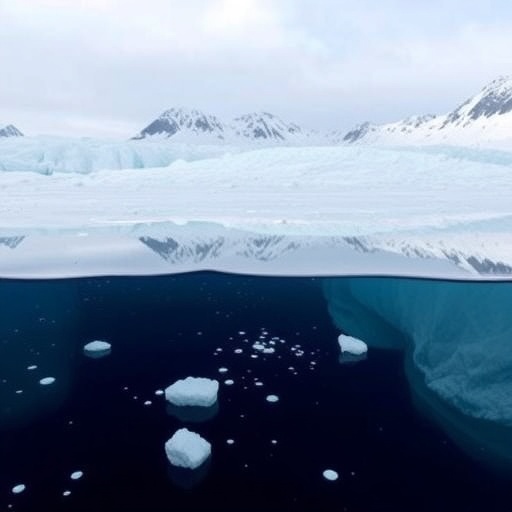
The fragile interface between the cryosphere and the ocean is undergoing significant transformation, with compelling implications for marine ecosystems and global biogeochemical cycles. A groundbreaking study led by Tessin, März, Faust, and colleagues, recently published in Nature Communications, delves into the intricate relationship between instability in the Svalbard-Barents ice sheet and the consequent marine delivery of reactive iron. This research unveils crucial links that could redefine our understanding of nutrient fluxes in Arctic marine environments and their potential global feedbacks.
The Svalbard-Barents ice sheet, located in the Arctic, represents one of the planet’s most rapidly changing cryospheric regions. Its dynamic instability is driven by a combination of atmospheric warming, oceanic heat intrusions, and complex feedback mechanisms inherent to polar glacier and ice sheet systems. As the ice sheet undergoes dissolution and disintegration, previously locked minerals and nutrients are released into the surrounding oceans, fundamentally altering the chemical landscape of these marine ecosystems. This study provides an in-depth exploration of how these processes enhance the delivery of reactive iron—a critical micronutrient that governs many phytoplankton growth dynamics.
Reactive iron holds particular significance in ocean biogeochemistry because it acts as a limiting nutrient in various marine environments, especially in high-latitude oceans where iron scarcity restricts primary productivity. The research team scrutinized sediment cores, ice sheet meltwater outputs, and ocean water column samples, integrating geochemical signatures with cutting-edge modeling techniques to quantify fluxes of bioavailable iron. Their analyses revealed that the ice sheet’s instability markedly increases the flux of reactive iron, catalyzing profound ecological consequences attributed to enhanced marine productivity and carbon sequestration potential.
Underlying the study is an innovative assessment of the physical processes governing ice sheet erosion and sediment transport. The researchers examined how glacial calving and subglacial meltwater release mobilize iron-rich particulates, enabling their transit from terrestrial to marine systems. Moreover, the rapid physical destabilization of the ice sheet amplifies mechanical weathering and mineral liberation within the glacial environment. The manner in which these processes interact with seasonal variations and ocean currents further modulate the spatial and temporal patterns of iron delivery.
Iron’s bioavailability is contingent upon its chemical form and aggregation state once released into the ocean. Reactive iron comprises forms readily assimilated by phytoplankton, unlike more inert mineral-bound species. This study elucidates the complex chemical transformations post-release, including oxidation, complexation with organic ligands, and interactions with suspended particulate matter. The results underscore how ice sheet processes influence not just iron quantity but crucially its bio-accessibility and residence time in surface waters, thereby shaping nutrient cycling and primary production trajectories.
The ecological implications of enhanced reactive iron supply ripple extensively through Arctic marine communities. Phytoplankton, forming the base of the food web, are poised to respond to increased iron availability with shifts in species composition and productivity levels. This, in turn, impacts higher trophic levels including zooplankton, fish, and marine mammals. Additionally, augmented primary productivity facilitates more significant drawdown of atmospheric carbon dioxide, contributing to climate regulation. The study’s findings thus connect cryospheric changes directly to global climate processes via marine biogeochemical pathways.
Importantly, the research frames these phenomena within the broader context of ongoing climate change. The Arctic region warms at approximately twice the global average rate, accelerating ice sheet retreat and destabilization. By quantifying the reactive iron flux associated with these processes, the study offers critical insights into feedback loops potentially reinforcing or mitigating climate warming. It serves as a clarion call for integrating cryosphere-ocean interactions into predictive climate models to improve forecast accuracy and environmental policy formulation.
Methodologically, the team employed a multifaceted approach combining geochemical assays, isotopic tracing, and advanced oceanographic instrumentation. This comprehensive data collection was matched with computational simulations modeling sediment transport, iron speciation, and biological uptake under varying climate scenarios. The combination of empirical and theoretical frameworks allowed for robust extrapolations about future changes and their biogeochemical impacts, setting a new standard for interdisciplinary Arctic research.
The study also highlights the importance of temporal variability, investigating seasonal shifts in reactive iron delivery. Meltwater pulses during summer months, coupled with episodic calving events, generate transient yet intense influxes of nutrients. This temporal coupling presents windows of heightened biological activity with implications for ecosystem resilience and carbon cycling dynamics. Recognizing these patterns is fundamental to understanding ecosystem responses to ongoing environmental change.
Moreover, the coupling of iron flux with other nutrient cycles, such as nitrogen and phosphorus, was explored. The interaction between these limiting nutrients determines the extent and nature of phytoplankton responses. By mapping correlations and feedback within nutrient networks, the study enriches current models which often consider these elements in isolation. This integrated nutrient framework captures the complexity of Arctic marine ecosystems under climate stress.
Beyond regional impacts, the findings possess broader significance for global ocean systems. The Arctic Ocean acts as a conduit for nutrient exchange between polar and lower latitude waters, influencing biogeochemical cycles over vast scales. Changes in reactive iron export from the Arctic may thus exert cascading effects throughout the Atlantic and beyond, potentially modulating productivity in distant marine regions and altering global carbon cycling patterns.
Policy implications stemming from this research are profound. Understanding how ice sheet instability amplifies iron delivery to the ocean informs climate mitigation strategies and resource management policies. Enhanced knowledge supports the development of adaptive frameworks to conserve marine biodiversity and maintain ecosystem services critical to human well-being. It also informs geoengineering debates centered on iron fertilization techniques to combat climate change, grounding such discussions in natural analogs revealed by this study.
In sum, the pioneering work by Tessin, März, Faust, and colleagues provides pivotal advancements in glaciology, marine chemistry, and ecosystem science. It reveals how intricate, climate-driven transformations in the Arctic cryosphere directly shape marine nutrient regimes and biological productivity. The enhanced delivery of reactive iron from destabilized ice sheets emerges as a key process with cascading effects on oceanic carbon cycles and climate feedbacks, underscoring the urgency of monitoring and modeling these vulnerable systems.
As the Arctic continues to warm and its ice sheets respond dynamically, these findings prompt urgent questions about the resilience and adaptability of polar marine environments. Future research must build on this foundation, exploring longer-term trends, integrating additional biogeochemical variables, and refining models to anticipate ecological outcomes. This study is a clarion call emphasizing the interconnectedness of cryospheric processes and ocean health in a rapidly changing world—a vital narrative essential for science and society alike.
Ultimately, this research marks a milestone in linking cryosphere instability to ocean nutrient dynamics via reactive iron fluxes. It challenges existing paradigms about Arctic ecosystem functioning and expands the toolkit available to scientists striving to unravel the climate system’s complexities. In doing so, it equips humanity with deeper insights into one of Earth’s most sensitive and consequential environmental frontiers.
Tessin, A., März, C., Faust, J.C. et al. Svalbard-barents ice sheet instability enhanced delivery of reactive iron to the ocean.
Nat Commun (2026). https://doi.org/10.1038/s41467-026-75133-2
Cite Scienmag News
Violet Maxwell. (July 1, 2026). Svalbard Ice Sheet Instability Boosts Ocean Iron Delivery. Scienmag. https://scienmag.com/svalbard-ice-sheet-instability-boosts-ocean-iron-delivery/
Violet Maxwell. "Svalbard Ice Sheet Instability Boosts Ocean Iron Delivery." Scienmag, 1 July 2026, https://scienmag.com/svalbard-ice-sheet-instability-boosts-ocean-iron-delivery/. Accessed 1 September 2026.
Violet Maxwell. "Svalbard Ice Sheet Instability Boosts Ocean Iron Delivery." Scienmag. July 1, 2026. https://scienmag.com/svalbard-ice-sheet-instability-boosts-ocean-iron-delivery/


