


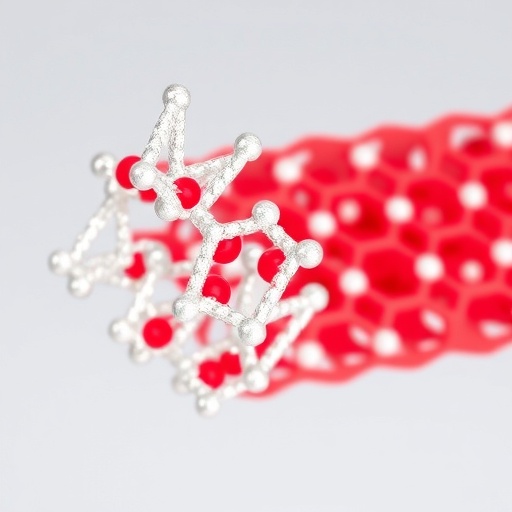
In the dynamic world of materials science, the quest for developing elastomers that combine both exceptional softness and steadfast toughness has taken a significant leap forward. A team of innovative researchers at the University of Osaka has pioneered a groundbreaking approach to toughen elastomers—a class of highly elastic polymers widely used in everyday products such as shock-absorbing sneaker soles. Their novel methodology, detailed in the prestigious journal Nature Communications, overcomes longstanding hurdles by orchestrating multiple energy dissipation mechanisms in a sequence that effectively shields the material from failure under increasing stress.
Elastomers are renowned for their extraordinary ability to deform and recover, a trait born from their unique polymeric structure that allows extensive stretching without permanent deformation. However, their Achilles’ heel resides in their relative fragility to cracking under concentrated force, which has historically restricted their applications in environments demanding high durability. Traditional attempts to enhance elastomer toughness primarily focused on integrating single methods of energy dissipation, which, while somewhat effective, fall short when facing the multifaceted stresses materials endure in real-world scenarios.
The research team tackled this limitation by integrating three distinct molecular mechanisms of energy dissipation—rotaxane molecular sliding, sacrificial bond cleavage, and chain entanglement—into a unified system that activates progressively as stress levels increase. This multi-path synergistic strategy serves not only to absorb and redistribute applied forces but also to methodically delay failure by harnessing the unique advantages of each mechanism in a carefully timed sequence.
At the heart of this innovation lies the utilization of rotaxane molecules—mechanically interlocked molecules capable of sliding and rotating when subjected to external forces. When embedded into the elastomeric network, these molecular rings act as minute shock absorbers, redistributing stress across the material and preventing localized concentration that typically initiates cracks. This initial mechanism provides a primary line of defense by facilitating smooth molecular movement even under dynamic load.
As the applied stress surpasses a critical threshold, the sacrificial bonds within these rotaxane rings begin to cleave, a process analogous to intentional molecular ‘breaking points.’ This controlled bond scission dissipates additional mechanical energy by sacrificing weaker parts of the molecular architecture, thus delaying propagation of damage into the bulk polymer matrix. Importantly, these bonds do not merely fracture the material but transform the molecular topology, converting rings into linear chains that introduce new mechanical interactions.
Under even greater stress, the now-linear chains engage in a phenomenon known as chain entanglement, where polymer chains intertwine and form transient knots that further enhance toughness by distributing tension throughout the network. This molecular rearrangement acts as a final, robust defense, ensuring the material maintains its structural integrity while continuing to dissipate energy through chain slippage and movement.
The systematic activation of these three pathways—molecular sliding, sacrificial bond cleavage, and chain entanglement—represents a seminal advance in polymer engineering. It mirrors biological strategies found in natural materials, such as the complex hierarchical structures in cartilage or muscle tissue, which similarly rely on sequential energy dissipation mechanisms to prevent damage under mechanical stress.
This sophisticated molecular choreography not only imbues the elastomer with superior toughness but also retains its inherent softness, a vital attribute for applications requiring flexibility and comfort. The implications for industries ranging from automotive to biomedical devices are profound. For example, tires manufactured with such elastomers could exhibit longer lifespans and enhanced safety by better absorbing impacts, while gloves and adhesives could achieve unprecedented durability without sacrificing tactile performance.
Beyond immediate commercial impacts, this research opens new avenues for the rational design of smart materials capable of adapting their mechanical properties dynamically in response to environmental stimuli. By finely tuning the sequence and nature of molecular transformations at multiple scales, engineers may soon develop elastomers and other polymers with customizable toughness profiles optimized for specific applications.
Moreover, the approach exemplifies how detailed understanding of molecular architecture and mechanics can translate into tangible improvements at the macroscopic level—the very interface between human users and their technologies. It also paves the way for more sustainable material usage, as longer-lasting polymers reduce waste and energy consumption related to frequent replacements.
This paradigm shift is underpinned by rigorous experimental validation, where the Osaka research group meticulously synthesized and characterized the novel elastomer systems, employing advanced spectroscopic and mechanical testing techniques to elucidate the interplay of molecular events during deformation. Such comprehensive analysis confirmed the sequence of toughening mechanisms and established the strong correlation between molecular design and macroscopic performance.
The publication titled “Toughening Elastomer via Sequentially Activated Multi-Pathway Energy Dissipation” details these findings and can serve as a cornerstone reference for material scientists and engineers worldwide. As industries continually seek to balance flexibility, durability, and performance, the innovations emerging from this study underscore the transformative potential of molecular engineering in overcoming longstanding material challenges.
With elastomer toughness no longer constrained by singular energy dissipation pathways, this breakthrough brings us closer to a future in which everyday materials are not only smarter but also significantly more resilient, adapting seamlessly to the demands of their environment while maintaining essential physical qualities.
News Publication Date: 1-Jul-2026
Web References: https://doi.org/10.1038/s41467-026-74148-z
References:
University of Osaka. (2026). Toughening Elastomer via Sequentially Activated Multi-Pathway Energy Dissipation. Nature Communications.
Keywords
Elastomer, Polyurethane, Toughening, Energy Dissipation, Rotaxane, Sacrificial Bonds, Chain Entanglement, Polymer Engineering, Molecular Sliding, Mechanical Properties, Soft Materials, Polymer Chemistry
Cite Scienmag News
Denise Maddox. (July 1, 2026). Polymers Adapt Their Structure to Prevent Failure and Maintain Elastomer Toughness. Scienmag. https://scienmag.com/polymers-adapt-their-structure-to-prevent-failure-and-maintain-elastomer-toughness/
Denise Maddox. "Polymers Adapt Their Structure to Prevent Failure and Maintain Elastomer Toughness." Scienmag, 1 July 2026, https://scienmag.com/polymers-adapt-their-structure-to-prevent-failure-and-maintain-elastomer-toughness/. Accessed 4 September 2026.
Denise Maddox. "Polymers Adapt Their Structure to Prevent Failure and Maintain Elastomer Toughness." Scienmag. July 1, 2026. https://scienmag.com/polymers-adapt-their-structure-to-prevent-failure-and-maintain-elastomer-toughness/


