


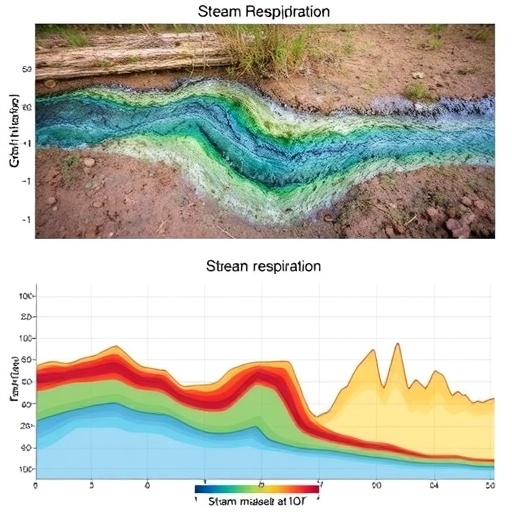
In the intricate web of stream ecosystems, the processes that govern respiration—an essential metabolic function reflecting the exchange of gases and energy—have long been a subject of intense scientific inquiry. Recent groundbreaking research published in Communications Earth & Environment has unveiled a surprising revelation: sediment-associated processes overshadow other ecological factors in driving spatial variations in stream ecosystem respiration. This insight transforms our understanding of how these freshwater systems operate and respond to environmental changes, with profound implications for ecosystem management and climate models.
Ecosystem respiration in streams encompasses the total metabolic activity, including the consumption of oxygen as organic matter is broken down by microbes, plants, and animals. Traditionally, attention has focused on the water column and primary producers like algae and aquatic plants as the main drivers of these respiration dynamics. However, the study by Garayburu-Caruso and colleagues shifts this paradigm by highlighting the dominant role of sediments which, despite their apparent inertness, provide the primary framework for respiratory variability across diverse stream habitats.
The researchers undertook a rigorous spatial analysis across multiple stream sites characterized by varied physical, chemical, and biological conditions. By integrating advanced field measurements with high-precision laboratory assays, they quantified the respiration rates directly associated with sediments and compared these to contributions from water column processes. Their results consistently indicated that sediments account for a substantial majority of the metabolic activity that accounts for spatial respiration differences.
Delving deeper into the sediment processes, the study sheds light on the complex interactions within the benthic microenvironment. Sediments serve as reservoirs for organic material and harbor dense microbial communities that mediate the breakdown and mineralization of organic compounds. The heterogeneity in sediment composition—including grain size, organic content, and redox potential—creates microhabitats where respiration rates can fluctuate dramatically even over short spatial scales. This patchiness, the study emphasizes, is a key factor in the overall spatial patterns observed in stream respiration.
Moreover, the physicochemical properties of sediments influence microbial community structure and activity profoundly. The availability of electron acceptors such as oxygen, nitrate, and sulfate varies with sediment depth and flow dynamics, dictating the metabolic pathways predominant in these strata. This complex redox layering supports diverse microbial metabolisms—from aerobic respiration near the sediment-water interface to anaerobic processes deeper down—each contributing uniquely to the cumulative respiratory output.
Beyond regional spatial variation, the research documents temporal dynamics where sediment respiration responds sensitively to environmental perturbations like shifts in temperature, flow regime, and organic matter input. These dynamic responses underscore the critical role of sediment processes not just as static contributors but as active mediators of ecosystem function and resilience in the face of changing climatic and hydrological conditions.
This paradigm-shifting emphasis on sediments challenges conventional monitoring and modeling approaches for freshwater ecosystems worldwide. Traditionally, stream respiration estimates have predominantly relied on measurements of dissolved oxygen fluctuations in the water column, often neglecting the sediment compartment. The findings advocate for an integrated assessment framework that explicitly incorporates sediment processes to achieve more accurate, predictive ecosystem models.
From a global carbon cycling perspective, these insights are especially timely. Streams and rivers are recognized as hotspots for carbon processing and emissions, contributing significantly to greenhouse gas fluxes. Understanding the sediment-driven variability in respiration enhances our capacity to predict how aquatic ecosystems modulate carbon budgets and respond to anthropogenic pressures such as nutrient loading, land use change, and climate warming.
The methodological advancements employed in this study also set a new benchmark for ecological research. The team combined fine-scale in situ respirometry with remote sensing and molecular analyses, enabling an unprecedented resolution of spatial data across ecosystems. This multidisciplinary approach not only confirmed sediment dominance but also identified specific biogeochemical signatures linked to respiration hotspots, paving the way for targeted conservation and restoration efforts.
Furthermore, the study’s integration of microbial ecology with sediment chemistry highlights emerging frontiers in understanding ecosystem functioning. Decoding the genetic and metabolic pathways that underpin microbial respiration within sediments could revolutionize biomonitoring and ecosystem health assessments, offering early-warning indicators of ecological stress and degradation.
As freshwater ecosystems face mounting threats globally, insights into the drivers of their fundamental processes—such as respiration—are indispensable for sustainable management. By revealing sediments as the pivotal arena for respiration variability, this research calls for a reevaluation of conservation priorities and intervention strategies that have historically overlooked benthic environments.
The broader scientific community has embraced this discovery as a crucial piece in the puzzle of aquatic ecosystem dynamics. It corroborates and extends theoretical frameworks positing that habitat structure and microbial consortia within sediments are not merely passive substrates but active engines of ecosystem metabolism.
Thus, the contribution of Garayburu-Caruso and colleagues represents a landmark advance in stream ecology, enhancing our conceptual models and broadening the horizon for future research. It encourages scientists, policymakers, and environmental managers to look beneath the surface—to the sediments—and recognize their critical role in sustaining stream ecosystem vitality and biogeochemical cycles.
In conclusion, as we endeavor to confront pressing environmental challenges, harnessing such mechanistic understanding of ecosystem respiration is a key step. Sediment-associated processes emerge not only as dominant but as indispensable components defining the spatial heterogeneity and functional capacity of stream ecosystems across landscapes. This newfound perspective propels freshwater science into a new era where benthic processes take center stage in unraveling the complexities of life beneath flowing waters.
Cite Scienmag News
Violet Maxwell. (June 30, 2026). Sediment Drives Spatial Differences in Stream Respiration. Scienmag. https://scienmag.com/sediment-drives-spatial-differences-in-stream-respiration/
Violet Maxwell. "Sediment Drives Spatial Differences in Stream Respiration." Scienmag, 30 June 2026, https://scienmag.com/sediment-drives-spatial-differences-in-stream-respiration/. Accessed 3 September 2026.
Violet Maxwell. "Sediment Drives Spatial Differences in Stream Respiration." Scienmag. June 30, 2026. https://scienmag.com/sediment-drives-spatial-differences-in-stream-respiration/


