


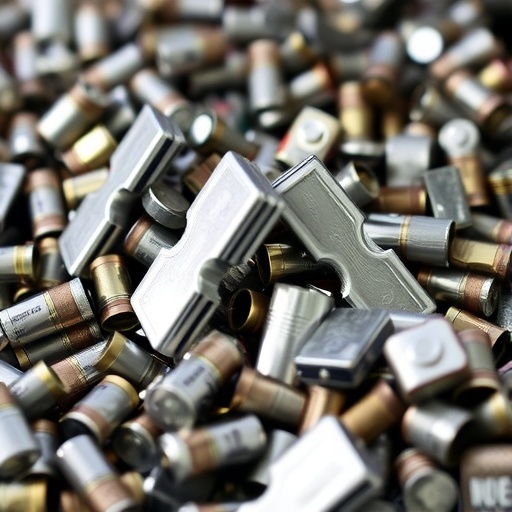
In the quest for a more sustainable future, the recycling of metals from spent rechargeable batteries has emerged as a critical environmental and economic challenge. Researchers at Chalmers University of Technology in Sweden have pioneered an innovative approach that promises to transform the metal recovery landscape by utilizing renewable biomass-derived chemicals. This breakthrough offers a safer, more environmentally friendly alternative to traditional, fossil-based solvents while maintaining the necessary efficiency and purity standards essential for battery manufacturing and other high-value industrial applications.
The global surge in energy demand, driven by rapid advancements toward renewable energy systems and electric vehicles, underscores the importance of efficient energy storage solutions. Batteries, laden with critical metals such as copper, cobalt, lithium, and manganese, are central to this transformation. However, these metals are finite and largely sourced outside Europe, posing supply risks exacerbated by geopolitical tensions and market concentration. The European Union’s Critical Raw Materials Act highlights the precarious nature of such dependencies, emphasizing the urgent need for sustainable recycling techniques capable of ensuring a stable supply chain while mitigating environmental and safety impacts.
Battery production demands metals of exceptional purity, particularly for cutting-edge applications. Recycling processes must therefore not only extract metals but also achieve a degree of separation and refinement that prevents contamination with hazardous substances. Historically, impurities like mercury were tolerated or even intentionally added—for instance, mercury extended the shelf life of zinc electrodes in disposable batteries. Today, higher purity requirements have enabled manufacturers to eliminate such toxic additives, enhancing both product safety and environmental outcomes. The degradation of metal quality through substandard recycling threatens this balance, underscoring the need for advanced purification methods.
Metal recycling industrial procedures often employ solvent extraction, a sophisticated technique involving the transfer of metals from aqueous phases into organic solvents. This method relies on extractants—molecules that bind selectively to target metals—and diluents, which dissolve these extractants to create functional organic phases. Conventional diluents are predominantly derived from petroleum feedstocks, raising concerns about sustainability, human safety, and environmental toxicity. The Chalmers team focused on substituting these with aromatic compounds sourced from renewable biomass, such as forestry by-products, thereby cutting reliance on fossil resources without disrupting existing manufacturing infrastructure.
The research specifically examined two biomass-derived aromatic diluents, assessing their efficacy in the selective extraction of key metals from spent batteries. These compounds demonstrated extraction performance on par with, and in some cases surpassing, that of well-established commercial solvents. Crucially, the new diluents could be seamlessly integrated into current industrial solvent extraction processes, thus eliminating costly retrofits or plant modifications that frequently obstruct the adoption of greener technologies in heavy industry. This pragmatic compatibility could accelerate the transition to safer, sustainable chemical use in metal recovery.
Beyond their extraction capacity, the novel aromatic diluents possess significantly higher flash points and reduced volatility compared to traditional solvents. This dual advantage lowers the risk of combustion hazards and minimizes worker exposure to toxic emissions, addressing major industrial safety concerns. Many established solvents degrade into neurotoxic by-products with detrimental effects on human and animal nervous systems. By contrast, the Chalmers compounds are designed to avoid such degradative pathways, representing a substantial step forward in occupational and environmental health standards.
Mark Foreman, Associate Professor at Chalmers and co-author of the study, emphasizes that maintaining the quality of recycled metals is not solely an economic imperative but a safeguard for the entire lifecycle of recycled materials. Without rigorous purification, recycled metals risk becoming too contaminated for use in advanced applications, effectively negating the ecological benefits of recycling. This research thus sets a new benchmark for sustainable chemistry practices in the circular economy, promising to uphold both metal integrity and environmental stewardship.
Daniel Keywan Hoffmann, a PhD student and lead researcher, points out that the successful demonstration of renewable diluents highlights an underestimated route to greener industrial chemistry: substituting existing chemicals rather than complete process reinvention. The compatibility of these bio-based solvents with current solvent extraction units suggests industries can enhance sustainability affordably by swapping hazardous materials for safer alternatives, bypassing expensive capital investments and extensive downtime.
Implementing renewable aromatic diluents on a commercial scale will require further optimization of manufacturing methods and an upscaling of biomass feedstock availability. However, this challenge aligns with broader trends in the forestry and bioproduct sectors, which increasingly valorize waste streams as raw materials for high-tech chemical production. Leveraging these synergies could foster a circular bioeconomy, linking battery recycling with sustainable forestry management and green chemical manufacturing.
The implications for environmental safety are profound. The shift to renewable diluents reduces the ecological footprint of metal recovery by decreasing emissions of volatile organic compounds and eliminating neurotoxic degradation products. In addition, safer handling conditions lower health risks for workers in facilities engaged in large-scale solvent extraction processes. Such improvements contribute to the United Nations Sustainable Development Goals by fostering safer industrial environments and promoting resource efficiency.
This academic advance comes at a pivotal moment as nations worldwide ramp up electric battery production to meet decarbonization targets. Europe, in particular, is striving to obtain greater autonomy over critical materials supply chains, with recycling poised as a cornerstone strategy. Innovations like those from Chalmers University could thus play a decisive role in closing material loops, reducing dependence on imports, and elevating the sustainability profile of battery technologies critical to the green economy.
In summary, the Chalmers research offers a compelling blueprint for greener, safer, and economically feasible metal recycling processes. By harnessing biomass-derived aromatic compounds as solvent extraction diluents, the study illustrates a path to enhance the purity of recycled metals while mitigating environmental and health hazards. It exemplifies how incremental yet strategic chemical substitutions can catalyze significant sustainability gains in industrial operations, charting a course toward a more resilient and responsible materials economy.
News Publication Date: Not explicitly provided; article publication date is 7-May-2026
Web References:
- Study DOI: 10.1039/D6SU00096G
- EU Critical Raw Materials Act infographic: https://www.consilium.europa.eu/en/infographics/critical-raw-materials/
References:
- Hoffmann, D.K. et al. “Safer aromatic process diluents for solvent extraction of critical metals from spent batteries,” RSC Sustainability, 7-May-2026, DOI: 10.1039/D6SU00096G.
Keywords
Battery recycling, solvent extraction, renewable biomass, aromatic diluents, metal recovery, critical raw materials, sustainability, green chemistry, solvent toxicity, circular economy, cobalt recycling, lithium recovery
Cite Scienmag News
Faith Mcneil. (July 1, 2026). Advancing Safer Metal Recycling Technologies in the Battery Industry. Scienmag. https://scienmag.com/advancing-safer-metal-recycling-technologies-in-the-battery-industry/
Faith Mcneil. "Advancing Safer Metal Recycling Technologies in the Battery Industry." Scienmag, 1 July 2026, https://scienmag.com/advancing-safer-metal-recycling-technologies-in-the-battery-industry/. Accessed 5 September 2026.
Faith Mcneil. "Advancing Safer Metal Recycling Technologies in the Battery Industry." Scienmag. July 1, 2026. https://scienmag.com/advancing-safer-metal-recycling-technologies-in-the-battery-industry/


