



view more
Credit: International Innovation Center for Forest Chemicals and Materials, College of Materials Science and Engineering, Nanjing Forestry University, Nanjing 210037, China
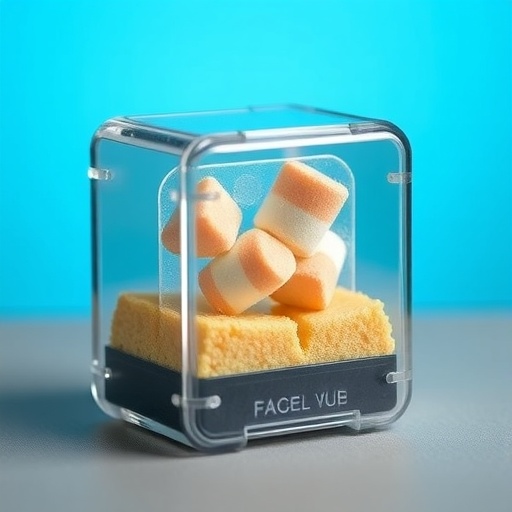
A study published in the Journal of Bioresources and Bioproducts reports a novel dual-scale encapsulation strategy for thermal energy storage using bio-derived palmitic acid and nanocellulose. The research team employed Pickering emulsion technology to encapsulate palmitic acid into microcapsules stabilized by nanocellulose fibers, then embedded these microcapsules into a nanocellulose aerogel skeleton via directional freeze-drying. This hierarchical architecture creates a composite phase change material with a dual microcapsule-aerogel coating structure. Even with a high palmitic acid loading of 88.9%, the composite exhibited excellent shape stability and leakage resistance, with a cumulative leakage rate of only 0.03% after heating at 80°C for 120 minutes. The material achieved a latent heat of 183 J/g, along with good thermal cycling stability and reversibility over 100 heating-cooling cycles. Notably, the abundant hydroxyl groups on the nanocellulose surface served as heterogeneous nucleation sites, effectively suppressing supercooling from 3.6°C to 1.4°C. The composite also demonstrated remarkable thermal buffering and regulation capabilities, with the highest-loading sample requiring 380 seconds to reach 59.5°C during heating compared to just 70 seconds for the pure aerogel. The work provides a scalable green approach for developing high-performance composite phase change materials.
The increasing depletion of conventional fossil fuels and the intermittent nature of renewable energy sources have underscored the urgent need for efficient thermal energy storage technologies. Solid-liquid phase change materials are considered among the most promising approaches due to their high energy storage density, yet practical applications are often hindered by leakage, poor cycling stability, and supercooling issues. Existing encapsulation strategies each present limitations: microencapsulation offers excellent sealing but involves complex preparation and high costs, while porous scaffold encapsulation struggles with the pore size trade-off between loading capacity and leakage prevention. The new dual-scale strategy overcomes these individual limitations by fusing the leakage-proof storage capability of microcapsules with the structural stability of the nanocellulose aerogel. The researchers found that palmitic acid, with its longer carbon chain, formed stronger hydrophobic interactions with nanocellulose compared to lauric acid, enabling higher encapsulation capacity. The resulting composite maintained approximately 93% porosity even at the highest loading, and exhibited anisotropic mechanical properties with excellent energy absorption along the axial direction. The strategy relies on simple preparation using renewable raw materials, offering a new design concept for polymer-based composite phase change materials in applications ranging from building energy efficiency to thermal management of electronic devices.
See the article:
Original Source URL
Journal
Journal of Bioresources and Bioproducts
Journal
Journal of Bioresources and Bioproducts
Method of Research
Experimental study
Subject of Research
Not applicable
Article Title
Dual-Scale Encapsulation via Pickering Emulsion Microencapsulation in Nanocellulose Aerogel for Thermal Energy Storage
Article Publication Date
22-Jun-2026
Huicong Cao
Journal of Bioresources and Bioproducts
zhaochuanyu0320@gmail.com
Cell: 8259868744
Journal
Journal of Bioresources and Bioproducts
Method of Research
Experimental study
Subject of Research
Not applicable
Article Title
Dual-Scale Encapsulation via Pickering Emulsion Microencapsulation in Nanocellulose Aerogel for Thermal Energy Storage
Article Publication Date
22-Jun-2026
Tags
Cite Scienmag News
Bethany Barker. (June 23, 2026). Dual-Scale Encapsulation Technique Produces Leak-Proof Biomass-Based Phase Change Materials. Scienmag. https://scienmag.com/dual-scale-encapsulation-technique-produces-leak-proof-biomass-based-phase-change-materials/
Bethany Barker. "Dual-Scale Encapsulation Technique Produces Leak-Proof Biomass-Based Phase Change Materials." Scienmag, 23 June 2026, https://scienmag.com/dual-scale-encapsulation-technique-produces-leak-proof-biomass-based-phase-change-materials/. Accessed 4 September 2026.
Bethany Barker. "Dual-Scale Encapsulation Technique Produces Leak-Proof Biomass-Based Phase Change Materials." Scienmag. June 23, 2026. https://scienmag.com/dual-scale-encapsulation-technique-produces-leak-proof-biomass-based-phase-change-materials/

