


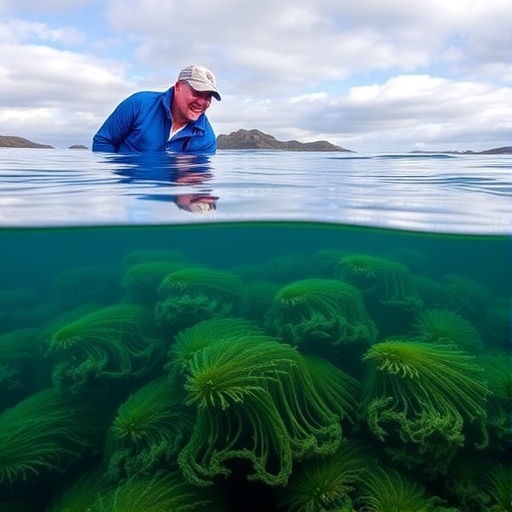
In the remote and harshly windswept reaches of Tierra del Fuego, at the icy tip of South America, lies Inútil Bay—a marine environment that until recently has guarded its underwater ecosystems in near-total secrecy. This isolation, born of severe meteorological conditions and formidable logistical challenges, has left the bay’s intertidal and subtidal rocky environments virtually unexplored. However, a groundbreaking interdisciplinary scientific expedition, spearheaded by a coalition of institutions including Argentina’s CADIC-CONICET and the Universidad Nacional de Tierra del Fuego and supported by Rewilding Chile’s Marine Program, has for the first time conducted an exhaustive survey of the benthic macroalgae that populate this sub-Antarctic region. This expedition has unveiled a vibrant and diverse underwater landscape that significantly enriches the understanding of Magellanic marine biodiversity and ecosystem dynamics.
The research team applied rigorous scientific diving methodologies combined with structured sampling approaches in six strategically chosen locations along both the northern and southern shores of Inútil Bay. Employing 25-meter line transects and photo-quadrat imaging techniques, the investigators systematically documented the distribution and diversity of macroalgal species. These methodologies enabled precise spatial mapping and abundance estimates of macroalgae, which are critical ecosystem engineers shaping the physical habitat structures of rocky intertidal and subtidal zones. Through these careful and labor-intensive methods, the team was able to overcome the traditional difficulties posed by the bay’s adverse conditions, generating data of unprecedented breadth and accuracy for this region.
The macroalgal communities uncovered in Inútil Bay revealed an extraordinary range of biodiversity, encompassing a total of 72 distinct taxa. This figure substantially expands the known phytogeographic catalog of the Magellanic region, an area previously underrepresented in global marine biodiversity datasets. Among the 72 taxa identified, 32 species were recorded in the variable intertidal zones, while 58 taxa were documented in the more stable subtidal habitats. These species span across the three classical macroalgal groups—green algae (Chlorophyta), brown algae (Phaeophyceae), and red algae (Rhodophyta)—each fulfilling integral ecological roles in these coastal ecosystems.
Particularly notable was the dominance of canopy-forming kelp species such as Macrocystis pyrifera and Lessonia flavicans. These kelps contribute substantially to habitat complexity by providing vertical structure and shelter for diverse marine organisms, enhancing local biodiversity and fostering rich food webs. Alongside these dominant taxa, common species such as Ptilonia magellanica were widespread, creating additional layers of habitat structure across the bay. The presence of such foundational species highlights the ecological significance of Inútil Bay as a refuge and nursery for marine life in the sub-Antarctic environment.
Intriguingly, the survey also documented the presence of rare and highly unusual macroalgal species, which underscore the unique evolutionary pathways and biogeographical isolation of this region. Among these was Microzonia velutina, a little brown macroalga rarely recorded elsewhere. The discovery of such species adds valuable data points to the global understanding of macroalgal diversity and distribution, potentially influencing theories related to species dispersal, adaptation, and conservation in extreme environments.
Beyond biodiversity assessments, benthic macroalgae play multifaceted roles in both local and global ecological processes. As ecosystem engineers, they actively shape physical habitats, creating complex environments that support intricate food webs and contribute significantly to regional biodiversity resilience. Additionally, these macroalgal forests function as important blue carbon sinks, aiding in the sequestration of atmospheric carbon dioxide and thereby contributing to global climate mitigation efforts. Their ability to act as sensitive bioindicators further allows scientists to monitor environmental health and anthropogenic impacts, including pollution and climate-related stressors.
The comprehensive dataset generated by this expedition has been meticulously preserved, with all collected specimens housed at the Rewilding Chile Herbarium in Puerto Varas. This repository ensures the long-term availability of valuable taxonomic material for ongoing and future research endeavors, facilitating enhanced monitoring, early detection of invasive species, and informed conservation planning for southern Patagonian marine ecosystems. These efforts are vital for establishing baseline conditions against which environmental changes can be assessed over time.
In a strategic move to foster further collaborative research and strengthen institutional networks, the team is currently forging alliances with prominent organizations such as the National Museum of Natural History of Chile. Notably, specimens from prior expeditions, including an icefish larva (Champsocephalus esox) and the enigmatic Microzonia velutina, have already been deposited in the museum’s collections. This partnership promises to enhance scientific exchange, educational outreach, and public engagement around the fragile and biologically rich ecosystems of Tierra del Fuego and beyond.
The publication of these findings in the Biodiversity Data Journal marks a significant milestone. It not only fills critical gaps in the biogeographical puzzle of sub-Antarctic coastal environments but also provides a robust foundation for interdisciplinary research that spans marine biology, ecology, conservation, and climate science. The detailed and methodical approach taken by the researchers sets a benchmark for future biodiversity assessments in similarly challenging habitats worldwide.
This pioneering survey underscores the urgency and importance of exploring and understanding remote ecosystems that are rapidly changing due to global climatic shifts. The rich macroalgal diversity of Inútil Bay exemplifies the hidden ecological treasures that remain unexplored in Earth’s most forbidding marine frontiers. By illuminating these underwater worlds, such research fosters global awareness and supports the formulation of evidence-based strategies necessary to safeguard the resilience and biodiversity of our planet’s marine ecosystems amidst mounting environmental pressures.
In conclusion, the successful expedition to the rocky ecosystems of Inútil Bay represents a significant leap forward in marine science, highlighting the vital roles of benthic macroalgae in ecosystem functioning and climate regulation. It exemplifies how interdisciplinary collaboration, cutting-edge field techniques, and strategic partnerships can unlock the secrets of the planet’s most remote and ecologically critical habitats, inspiring both the scientific community and the public towards greater stewardship of our natural world.
News Publication Date: 20-Apr-2026
Web References:
- Marine Program of Rewilding Chile: https://www.rewildingchile.org/en/projects/marine-program/
- CADIC-CONICET: https://cadic.conicet.gov.ar/
- Universidad Nacional de Tierra del Fuego: https://www.untdf.edu.ar/
- Biodiversity Data Journal Article: http://dx.doi.org/10.3897/BDJ.14.e183377
- National Museum of Natural History of Chile: https://www.patrimoniocultural.gob.cl/en/santiago-museums/national-natural-history-museum
References:
Kaminsky J, Palacios M, Rodríguez M, Hüne M (2026) Sub-Antarctic subtidal and intertidal macroalgae in rocky ecosystems of Inútil Bay, Tierra del Fuego in Southern Patagonia. Biodiversity Data Journal 14: e183377. DOI: 10.3897/BDJ.14.e183377
Cite Scienmag News
Margaret Porter. (June 22, 2026). Exploring Underwater: Mapping Seaweed Forests in the Remote Southern Patagonia Waters. Scienmag. https://scienmag.com/exploring-underwater-mapping-seaweed-forests-in-the-remote-southern-patagonia-waters/
Margaret Porter. "Exploring Underwater: Mapping Seaweed Forests in the Remote Southern Patagonia Waters." Scienmag, 22 June 2026, https://scienmag.com/exploring-underwater-mapping-seaweed-forests-in-the-remote-southern-patagonia-waters/. Accessed 3 September 2026.
Margaret Porter. "Exploring Underwater: Mapping Seaweed Forests in the Remote Southern Patagonia Waters." Scienmag. June 22, 2026. https://scienmag.com/exploring-underwater-mapping-seaweed-forests-in-the-remote-southern-patagonia-waters/


