


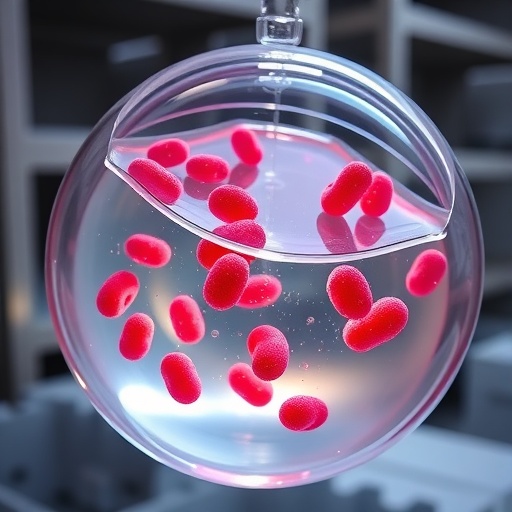
In a remarkable leap forward for regenerative medicine and pharmaceutical research, a pioneering protocol has emerged that promises to revolutionize the mass production of human pluripotent stem (hPS) cells. Traditional methodologies have long relied on adherent two-dimensional (2D) cell cultures as precursors for bioreactor inoculation, presenting numerous bottlenecks including labor intensity, poor process control, and limited scalability. This novel approach bypasses those hurdles by enabling the direct inoculation of bioreactors with cryopreserved hPS cells cultured in a three-dimensional (3D) suspension environment. The implications of this advance are vast, potentially redefining the landscape of stem cell bioprocessing through enhanced efficiency, standardization, and automation potential.
Human pluripotent stem cells hold transformative promise due to their ability to differentiate into any somatic cell type, creating a cornerstone for tissue engineering, regenerative therapies, and high-throughput drug screening. However, the scalable culture and expansion of these cells have faced persistent challenges. Existing suspension culture strategies using stirred-tank bioreactors (STBRs) have improved volume capacities but remain tethered to 2D precursor cultures, which are resource-demanding and complicate full automation. The newly established protocol dismantles this dependency by cultivating hPS cell aggregates directly within the controlled environment of STBRs, integrating automated mechanical dissociation processes to transition cells without enzymatic intervention.
A central innovation of this technique lies in its nonenzymatic, EDTA-based dissociation of hPS cell aggregates directly in the bioreactor setting. EDTA acts by chelating calcium ions necessary for cell-cell adhesion, facilitating gentle aggregate disaggregation when coupled with precisely controlled mechanical stirring via impeller rotation. This methodology circumvents potential cellular damage associated with enzymatic treatments, maintaining high cell viability and pluripotent integrity. Furthermore, controlling dissociation mechanically within the bioreactor enables real-time adjustments and uniformity across batches—an important advance for industrial-scale cell manufacturing.
Beyond the mechanical dissociation, the produced single-cell suspensions exhibit remarkable utility. They can be directly cryopreserved into high-density stocks using controlled-rate freezing, ultimately creating a readily available resource for subsequent bioreactor inoculations. This cyclical capability diminishes dependency on traditional 2D precultures, markedly reducing process time, labor, and contamination risk. Moreover, it presents a streamlined seed train-based upscaling strategy, where each subsequent bioreactor culture can be promptly inoculated from cryopreserved stocks. This bioprocess modularity stands to accelerate both research timelines and clinical manufacturing pipelines.
The comprehensive protocol outlines a detailed timeline encompassing cell thawing, bioreactor preparation, inoculation, 3D culture expansion, and aggregate dissociation. Remarkably, the entire bioreactor preparation phase can be completed within two days, while direct bioreactor inoculation with cryopreserved cells requires approximately ninety minutes. The 3D bioreactor culture then proceeds for three to four days before aggregate dissociation is performed over another two-hour period. By comparison, conventional 2D preculture alone demands a nine-day incubation, underscoring the dramatic time savings rendered by this technique.
Scalability and quality control remain the cornerstones of this method’s appeal. By maintaining karyotype stability and pluripotency markers over multiple passages in suspension cultures, researchers can be assured of the biological integrity of the cells produced. This continuous preservation of genetic and functional properties reinforces the protocol’s value for both laboratory research and clinical-grade manufacturing. The resulting cell populations exhibit robust growth, differentiation potential, and stability, essential for therapeutic applications aiming at high fidelity and safety.
The advent of this bioprocess-centric innovation also opens new avenues in process automation and standardization. Owing to the omission of labor-intensive 2D cultures and the integration of mechanical dissociation directly within the stirred-tank environment, many manual interventions can be reduced or eliminated. This creates promise for easier adaptation to closed, automated bioreactor systems that align with Good Manufacturing Practice (GMP) standards, a prerequisite for clinical translation. Consequently, industrial stakeholders and academic researchers alike can benefit from reduced production costs and enhanced reproducibility.
From a technical perspective, controlling the shear forces exerted by the impeller during dissociation is critical to avoid cell damage and ensure consistent cell yields. Optimization of stirring rates and EDTA concentrations is thus integral to standardizing the process. The controlled mechanical environment also facilitates uniform nutrient and oxygen distribution, supporting aggregate formation, growth, and harvest in one integrated system. Such fine-tuning is a testament to the sophistication achievable through modern bioreactor engineering when paired with tailored chemical treatments.
Therapeutically, the implications are profound. The ability to generate large quantities of high-quality hPS cells rapidly and reproducibly serves as a crucial bottleneck alleviator for downstream applications such as tissue engineering and personalized medicine. Rapid scale-up potential permits faster development of cell-based therapeutics, while the maintenance of functional pluripotency guarantees that these cells can effectively differentiate into target lineages. The protocol thus presents a vital link between stem cell biology and clinical applicability.
Environmental and economic considerations further accentuate the protocol’s significance. By diminishing reagent use and manual labor associated with 2D culture, this suspension culture method promises a smaller carbon footprint and cost-effective production. Moreover, the long-term cryostorage capability of the cell suspensions allows for robust supply chain management, enabling stockpiling of clinical-grade cells without continuous culture maintenance. These efficiencies pave the way for more sustainable cell therapy manufacturing frameworks.
Importantly, the accessibility of this protocol is notable. Designed for implementation by scientists familiar with cell culture techniques but without extensive bioprocess expertise, it democratizes cutting-edge stem cell production technologies. Institutions lacking large-scale cell manufacturing facilities or specialized automation equipment can still adopt the methodology, broadening its impact across the scientific community. This inclusiveness promises accelerated adoption and innovation diffusion.
In sum, this groundbreaking protocol addresses some of the most persistent challenges in human pluripotent stem cell bioprocessing. By coupling direct inoculation of stirred suspension cultures from cryopreserved stocks with a controlled, nonenzymatic mechanical dissociation step, it unlocks unprecedented opportunities for high-quality, scalable hPS cell production. The combination of efficiency, scalability, quality preservation, and automation compatibility heralds a new era for stem cell biotechnology aimed at fulfilling the lofty ambitions of regenerative medicine and drug discovery.
As this protocol gains traction, its paradigm shift will likely inspire further advances in bioreactor design and stem cell culture conditions. The integration of real-time monitoring and artificial intelligence-driven process control could build on this foundational work, driving even greater yields and reproducibility. The capacity to cultivate and manipulate stem cells in more physiologically relevant 3D architectures at scale invites new explorations into cell behavior, disease modeling, and therapeutic development.
By fully bypassing the traditional 2D preculture bottleneck and offering a streamlined, standardized pathway from cryovial to large-scale bioreactor culture, this protocol redefines the operational blueprint for human pluripotent stem cell production. Its impact extends across academic research, clinical translation, and industrial manufacturing, positioning stem cell science for rapid and radical advancement in the coming years. This transformative approach represents a milestone in achieving efficient, flexible, and reliable hPS cell supply chains essential for future biomedical breakthroughs.
Cite Scienmag News
Denise Maddox. (June 22, 2026). Direct Inoculation of Bioreactors with Cryopreserved Stem Cells. Scienmag. https://scienmag.com/direct-inoculation-of-bioreactors-with-cryopreserved-stem-cells/
Denise Maddox. "Direct Inoculation of Bioreactors with Cryopreserved Stem Cells." Scienmag, 22 June 2026, https://scienmag.com/direct-inoculation-of-bioreactors-with-cryopreserved-stem-cells/. Accessed 4 September 2026.
Denise Maddox. "Direct Inoculation of Bioreactors with Cryopreserved Stem Cells." Scienmag. June 22, 2026. https://scienmag.com/direct-inoculation-of-bioreactors-with-cryopreserved-stem-cells/


