


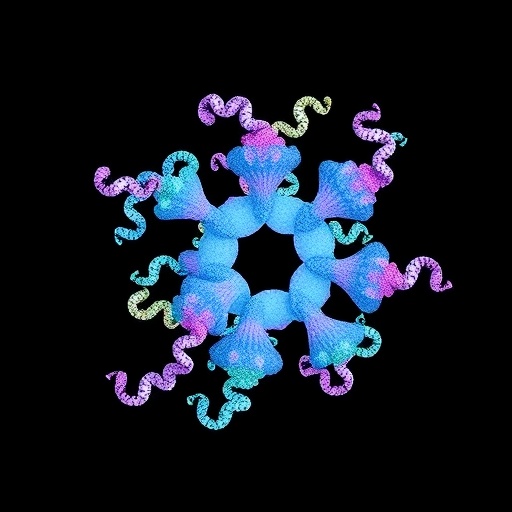
The Shanghai Synchrotron Radiation Facility (SSRF) has unveiled a landmark advancement in the realm of structural biology with its state-of-the-art protein microcrystallography beamline, BL18U1. As the first microcrystallography beamline constructed at a third-generation synchrotron light source in China, BL18U1 represents a critical leap forward, tailored to meet the demanding needs of structural biologists probing the intricacies of minuscule and challenging crystalline samples. This sophisticated platform integrates cutting-edge optical technology, high-precision instrumentation, and comprehensive automation to facilitate unprecedented resolution and throughput in crystallographic research.
At the heart of BL18U1’s innovation lies its finely tuned microbeam, which delivers a beam size of approximately 9.8 micrometers horizontally and 4.6 micrometers vertically at the sample stage. This precise beam geometry is meticulously optimized to address the diffraction requirements of protein microcrystals, membrane protein assemblies, and a spectrum of small-molecule crystals, many of which pose notable experimental challenges due to their diminutive size or inherent fragility. The beamline’s capacity to produce such a focused beam stems from an innovative optical design that ensures both stability and beam quality, critical factors underpinning reproducible, high-fidelity diffraction measurements.
The beamline operates within a versatile tunable energy window spanning from 5 to 18 keV. This energy flexibility empowers researchers to tailor experiments according to their specific scientific goals, encompassing conventional diffraction, absorption-edge spectroscopy, as well as specialized anomalous diffraction methods. Crucially, this adaptability enables the execution of experiments requiring precise energy selection such as multi-wavelength anomalous diffraction or sulfur-SAD phasing, which are indispensable for de novo structure determination particularly when heavy atom derivatives are unavailable.
Instrumental integration at BL18U1 epitomizes the fusion of cutting-edge hardware with sophisticated control systems. The MD2 microdiffractometer at the core of the experimental station offers ultra-precise crystal alignment, facilitating meticulous sample positioning at the micron and submicron scale. Complementing this is the Pilatus 3 6M detector, renowned for its rapid frame rates and high dynamic range, enabling rapid data acquisition without compromising the integrity of diffraction signals. The Rigaku ACTOR robotic sample changer markedly accelerates throughput by automating sample exchange, thereby minimizing downtime and enhancing reproducibility. Together with an advanced cryogenic cooling apparatus, these components converge to optimize experimental conditions, preserving crystal integrity throughout data collection phases.
The integration of the MXCuBE3 control software synergizes the hardware capabilities by providing an intuitive, streamlined interface for experiment management. This platform coordinates precise sample alignment, automated data collection sequences, and real-time feedback, enabling researchers to maximize efficiency and data quality with minimal manual intervention. The seamless operation of these integrated systems ensures that experimental workflows at BL18U1 are both robust and adaptable to a wide array of crystallographic inquiries.
Demonstrating its prowess, BL18U1 has routinely produced diffraction data of exceptional quality, pushing the boundaries of attainable resolution. Experiments using lysozyme crystals yielded diffraction patterns extending to a remarkable 1.28 Å resolution, with processing statistics underscoring excellent data completeness and signal-to-noise ratios. Such performance illustrates the beamline’s capacity to reveal atomic-level details critical for elucidating intricate biomolecular architectures, thereby enhancing the precision of subsequent structural modeling efforts.
Notably, BL18U1 excels in long-wavelength anomalous diffraction applications, with demonstrated capability at a wavelength of 2.02 Å. This feature is particularly significant for sulfur-SAD phasing, a method leveraging the intrinsic anomalous signals from endogenous sulfur atoms within proteins. The enhanced anomalous signals collected at BL18U1 facilitate reliable phase determination even in the absence of exogenous heavy atom labels, thus broadening the scope of structure determination for proteins that have historically evaded crystallographic characterization.
The impact of BL18U1 extends well beyond individual experiments, as evidenced by its substantial contribution to the Protein Data Bank (PDB). By the close of 2024, diffraction data collected at this beamline had been instrumental in the deposition of 1,687 macromolecular structures, predominantly within a high-resolution range between 1.5 and 2.5 Å. This impressive output underscores the beamline’s pivotal role in advancing the global structural biology community, enabling groundbreaking insights into protein function, enzymatic mechanisms, and drug-target interactions.
The transformative nature of BL18U1 is further amplified by its integrated approach that combines technical excellence with user-centric operational efficiency. Researchers benefit from a platform that streamlines the entire experimental lifecycle, from crystal mounting and alignment to data acquisition and initial processing. This holistic integration not only accelerates research timelines but also ensures reproducibility and methodological rigor, fostering an environment conducive to high-impact scientific discovery.
In addition to facilitating traditional crystallographic studies, BL18U1’s capabilities open new frontiers for analyzing complex biological systems that were previously intractable due to sample constraints. Microcrystals derived from membrane proteins and multi-protein assemblies often exhibit heterogeneity and limited size, challenges that BL18U1’s focused beam and sensitive detection systems are specifically designed to overcome. Through this, the beamline supports an expanding array of structural investigations, encompassing dynamic and functional states of biomolecules critical for biomedical innovation.
The strategic development of BL18U1 as part of the National Facility for Protein Science in Shanghai highlights China’s growing leadership in synchrotron-based research infrastructure. By providing a world-class experimental platform, SSRF not only bolsters domestic scientific capacity but also fosters international collaboration, enabling a diverse community of researchers to access cutting-edge tools for macromolecular crystallography. This fosters an inclusive scientific environment accelerating structural insights across a range of disciplines, from fundamental biology to pharmaceutical development.
Looking ahead, BL18U1’s integration of precision optics, advanced robotics, and adaptive software positions it as a cornerstone facility capable of meeting the evolving demands of structural biology. Its contributions to high-resolution diffraction, anomalous signal exploitation, and throughput efficiency demonstrate a model for next-generation synchrotron beamlines. As scientific questions grow increasingly complex, platforms like BL18U1 will remain indispensable for decoding the molecular machinery of life with unrivaled accuracy and speed.
Cite Scienmag News
Jason Bradley. (June 22, 2026). Shanghai Synchrotron Radiation Facility Launches Advanced Protein Microcrystallography Beamline (BL18U1). Scienmag. https://scienmag.com/shanghai-synchrotron-radiation-facility-launches-advanced-protein-microcrystallography-beamline-bl18u1/
Jason Bradley. "Shanghai Synchrotron Radiation Facility Launches Advanced Protein Microcrystallography Beamline (BL18U1)." Scienmag, 22 June 2026, https://scienmag.com/shanghai-synchrotron-radiation-facility-launches-advanced-protein-microcrystallography-beamline-bl18u1/. Accessed 4 September 2026.
Jason Bradley. "Shanghai Synchrotron Radiation Facility Launches Advanced Protein Microcrystallography Beamline (BL18U1)." Scienmag. June 22, 2026. https://scienmag.com/shanghai-synchrotron-radiation-facility-launches-advanced-protein-microcrystallography-beamline-bl18u1/


