


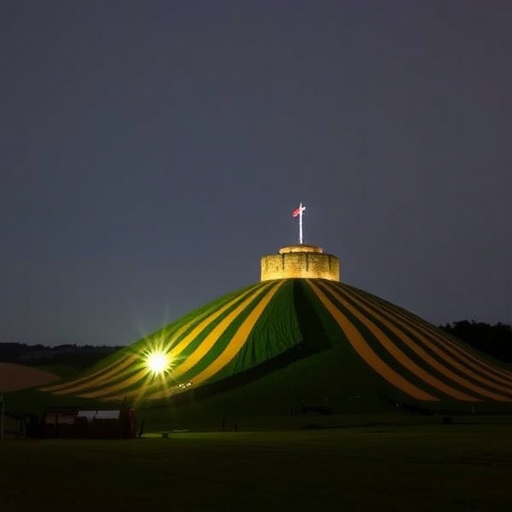
In a striking and evocative display of climate science communication, one of the United Kingdom’s most emblematic landmarks, Glastonbury Tor, has been illuminated with the iconic climate stripes devised by the University of Reading. This powerful visual symbol, projected onto St. Michael’s Tower—an ancient 14th-century structure perched upon the 521-foot hill in Somerset—serves not only as an artistic statement but also as an urgent call to recognize and confront the realities of anthropogenic climate change. By utilizing the well-recognized pattern of alternating blue and red stripes that indicate cooler and warmer years respectively, this installation connects a tangible national symbol with the often intangible data of global temperature trends, fostering public dialogue on the implications of a warming climate.
The climate stripes themselves were originally generated as a straightforward yet impactful method to illustrate the relentless increase in global surface temperatures since the pre-industrial era, specifically from 1850. Each vertical band in the projection corresponds to the temperature anomaly of a single year relative to a mid-20th century baseline average, encompassing 1961 to 2010. The gradual shift from predominately blue hues, denoting cooler years, to intense reds starkly reveals the persistent long-term trend of warming—a signature of human-driven impacts on the Earth’s climate system. This simple color-coded representation distills complex climate datasets into a universally comprehensible narrative, effectively bridging scientific evidence with public awareness.
The timing of this illuminating event coincides with Show Your Stripes Day, observed annually on June 20th, which aims to catalyze global engagement around climate change by encouraging communities to share and discuss their own stripe visualizations. This year’s event gains heightened significance amidst projections of extreme heat conditions across the UK, including the surrounding regions of Somerset. Such extreme weather episodes exemplify the increasing frequency and intensity of climatic anomalies fueled by rising greenhouse gas concentrations, underscoring the urgency of adaptation and mitigation strategies to safeguard vulnerable ecosystems and human livelihoods alike.
What makes the projection on Glastonbury Tor particularly resonant is its confluence with the Glastonbury Festival’s fallow year, a biennial pause in the cultural event designed to allow the environment to regenerate. This intentional rest period for the landscape symbolizes the broader imperative for society to also pause and reassess its relationship with natural systems. Yet, the unyielding glow of the climate stripes serves as a poignant reminder that environmental feedbacks and atmospheric warming are relentless forces, indifferent to societal schedules, demanding sustained commitment to addressing climate change.
Professor Ed Hawkins, the researcher who pioneered the climate stripes visualization, emphasizes that each stripe’s color gradient is derived from robust instrumental temperature records standardized to reveal deviations from the long-term climatological norm. The representation encapsulates variability and trend simultaneously—thereby communicating not only that the planet is warming but also that this warming is unprecedented in recorded human history. He highlights the symbolic potency of projecting these stripes onto an iconic heritage site, linking the abstract concept of global climate change intricately to places deeply embedded in cultural identity and historical lineage.
Furthermore, Hawkins points to the critical importance of intergenerational responsibility. While the temperature data points to a sobering trajectory, the future climate dispensation is not irrevocably fixed. Incremental reductions in emissions, changes in land use, and adoption of renewable technologies can meaningfully alter the course, limiting warming to levels that minimize ecological and societal disruption. Such scientific optimism is reinforced by the vigorous engagement of young people worldwide who are increasingly becoming leaders in climate science, policy advocacy, and sustainable innovation, signaling a potential pivot toward a more climate-resilient future.
Keith Jones, senior climate specialist at the National Trust, echoes this sentiment by connecting climate change impacts directly to heritage conservation challenges. The UK’s natural and built environments are experiencing unprecedented stress induced by shifting weather patterns—ranging from prolonged droughts to intense flooding. In regions such as Somerset, these oscillations manifest starkly, threatening biodiversity, soil health, and agricultural productivity. The illumination of Glastonbury Tor with climate stripes thus embodies a tangible manifestation of these climatic strains, advocating for immediate action to mitigate further damage.
Critical to the success of these visual campaigns is their capacity to simplify complex datasets into accessible and aesthetically compelling messages without sacrificing scientific rigor. The climate stripes have transcended scientific literature to become a ubiquitous symbol across various sectors—including infrastructure, sportswear, and public art—helping to embed climate awareness into diverse societal dialogues. This diffusion into public consciousness assists in combating denial and apathy by presenting empirical climate data through a universally understandable medium.
Researchers continue to update these stripe patterns annually, incorporating the most recent temperature data to maintain their relevance and accuracy. The latest updates utilize 2025 datasets, reflecting the near-real-time evolution of the climate system. Such temporal resolution ensures that the visualization remains a living document of our changing world, highlighting ongoing trends and prompting continual public engagement. These resources are freely available to the international community through platforms such as showyourstripes.info, encouraging global participation in climate communication.
Scientific communication initiatives like the illumination of Glastonbury Tor reaffirm the critical role of interdisciplinary collaborations—melding climatology, heritage conservation, and public outreach—to foster comprehensive climate literacy. As the climatic and societal landscapes evolve, integrating scientific evidence with cultural narratives becomes increasingly essential. The societal response to climate change hinges not only on technological solutions but also on forging shared understandings and values that motivate collective action.
In conclusion, the projection of climate stripes onto Glastonbury Tor stands as a compelling metaphor for the intersection of past, present, and future. It bridges centuries of cultural history with the unfolding story of Earth’s climate, inviting a wide audience to visualize and confront the stark realities of warming trends that imperil natural and human systems alike. This visual articulation challenges individuals and communities to recognize their roles in influencing—and potentially reversing—the trajectory of climate change, underscoring that informed choices today resonate profoundly for generations to come.
News Publication Date: June 20, 2026
Web References:
- University of Reading climate stripes project: http://showyourstripes.info/
- Expert UK heatwave commentary: https://www.reading.ac.uk/news/2026/Expert-Comment/UK-June-heatwave-alert-expert-comment
- Real-time UK temperature tracking: https://istheukhotrightnow.com/
Cite Scienmag News
Sloane Callahan. (June 22, 2026). Glastonbury Tor Displays Stripes to Spark Climate Change Dialogue. Scienmag. https://scienmag.com/glastonbury-tor-displays-stripes-to-spark-climate-change-dialogue/
Sloane Callahan. "Glastonbury Tor Displays Stripes to Spark Climate Change Dialogue." Scienmag, 22 June 2026, https://scienmag.com/glastonbury-tor-displays-stripes-to-spark-climate-change-dialogue/. Accessed 4 September 2026.
Sloane Callahan. "Glastonbury Tor Displays Stripes to Spark Climate Change Dialogue." Scienmag. June 22, 2026. https://scienmag.com/glastonbury-tor-displays-stripes-to-spark-climate-change-dialogue/


