


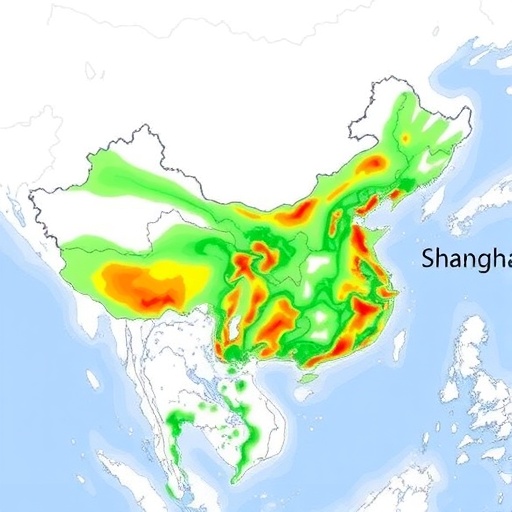
The escalating threat posed by rising sea levels has become a defining environmental challenge of the 21st century, with profound implications for densely populated coastal regions worldwide. Recent research sheds new light on this crisis by examining the spatial and temporal evolution of sea level rise under the ongoing forces of climate change. Particularly vulnerable to these changes are Shanghai and other parts of China’s coastal waters, where natural and anthropogenic factors synergize to amplify the risks.
This pioneering study deploys advanced climate modeling combined with detailed regional analysis, revealing that sea level rise in China’s coastal zones exceeds average global projections. The unique convergence of local land subsidence, riverine water discharge variability, and dynamic marine currents exacerbates the vulnerability of these regions. Such localized processes interact with global sea level trends, creating hotspots where the risk is acutely intensified.
Land subsidence, the sinking or settling of the ground surface, has emerged as a critical factor accelerating local sea level rise in coastal China. Driven largely by groundwater extraction and urban development, subsidence lowers the land elevation relative to the rising ocean, effectively increasing flood risk and saltwater intrusion. This phenomenon, when combined with the gradual thermal expansion of seawater and melting ice sheets, underlines the compound nature of sea-level hazards facing mega-cities like Shanghai.
Moreover, the study brings to the forefront the role of river water discharge, an often overlooked element in sea level dynamics. Changes in the volume and timing of freshwater flow from major river systems alter sediment supply and coastal circulation patterns, which have direct impacts on shoreline stability and ecological health. In the Yangtze River estuary, fluctuations in discharge affect sediment deposition that could either reinforce or undermine coastal defenses against the rising tides.
Marine currents along China’s coastline further complicate the picture by influencing regional sea level changes. Currents can redistribute water masses, leading to regional variations in sea level rise that diverge significantly from global averages. Variability in monsoon strength and ocean-atmosphere interactions introduce additional temporal complexity, affecting sea level trends on seasonal to decadal scales.
The implications of these findings are far-reaching. Beyond the increased risk of flooding and coastal erosion, rising seas threaten the socio-economic fabric of communities reliant on coastal infrastructure and ecosystems. Shanghai, a global financial hub with millions residing in low-lying areas, confronts immense challenges in urban planning, disaster preparedness, and climate resilience efforts.
This comprehensive research integrates satellite data, ground observations, and climate projections to afford a high-resolution understanding of these localized sea level dynamics. By unraveling the intricate interplay between climatic and human-induced factors, the analysis offers crucial insights for policymakers and urban planners striving to mitigate and adapt to future sea level scenarios.
Furthermore, the study underscores the necessity of cross-disciplinary collaboration, merging geoscience, hydrology, oceanography, and urban studies. It challenges simplistic global sea level rise metrics by demonstrating that effective mitigation and adaptation require granular regional assessments that account for local geophysical and hydrodynamic conditions.
In the context of climate change mitigation strategies, this research elevates the urgency of addressing greenhouse gas emissions while concurrently managing human activities that exacerbate coastal vulnerability, such as groundwater over-extraction. It suggests that adaptation measures, including coastal defenses, managed retreat, and ecological restoration, must be tailored to localized conditions revealed through detailed spatial-temporal analysis.
Moreover, the insight gained concerning the temporal evolution of sea level rise offers valuable foresight into critical tipping points and thresholds. Understanding when and where acceleration of sea level increase may occur enables more precise targeting of resources and emergency preparedness efforts.
In conclusion, this comprehensive examination of sea level rise in China’s coastal waters highlights a complex mosaic of contributing factors that extend beyond traditional global climate models. The findings serve as a clarion call for integrative and localized climate action to safeguard vulnerable coastal megacities against the rising tides of the future.
News Publication Date: 17-Jun-2026
Web References: http://dx.doi.org/10.1371/journal.pone.0347855
Cite Scienmag News
Thomas Green. (June 17, 2026). New Analysis Reveals Shanghai and China’s Coastal Waters Highly Vulnerable to 21st Century Sea Level Rise Due to Land Subsidence, River Discharge, and Marine Currents. Scienmag. https://scienmag.com/new-analysis-reveals-shanghai-and-chinas-coastal-waters-highly-vulnerable-to-21st-century-sea-level-rise-due-to-land-subsidence-river-discharge-and-marine-currents/
Thomas Green. "New Analysis Reveals Shanghai and China’s Coastal Waters Highly Vulnerable to 21st Century Sea Level Rise Due to Land Subsidence, River Discharge, and Marine Currents." Scienmag, 17 June 2026, https://scienmag.com/new-analysis-reveals-shanghai-and-chinas-coastal-waters-highly-vulnerable-to-21st-century-sea-level-rise-due-to-land-subsidence-river-discharge-and-marine-currents/. Accessed 3 September 2026.
Thomas Green. "New Analysis Reveals Shanghai and China’s Coastal Waters Highly Vulnerable to 21st Century Sea Level Rise Due to Land Subsidence, River Discharge, and Marine Currents." Scienmag. June 17, 2026. https://scienmag.com/new-analysis-reveals-shanghai-and-chinas-coastal-waters-highly-vulnerable-to-21st-century-sea-level-rise-due-to-land-subsidence-river-discharge-and-marine-currents/


