


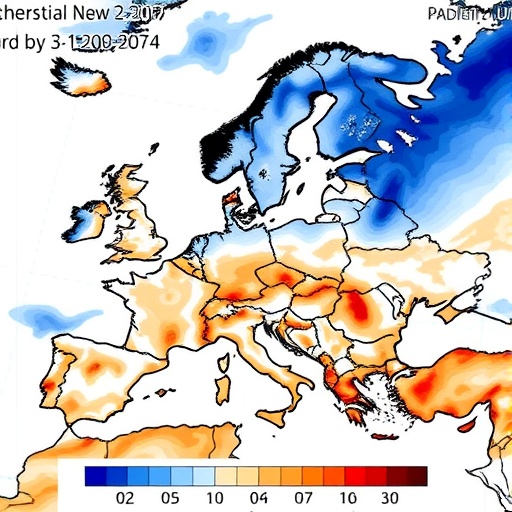
In a compelling advancement in climate science, recent research has unveiled a critical linkage between the winter phase of the North Atlantic Oscillation (NAO) and the incidence of summer droughts across Central Europe. This discovery shines a spotlight on the far-reaching influence of atmospheric patterns on regional water availability and agricultural conditions, highlighting the intricate connectivity within Earth’s climate system. The study, helmed by Jiang, Soulsby, Laudon, and their interdisciplinary team, deeply explores how a positive phase of the winter NAO sets the stage for significantly drier summers, emphasizing the pressing need to decode atmospheric teleconnections for improved drought forecasting.
The North Atlantic Oscillation is a dominant mode of atmospheric variability characterized by fluctuations in the difference of atmospheric pressure between the Icelandic low and the Azores high. This oscillation profoundly influences weather and climate patterns over the North Atlantic region and adjacent continental areas. During a positive NAO phase, the pressure gradient intensifies, steering storm tracks and altering precipitation regimes across Europe. Historically, the NAO has been extensively studied for its wintertime impacts, but its delayed effects on summer hydroclimate have been less understood until now.
Researchers employed sophisticated climate data analysis, combining observational datasets with advanced atmospheric modeling to trace the complex cause-and-effect relationship between winter NAO conditions and subsequent summer drought episodes. Through rigorous statistical methodologies and machine learning techniques, the team could identify a robust correlation wherein positive winter NAO phases consistently corresponded with reduced precipitation and heightened drought severity in Central Europe during the ensuing summer months.
Delving deeper into atmospheric dynamics, the study elucidates that the positive NAO phase induces persistent anomalies in the jet stream position and strength during winter. This atmospheric configuration primes regional soil moisture deficits by reduced winter precipitation and increased evapotranspiration. These deficits then persist into the summer, exacerbated by high-pressure systems that inhibit convective rainfall, culminating in drought conditions. This persistence mechanism underscores the importance of antecedent climatic states in modulating surface hydrological responses months later.
By integrating high-resolution climate models incorporating land-atmosphere feedbacks, the team has underscored how snowpack reductions and earlier spring melt, consequences of positive NAO winters, further diminish summer soil moisture recharge. This nuanced understanding reveals a cascading sequence of interconnected processes, where atmospheric pressure patterns alter seasonal snow dynamics and hydrological cycles, ultimately affecting water availability during the agriculturally critical summer season.
Moreover, this study challenges conventional seasonal forecasting paradigms by demonstrating that winter atmospheric variability holds predictive power for summer drought occurrences, a temporal leap that could revolutionize early warning systems. With more accurate predictions, stakeholders in agriculture, water management, and disaster preparedness could optimize resource allocation, mitigate crop failures, and safeguard ecosystems against the growing threat of climate extremes.
In light of global climate change, the frequency and intensity of positive NAO phases may shift, potentially exacerbating drought risks across Central Europe. This research provides a vital baseline for projecting future hydroclimate scenarios, emphasizing the urgent need to incorporate atmospheric oscillation indices into climate resilience strategies and regional adaptation plans. It also highlights gaps in understanding feedback mechanisms between ocean-atmosphere interactions in the North Atlantic and terrestrial hydrology.
The methodology presented in the study combines satellite remote sensing, ground-based hydrological observations, and retrospective climate reanalyses to strengthen the empirical evidence of the NAO-drought linkage. These multi-source datasets enable the disentanglement of natural variability from anthropogenically induced climatic trends, enhancing confidence in the robustness of the findings across different temporal and spatial scales.
Importantly, the research paves the way for analogous investigations into other teleconnection patterns affecting global drought distributions. Understanding how phenomena such as the El Niño Southern Oscillation or the Indian Ocean Dipole similarly imprint their signatures on regional climates remains a critical frontier. The integrative framework developed here offers a template for dissecting these complex climate interactions with implications for global water security.
This scientific contribution further stresses the importance of interdisciplinary collaboration, integrating atmospheric sciences, hydrology, and climate modeling expertise. Such synergy is essential for tackling multifaceted environmental challenges that transcend traditional disciplinary boundaries. The comprehensive approach adopted by Jiang and colleagues showcases how incremental advancements in climate knowledge can yield substantial societal benefits.
In conclusion, the revelation that a positive phase of the winter North Atlantic Oscillation forecasts drought in Central Europe the following summer marks a significant leap forward in climate prediction science. It not only enriches our conceptual grasp of atmospheric teleconnections but also serves as a call to action for policymakers and scientists to harness these insights in building climate-resilient societies. As climate variability continues to challenge human and ecological systems, breakthroughs like these underscore the value of predictive science in managing water resources sustainably.
Given the intricate interplay between atmospheric circulation patterns and regional climatology, this discovery may also inspire innovations in agricultural planning and water management infrastructure. Early drought warnings based on NAO monitoring could enable proactive measures such as altered cropping schedules, enhanced irrigation efficiency, and strategic water reservoir operations, thereby reducing vulnerability to climate extremes.
Future research trajectories prompted by this study include exploring the modulation of NAO impacts by other climatic indices, assessing the influence of anthropogenic climate forcing on NAO dynamics themselves, and extending analyses to include socioeconomic impacts. As climate models evolve and observational networks expand, the possibility of fine-tuned, localized drought predictions based on winter NAO states becomes increasingly achievable.
Ultimately, this investigation stands as a testament to the profound influence that large-scale atmospheric phenomena exert on local climates and the critical importance of climate science in anticipating and mitigating environmental risks. The pioneering findings published by Jiang, Soulsby, Laudon, et al. in Communications Earth & Environment embody the progressive trajectory of climate research in unraveling complex, impactful interactions that shape our planet’s future.
Cite Scienmag News
Violet Maxwell. (June 22, 2026). Winter NAO Positive Phase Predicts Central Europe Drought. Scienmag. https://scienmag.com/winter-nao-positive-phase-predicts-central-europe-drought/
Violet Maxwell. "Winter NAO Positive Phase Predicts Central Europe Drought." Scienmag, 22 June 2026, https://scienmag.com/winter-nao-positive-phase-predicts-central-europe-drought/. Accessed 6 September 2026.
Violet Maxwell. "Winter NAO Positive Phase Predicts Central Europe Drought." Scienmag. June 22, 2026. https://scienmag.com/winter-nao-positive-phase-predicts-central-europe-drought/


